
Licensed editorial adaptation
Adapted and localized by the ZWCNC Editorial Team from licensed technical material. The source record is published for traceability.
Technical boundary: confirm machine-specific capacity, configuration and safety requirements against the current quotation, manual and application review.
A panel bender and a folding machine do not solve the same bending problem. A panel bender references, holds, rotates, and presents a blank through a programmed sequence. A folding machine clamps the sheet while an operator does more of the presenting, supporting, turning, and evaluating between bends.
For application-specific equipment selection, contact ZWCNC.
Related: Panel Bender vs. Press Brake
Automation Is a Process Architecture, Not an Upgrade Path
It is tempting to describe a panel bender as an automated folding machine. That description hides the buying decision. The machines assign control differently.
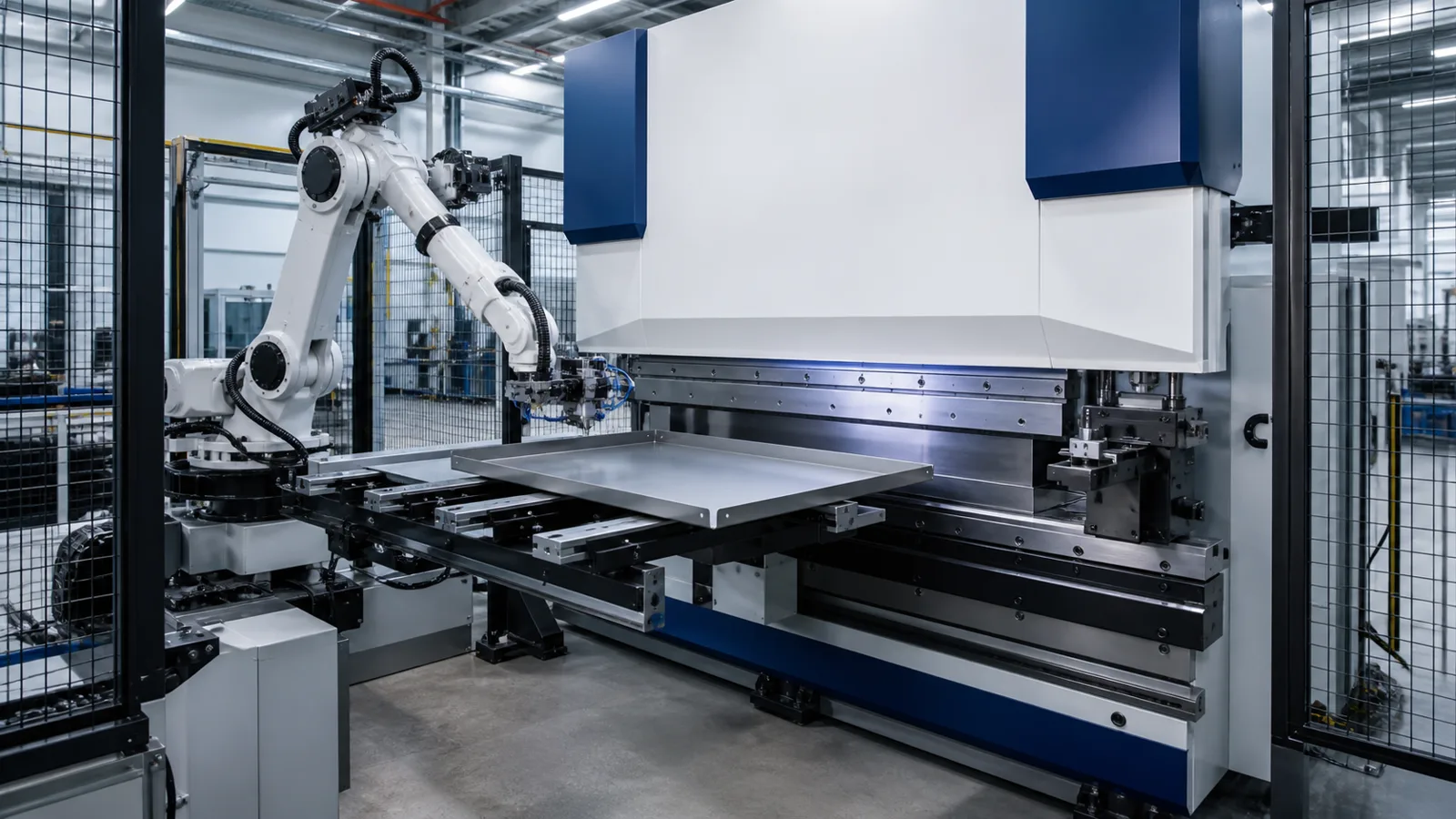
At the start of a panel-bending cycle, the blank must reach controlled reference stops. The machine centers it, secures it with a blankholder or holding system, and forms the exposed flange. A manipulator then repositions or rotates the developing part for the next bend. The machine expects the part to remain controllable throughout this route.
At a folding machine, the workpiece is clamped while a folding beam moves the projecting flange. The operator generally has a larger role in presenting the blank, supporting the material, changing its orientation, and judging how the next bend can be made. That labor is costly on a repeatable multi-sided enclosure, but it can be valuable when the part does not behave predictably.
The panel bender attacks repeated lifting, alignment, rotation, and operator-dependent positioning. The folder protects flexibility when a cutout removes a grip area, a long profile becomes unbalanced, a return flange blocks a later movement, or a new part needs shop-floor judgment. Automation therefore narrows the question: is the part predictable enough to remain under automatic control from loading through unloading?
The panel bender's automatic reference and handling system
One-time referencing is a central panel-bender advantage. If the blank is accurately cut and reaches the stops consistently, the first bend establishes a stable machine-controlled reference. Subsequent bends can then be made from that controlled position rather than from a chain of manual repositioning decisions.
This can absorb some blank dimensional error in the first bend instead of carrying the error through every later manual setup. Adaptive blankholding and automatic adjustments may also reduce setup interruptions. But the benefit depends on the starting condition. The blank must be square and flat enough to reference, have a reliable area for gripping, and present edges and features that do not obstruct the sequence.
Every removed operator action becomes a machine requirement. The manipulator needs sufficient holding force and clearance. The bending tools must reach each line. Existing flanges must clear the blade, blankholder, table, frame, and handling system. The finished part must be released and removed without damage. A programmed sequence that looks plausible in software has not been proven until these physical movements work on the real part.
The folder's wider operator-controlled window
A folding machine leaves more decisions available at the point of work. An operator can support an awkward panel, choose a practical introduction angle, watch an existing flange clear the machine, and adjust when a nominally familiar blank arrives with a different condition. The operator supplies judgment and physical control between bends.
That flexibility is purchased with labor, skill, and cycle-time variation. Each turn, support action, and manual reference can introduce inconsistency. Shops with scarce experienced operators may find the folder difficult to staff. Shops with short runs, frequent new geometries, and many exceptions may find operator-controlled flexibility cheaper than continually proving and rerouting automated sequences.
The folder is not a less advanced version of a panel bender. It is a different allocation of control. The decision is whether operator flexibility is a recurring cost to remove or a capability the product mix still needs.
Geometry Is the First Elimination Test
Start with geometry before comparing speed or price. A current panel-bender specification may allow incoming sheets up to 3.05 m long and 1.524 m wide. Its stated maximum bendable thickness may be 3.2 mm for steel at the specified tensile strength, 2.5 mm for stainless steel, and 4.0 mm for aluminum. These values are useful screening limits, but they do not prove that every part inside them can complete the route.
Follow each representative part from flat blank to finished form. Ask five questions:
- Can the machine reference the blank reliably?
- Is there a usable grip area that remains available through the sequence?
- Can every bend line be reached without collision?
- Can the developing part rotate or reposition within the available swept envelope?
- Can the finished part be released and unloaded?
If one required movement fails, the part is not a productive panel-bender part unless a defined and priced intervention makes it so. That intervention may be a new sequence, special tooling, a regrip, a manual transfer, a secondary operation, or another machine. It belongs in the route cost from the beginning.
Panel-like parts, long profiles, and irregular blanks
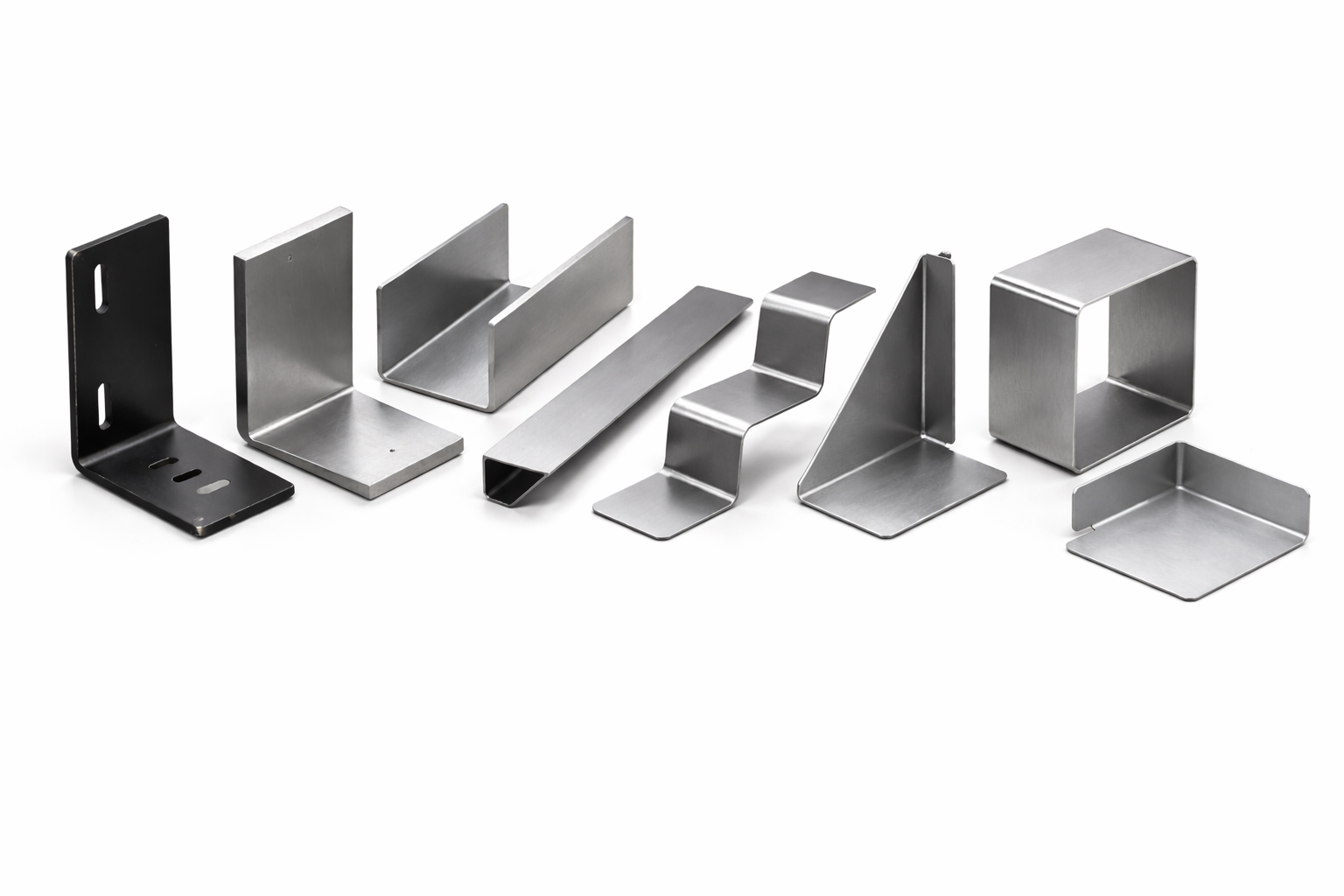
Picture a broad rectangular blank with a stable central surface and flanges around its perimeter. The geometry supports a panel bender: the central area can remain controlled while the machine forms successive edges. Repeatable enclosures, cabinet panels, shelves, doors, and similar families often fit this architecture.
Now narrow the blank into a long profile, add deep notches, or move most of the material to one side of an asymmetric outline. The nominal bend length may not change, but handling difficulty does. There may be too little reliable gripping area, an irregular edge may defeat automatic referencing, or the center of mass may move during rotation. These are handling failures disguised as part-shape details.
A folding machine often accepts more of this variation because the operator can support an unbalanced blank, choose a workable reference, and reposition it between bends. Long profiles with only one or two bend lines can suit a folder particularly well: the machine needs access to the line, while the operator or support equipment manages the material extending beyond it.
Folders still have limits. The part needs enough flange material for clamping and folding. A common rule of thumb is roughly six times material thickness, although some machine and part combinations can work near three times thickness. A very short flange can therefore exclude a folder even when the rest of the part appears simple.
Some parts are too irregular for dependable automatic manipulation and too short-flanged, thick, or constrained for folding. The correct result of the geometry test can be "neither." A press brake or another forming process may be the economical answer.
Flange height, returns, hems, boxes, and interference
Flange height is not a single machine property. It depends on the number of formed sides, bend order, tool profile, and escape path. On a folder, clamping-beam tool height may set the maximum 90-degree flange height for a four-sided box. The same flange on a one- or two-sided part may have much more open space around it.
Panel bending creates a different collision chain. A tall flange may clear its first bend but strike the manipulator or frame when the part rotates for a later edge. A return bend can place material inside the blade's movement. Hems need both a workable forming sequence and enough space for nearly closed layers. Deep boxes can trap tooling even when every individual flange appears to be within a listed limit.
Internal features create additional constraints. A cutout can remove the surface needed for gripping or reference stops. A louver, embossment, or internal flange can contact a support table or clamp before the next bend reaches position. The question is not whether the machine can form each feature in isolation. It is whether the feature can travel through every later movement without becoming an obstruction.
Changing the bend order may recover clearance, but it may also remove the flat reference needed for later bends or close the only tool entry path. A complete simulation must prove the order, grip, approach, and withdrawal, not merely display the finished model.
Sheet size, box depth, throat clearance, and rotation
A blank that fits on the table can still make a box too deep to finish. As walls rise, the remaining flat section moves closer to the clamping area while formed walls extend into the throat or open space. Eventually the box can contact the beam, frame, table, or handling system before the next bend line reaches its commanded position.
Rotation adds another envelope. A manipulator may hold a part securely when aligned with the machine but lack the clearance to turn its diagonal through the working area. A long, narrow blank may fit by length and width yet sweep beyond the permitted space during a quarter turn. An asymmetric part can shift its center of mass during the same movement, increasing the demand on gripping and support.
Regripping can extend the apparent process window, but it changes the economics. Every release and new reference adds time and another opportunity for positional error. On an automated machine, a manual intervention can also break the labor model that justified the investment. A technically possible part may stop being a sensible panel-bending part once repeated recovery is required.
The dimensional check must include three envelopes: the incoming blank, the finished part, and the swept volume created between them. Large parts may need followers, supports, or additional handling equipment regardless of the bending machine selected.
Material, radius, surface, and tolerance capability
Material grade belongs beside thickness in the compatibility review. Higher tensile strength increases forming force, which explains why a specification may accept 3.2 mm steel but limit stainless steel to 2.5 mm. Aluminum may have a different thickness limit again. Capacity must be checked against the actual grade and strength, not only the nominal thickness.
Required inside radius also matters. Tool geometry, thickness, springback, and forming method must produce the specified radius without cracking the outside surface or distorting the flange. A machine may have enough force to move the material while lacking the tool and process combination required by the drawing.
Coated, polished, or prefinished material must survive clamping, sliding, support, and manipulation. Automatic contact can repeat a marking mechanism consistently. Folding may reduce some forms of movement, but operator handling and support surfaces create their own risks. Inspect samples under the real production acceptance standard.
Finished-part tolerance is more than bend-angle repeatability. Blank variation, material behavior, reference changes, regripping, accumulated flange error, and sequence all affect distance and squareness between completed features. "The machine can bend it" is weaker than "the process can produce it repeatedly without damage and within specification."
Throughput Means Good Parts per Production Hour
A panel bender may be advertised at up to 17 folds per minute. That is a bending-system capability under suitable conditions, not a promise of accepted parts shipped per hour.
The complete route also includes blank identification, loading, referencing, holding, repositioning, rotation, unloading, inspection, stacking, changeover, program validation, and downstream handling. Material must arrive in a condition the machine can control. The part must fit the full sequence. Rejected or rerouted pieces remain production time.
Consider two clearly labeled hypothetical jobs. Job A is a repeating family of thin-sheet enclosures with stable blanks, accessible edges, compatible flange heights, and the same handling pattern across meaningful batch quantities. Job B changes daily and includes short runs, irregular blanks, deep returns, restricted grip areas, and parts requiring operator judgment during positioning.
The published fold rate may apply as a technical comparison to both machines, but it has economic meaning mainly for Job A. Repeatability keeps the automated route open long enough for fast bending and reduced handling to compound across good parts. Job B spends more time proving compatibility, changing programs, managing exceptions, or moving work to another process. High instantaneous speed cannot recover time lost because the part cannot complete the route.
Use good parts per production hour and cost per good part as the primary measures. Include labor, programming, setup, handling, scrap risk, and the cost of maintaining alternative capacity for incompatible work. Automation earns its return through sustained use, not maximum motion rate.
Buying for the highest-volume part, hardest part, or typical week?
A highest-volume part can make a panel bender look decisive. If it belongs to a stable compatible family and consumes enough capacity, it may justify an automated cell. The evidence must show recurring demand, not just that one sample ran quickly.
The hardest part creates the opposite distortion. Buying around one exceptional geometry can burden ordinary production with a process selected for an edge case. Unless that part is commercially critical, frequent, and otherwise difficult to route, it should not define the entire investment.
The typical production week exposes both errors. List the parts that actually consume bending capacity and weight them by recurring volume, batch size, handling effort, setup frequency, geometry, material condition, and routing exceptions. Parts that cannot pass through the proposed machine stay in the calculation with the cost of another setup, another machine, or outsourcing.
The panel bender wins when compatible families dominate the week and arrive often enough to keep automatic handling productive. The folder wins when variation is the recurring condition rather than the occasional exception.
Batch size and product families
A 2021 IPROS GMS case study described a panel bender used for sandwich panels produced in lots of 100. Bolt count fell from 83 to 8 per product, and annual bolting work dropped by about 1,600 hours. The strongest result was not a faster bending stroke. Repeated compatible production changed the labor required downstream.
Volume alone did not create that return. The parts also fit the machine, supported a stable sequence, and recurred often enough for the revised process to matter. A hundred incompatible parts are a hundred exceptions. Smaller orders can support automation when they belong to compatible families and return throughout the year.
Repeatability does not require one part number to run continuously. A family of cabinet panels may vary in width, length, hole pattern, or flange dimension while remaining inside the same gripping, tooling, and sequencing logic. Several low-volume stock-keeping units can behave economically like one repeatable family if the process rules are reusable.
Some current panel-bender guidance presents the technology as suitable for both high-mix, low-volume and high-volume work, and argues that a compatible batch of one can approach the bending cost of a batch of 100 when setup and manipulation are automatic. That claim is credible only when each new part fits the same process architecture. If every drawing adds a special grip, manual turn, secondary bend, or difficult unload, the machine is operating through engineering exceptions rather than true flexible automation.
When folding machines favor variable work
Architectural trim, large panels, and changing profiles often expose the value of a folder. A weekly queue may contain short runs with different flange depths, occasional hems, varied finishes, and field-driven dimensions. The pieces may all be bendable yet share little beyond being sheet metal.
Each variation can alter the support method, gauging reference, bend order, or clearance requirement. A folder may preserve a wider process window because the operator can respond as the job develops. The cost is labor and skill, but that can be less than programming and repeatedly rescuing an automated sequence.
Large or heavy parts require conditional analysis. If a part approaches the panel bender's manipulation envelope, exceeds a material-specific limit, or becomes awkward after early bends, automatic handling may cease to be the advantage advertised. A folder with suitable capacity, supports, and material handling may keep the part in one practical route.
Folding wins when variation repeatedly consumes the panel bender's automation advantage, not merely because a drawing is labeled "trim" or "heavy gauge." A recurring trim family inside a validated panel-bender envelope may still be an excellent automated application.
Labor Savings Depend on the Whole Workflow
A panel-bender cell can carry a one-operator label while that operator walks among cutting, bending, unloading, and stacking stations. Bending may be automatic, but labor remains in material presentation, replenishment, quality checks, finished-part handling, and exception recovery.
One operator can productively tend several stations when cycle times overlap, travel is short, carts are accessible, programs are reliable, and exceptions are rare. Headcount reduction comes from the cell design, not the panel bender alone. Measure paid touches per good part from available blank to correctly identified, accepted, and stacked component.
Who loads, supports, rotates, unloads, and stacks?
Begin at infeed. Someone or something must separate, orient, identify, and present each blank. After forming, the part must be removed without damage, inspected, assigned to the correct order, and stacked for the next operation. Cosmetic, flexible, large, or entangled parts can make these small steps substantial.
A panel bender can remove much of the support and rotation labor during forming. A folding machine generally leaves more of it with the operator. That is a clear disadvantage on stable repeat work. The same manual access can preserve flow when parts vary in size, orientation, flange sequence, or handling behavior.
Map every movement and place a time on it. If the operator can load the panel bender, unload it, and tend another process without either machine waiting, the shared assignment removes labor from the route. If the operator must choose which station to starve, the staffing model has hidden a capacity constraint.
Automation moves skill upstream
On a panel bender, the operator may no longer judge each reference, support each flange, or control every bend. Someone still needs to confirm geometry, select a viable sequence, resolve collisions, assign tooling, establish allowances, and validate the first part. Skill has moved into CAD/CAM, programming, and process planning.
That transfer can be powerful. A capable programmer can create reusable processes that several operators run consistently. Validated programs preserve knowledge between shifts and across repeat orders. The risk is concentration: one programmer or process engineer may become the only person able to diagnose an invalid sequence or recover from unexpected material behavior.
Folders distribute skill differently. Operators make more decisions at the machine and can adapt quickly when variation appears. That requires broader shop-floor expertise but can shorten the path from detecting a problem to correcting it. Compare routine production labor, new-job preparation, and exception recovery separately.
Blank quality and upstream cutting
Automatic referencing depends on the blank arriving in the expected condition. Cutting accuracy, edge quality, orientation, flatness, residual bow, burr direction, and material consistency all affect whether a stored process produces the same accepted part.
Automation reduces labor when inputs are controlled. It brings labor back as sorting, inspection, trial pieces, program adjustment, and recovery when blanks vary. A folder does not escape poor input quality, although an experienced operator may detect and compensate for variation within a broader process window.
This makes cutting and blank preparation part of the staffing calculation. A panel bender supported by reliable upstream processes may run validated parts with little intervention. The same machine fed inconsistent blanks may require more quality and engineering attention than the business case assumed.
Staffing for normal shifts and exceptions
Test the route when the strongest operator, programmer, or process engineer is absent. A validated panel-bender program for compatible recurring work should continue under ordinary staff. If an out-of-tolerance blank, handling alarm, or quality drift requires the specialist to restart the route, the machine has reduced operating skill without reducing dependence on expertise.
A folder can accept more unfamiliar work but may lose output when the most experienced operator is absent. Cross-training and documented setups reduce this exposure. The better investment is the machine whose critical knowledge the shop can realistically staff and preserve.
Define the purchased staffing model: who prepares programs, stages blanks, runs each station, validates first parts, changes tooling, handles finished work, inspects output, maintains the equipment, and responds to faults. Fewer people beside the machine does not always mean lower labor cost per good part.
Compare Cost per Good Part, Including What the Machine Cannot Do
Public listings place machines carrying panel-bender or folding-machine labels from roughly $26,000 to well above $120,000. Those prices are not comparable without scope. A stand-alone machine, an automated cell, and an integrated line have different handling equipment, software, staffing, service, and floor-space requirements.
Use a complete route model:
Cost per good part = (annualized ownership cost + operating cost + exception cost) / conforming parts shipped
Annualized ownership includes the machine, tooling, software, training, installation, service, maintenance, floor space, and material-handling equipment. Operating cost includes programming, setup, direct labor, inspection, energy, consumables, and normal material loss. Exception cost includes rework, scrap, secondary operations, internal rerouting, outsourcing, and schedule effects.
Run the calculation by part family before combining it. A recurring enclosure and an occasional long panel should not share the same cycle time, yield, or handling assumptions. If the chosen machine cannot complete a family, that family receives an alternative route with all attached costs.
Ownership scope and annualized premium
Bring competing quotations to the same production-ready boundary. Include freight, rigging, electrical work, guarding, tooling, software licenses, programming interfaces, operator and maintenance training, initial process development, and inspection equipment. If the automation case depends on conveyors, sheet identification, loading devices, or a stacker, those items belong in the panel-bender investment.
Floor cost includes service access, blank staging, finished-part storage, turning clearance, scrap containers, and operator travel. Convert one-time expenditures into equivalent annual cost over a common evaluation period. Apply the same assumptions for financing, residual value, useful life, service, and maintenance to both routes.
The automation premium is not the difference between two advertised machine prices. It is the annualized difference between two complete routes capable of making saleable work.
Break-even compatible volume
Let P be the annualized premium of the production-ready panel-bender route over the folding route. Let s be net savings per compatible good part after labor, handling, programming, setup, consumables, and yield are included. Let E be the additional annual cost created by parts that require another route because the panel bender cannot process them economically.
Break-even compatible volume = (P + E) / s
If s is zero or negative after the complete route is measured, no production volume recovers the premium. Use compatible demand rather than total shop volume. Parts outside the geometry, handling, sequence, or quality window cannot absorb the fixed cost merely because they pass through the same factory.
A minute saved has financial value only when it becomes less paid labor, avoided capital expenditure, shorter lead time, or additional contribution from work the shop can sell. If faster bending creates idle time before cutting, assembly, or inspection, the spreadsheet has recorded theoretical capacity rather than cash savings.
When the slower folder produces more sellable work
Capacity listings include folding machines designed for parts as long as 21 feet at 18-gauge capacity. A listing does not prove that a specific folder can make a buyer's parts within tolerance, but it illustrates why a folder should not be treated as a low-technology fallback.
Suppose 60 percent of annual demand consists of recurring parts well suited to a panel bender, while 40 percent consists of long panels, unfamiliar geometries, and short-run work outside the selected configuration. The panel bender may complete the first group much faster. The folder may take longer on every piece yet complete both groups without transferring the second group to another machine or supplier.
Compare the cost and value of all work shipped from the full mix. If the folder avoids outside lead time and keeps more high-value jobs inside one controllable route, it can produce more sellable work despite lower nominal throughput. Calculate cost per good part within each family and examine contribution per constrained production hour when capacity is scarce.
Secondary operations, rework, scrap, and outsourcing
When a part leaves the primary bender for a final feature, the second machine cycle is only a small part of the expense. Add identification, setup, movement, waiting, inspection, orientation control, and return handling. Count the receiving machine's constrained capacity when it is already a bottleneck.
Rework includes all correction labor and capacity even when the part eventually passes. Scrap carries material cost plus the value added before the defect was detected: cutting, programming, handling, bending, inspection, and replacement scheduling. Outsourcing includes supplier charges, freight, packaging, purchasing, incoming inspection, and lead-time effects.
Declined work belongs in a separate opportunity-cost line using contribution margin, without double counting an order already modeled as outsourced. Cost per good part forces unsupported work back onto the route that created it.
Prove the Choice with Your Own Parts
A reported enclosure required 11 bends and 33 seconds of machine time, but loading and unloading raised the complete cycle to 52 seconds. That gap shows why the trial must measure the route, not isolated bending motion.
Require each supplier to run production blanks through the exact machine model, tooling, software, and handling arrangement proposed in the quotation. Measure changeovers, inspection, stacking, and recovery from problems under conditions resembling normal work.
Build a representative trial set
Choose 10 to 20 actual parts from production and quoting history. The set should represent revenue, capacity consumption, difficulty, tolerance, surface quality, and future demand. Include:
- Core families with dependable recurring demand.
- Boundary parts near sheet-size, bend-length, flange-height, rotation, or material-thickness limits.
- Difficult sequences, tall returns, boxes, cutouts, or restricted grip areas.
- Material and finish combinations that production will actually use.
- Forecast parts, clearly labeled as future demand rather than secured volume.
Assign each part a role before testing. Selecting only easy high-volume parts biases the result toward speed; selecting only unusual parts biases it toward flexibility.
Measure complete cycle time and labor
Start the clock when blank handling begins and stop it when an acceptable part reaches its defined output position. Include identification, loading, alignment, machine processing, rotation, unloading, checking, labeling, and stacking. Keep the clock running during manual intervention.
Run enough consecutive pieces to separate first-part effort from sustained production. Record elapsed cycle time and paid labor time. The first part exposes programming, tooling, setup, and correction. Subsequent parts reveal alarms, handling delays, inspection work, and whether the claimed pace holds.
Use the complete route calculation:
Cost per good part = total setup, labor, machine, material-loss, inspection, rework, and secondary-operation cost / accepted parts
The denominator matters. Fast production followed by scrap, repair, or rerouting is not fast production of good parts.
Test changeover, quality, and failed sequences
Require changeovers between unlike trial parts. Measure the interval from the last good part of one job to the first good part of the next, including program retrieval, tool changes, adjustments, verification, and material handling. Separate repeat-program recall from genuinely new engineering work.
First-part yield means the first completed piece satisfies the drawing without corrective bending, manual reshaping, or an unplanned second route. Record every rejection and its cause. Inspect visible surfaces for clamp marks, scratches, waviness, distortion, inconsistent radii, and loading or stacking damage.
Count labor touches by purpose: loading, repositioning, supporting, gauging, unloading, inspecting, correcting, and moving the part to another machine. If a bend sequence fails, record the proposed response. A redesigned part, special tool, manual operation, press-brake bend, or outsourced feature must be priced before the machine is judged.
Make the Decision by Part Family
Choose the panel bender when the trial proves that economically important families fit the working envelope, complete all bends, hold tolerance, protect the surface, and move through the cell with few paid touches. Compatible demand must recur with enough confidence to keep the automated route productive. A dramatic cycle on one part cannot compensate for weak utilization or costly exceptions.
Choose the folding machine when geometry, batch size, and handling methods change frequently, and the folder produces good parts with fewer setup risks and secondary routes. Its value is a broad process window that protects contribution when future demand is uncertain. It may take longer on a stable panel family but still cost less across the complete mix.
Consider both machines, or retain a press brake, when the trial identifies two distinct production problems: recurring compatible panels that justify low-touch throughput, and variable or difficult work that needs broader access. Assign work by family. A panel bender can carry repeat enclosures, a folder can handle long profiles and variable short runs, and a press brake can remain available for thick material, special tooling, isolated features, or exceptions.
The strongest process is sometimes a deliberate division of work rather than a universal winner.
Define disqualification criteria before the demonstration
Write the pass/fail rules before the supplier trial. Disqualify a configuration when it cannot complete a required high-value geometry, exceeds limits for first-part yield, tolerance, surface quality, changeover, or operator involvement, depends on unpriced secondary operations, or produces a weighted cost per good part above the approved business case.
For the panel bender, require contracted and conservatively forecast compatible families to support the investment even after removing one major repeat order. For the folder, require the broader geometry window to produce enough accepted work, avoided outsourcing, and schedule protection to offset any throughput disadvantage on stable families.
The decision then has three gates: geometry determines whether the machine can finish the part; repeatable demand determines whether its advantage will recur; measured cost per good part determines whether the advantage is worth buying. Only the machine, or combination of machines, that reaches the finish line should receive the order.
Apply this guidance to your production
Share your material, thickness, part drawing, tolerance, and target output with the ZWCNC engineering team for an application-specific equipment review.
More news, insights, and updates from ZWCNC.
Panel Bender Advantages: Automation, Labor Savings, and Production Value
Panel Bender Automation: Choosing the Right Level for Your Workflow
9 Panel Bender Advantages: Automation, ROI, and Best-Fit Jobs
Automated Panel Bender Case Study: From Machine Speed to Shipped Orders
Panel Bender and Laser Cutting Integration for Higher Throughput