Licensed editorial adaptation
Adapted and localized by the ZWCNC Editorial Team from licensed technical material. The source record is published for traceability.
Technical boundary: confirm machine-specific capacity, configuration and safety requirements against the current quotation, manual and application review.
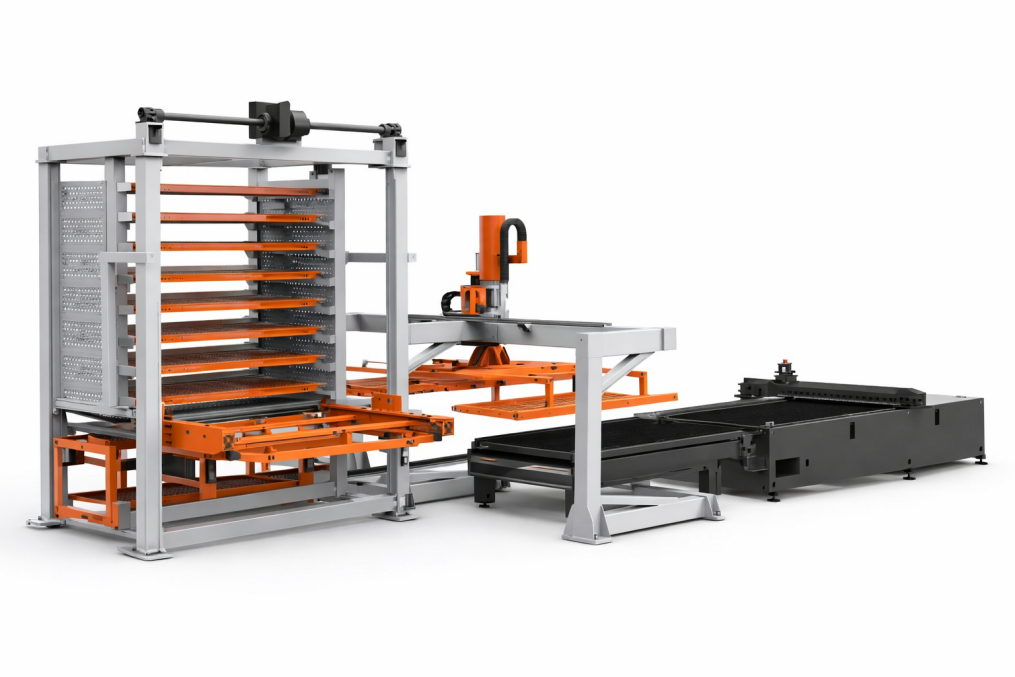
Cadrex has reported a lights-out integrated flow reaching 300 parts per hour. In the same account, a conventional press brake produced 12 parts per hour while a panel bender produced 68. The headline naturally points to 300. The more important capital question is different:
How much of the improvement came from faster forming, and how much came from physically linking cutting and bending?
Raw rates cannot answer that question by themselves. They are meaningful only when the part mix, time boundary, staffing, changeovers, quality definition, and system exit are the same. Otherwise, a demonstration can make the transfer hardware look responsible for a gain that actually came from replacing a slower forming process, redesigning the part, or selecting an unusually easy product family.
The right investment is the least rigid architecture that can keep the real constraint supplied with conforming work and ship more good parts at the required service level.
Start With the Constraint, Not the Handoff
Integration must improve constrained throughput, not merely remove movement between machines.
A constraint is the resource whose available capacity limits the rate of completed good parts for the required production mix. If bending is the constraint and a panel bender can produce 68 good parts per hour, reducing laser-to-bender transfer from several minutes to a few seconds does not automatically create more saleable capacity. It may reduce walking, forklift movement, work-in-process, labor content, or lead time. Those benefits are real, but they are not the same as increased output.
The distinction matters because the same investment can have very different economic value depending on what limits shipments. If scarce material-handling labor is preventing the bender from running, automation may increase throughput. If the bender is already continuously supplied and downstream welding limits shipments, the same automation may only move the queue faster toward welding.
Three competent baselines
A fair comparison should use three operating architectures rather than comparing a highly automated cell with an uncontrolled shop full of unidentified stacks.
- Standalone equipment operates independently. Manual or conventional transport moves work between cutting and bending, while buffers absorb cycle-time differences. Either machine can continue when the other stops, and each can serve other routes. The trade-off is more handling, more work-in-process, longer queue time, and greater dependence on dispatch discipline.
- Coordinated automation connects scheduling, part identification, material movement, and status data while retaining a controlled buffer or alternative route. Cutting can be paced to bending demand, and either process can recover without necessarily stopping the other. This arrangement removes information delays and much avoidable handling without requiring literal machine-to-machine attachment.
- A physically linked cell transfers parts directly from cutting into bending with little or no intermediate staging. It can compress lead time and labor sharply when compatible parts repeat, cycle times stay balanced, and exception handling is reliable. Its weakness is the same connection that creates its speed: a tooling problem, rejected blank, software fault, or downstream blockage can interrupt both processes.
These are not simply three levels of automation. They are three ways to manage queues, variability, and recovery. Standalone equipment buys flexibility with buffers. Physical linkage buys immediacy by removing them. Coordinated automation occupies the middle when timing and traceability matter more than literal attachment.
Four rates that must not be mixed
Suppose direct transfer reduces the handoff between cutting and bending from three minutes to thirty seconds. If blanks previously waited six hours in a bending queue, the saved two and a half minutes barely changes total lead time. If the bender was already continuously busy, it changes no output.
The comparison contains four different measures:
- Transfer time: how long it takes to move work between operations.
- Output rate: how many pieces an operation completes per unit of time.
- Lead time: elapsed time from production release to completion, including waiting.
- Good-part throughput: conforming parts that pass the limiting operation and continue toward shipment.
A faster handoff improves transfer time directly. It shortens lead time only if the removed movement and queue time are not replaced elsewhere. It raises output only if the receiving resource was being starved or scarce handling labor was suppressing production. More good parts ship only when quality, downstream capacity, demand, and schedule priorities support the higher rate.
Work-in-process control can matter more than transfer speed. Producing blanks early does not create output when bending is the constraint. It creates inventory that can hide priorities, defects, and missing capacity. A controlled cut-to-bend queue—often measured in hours of constraint coverage rather than a large nominal part count—can be more valuable than an empty handoff.
Model the Mismatch Before Selecting the Architecture
Consider a representative mix in which the laser releases 60 acceptable blanks per hour while the panel bender completes 40. The queue grows by 20 blanks per hour. After an eight-hour shift, 160 additional blanks are waiting unless cutting is throttled, diverted, or stopped.
A direct link does not eliminate the mismatch. With no useful buffer, it converts excess laser capacity into blocking: the laser waits because the bender cannot accept another part. That may be acceptable if bending is unquestionably the plant constraint and the laser has no other valuable work. If the laser also feeds press brakes, welding cells, or outside orders, the linked arrangement sacrifices useful cutting capacity simply to preserve the physical connection.
Reverse the rates and the bender starves. A faster bender cannot form blanks that the laser has not released. A controlled buffer could keep it working through nest changes, material loading, or brief cutting interruptions; a rigid direct feed transmits those interruptions immediately.
For a two-process flow, the sustainable good-part rate cannot exceed the lower effective rate:
System rate ≤ the minimum of cutting rate, bending rate, and downstream acceptance rate.
Effective rate includes the actual mix, changeovers, availability, scrap, rework, manual interventions, and job sequence. Average nameplate cycles hide the variation that fills or empties a queue. A cell balanced around one repeated enclosure can become badly mismatched when thick material, small nested parts, complex bends, or short runs enter the schedule.
Some buffering is therefore not waste. It is insurance against ordinary variation. The question is not whether all intermediate inventory can be removed, but how little buffer the flow can tolerate without starving the constraint or spreading every minor stop across the system.
Find the Actual Constraint in the Plant
Watch a representative schedule rather than a demonstration part. Record when each resource is running, starved, blocked, changing over, awaiting an operator, recovering from a fault, or producing work that later requires correction. Persistent queues help locate the constraint, but the decisive test is intervention: if one additional productive hour at a resource would not increase completed good parts, that resource is not the current constraint.
The likely constraint changes the investment case:
- Labor: Integration helps when scarce operators spend production time moving, sorting, identifying, or presenting parts. The case weakens if exceptions still require constant attendance or if released labor cannot remove another limit.
- Cutting: Linking a panel bender cannot create missing laser capacity. Direct coupling may make matters worse if the laser becomes blocked instead of serving other routes.
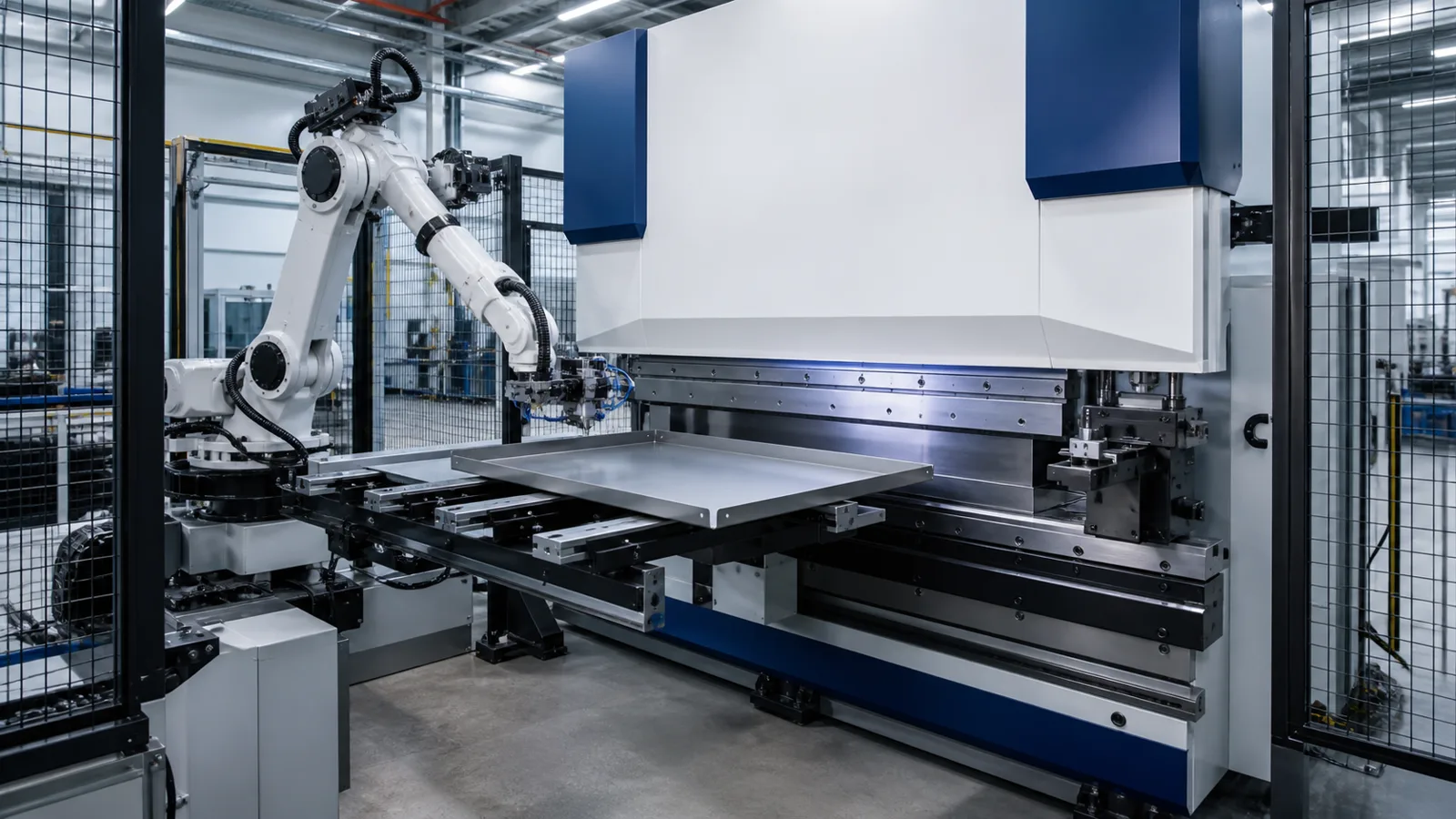
- Bending: A panel bender may release the constraint when eligible parts move away from slower forming methods and the machine remains supplied. Coordinated flow may be enough; physical linkage must prove that reduced starvation and handling losses justify the added rigidity. For plants evaluating this balance, the panel bending solutions offers a CNC-based path aligned with bending and sheet-metal automation.
- Downstream flow: If deburring, welding, coating, inspection, packing, or customer demand limits shipments, a faster cut-to-bend cell only builds a larger downstream queue.
The constraint can move as the mix changes. Cutting may govern on one shift, manual exception handling on another, and welding later in the week. Sustained throughput across the required mix matters more than peak output on a favorable part.
Measure Real Eligibility, Not Nominal Compatibility
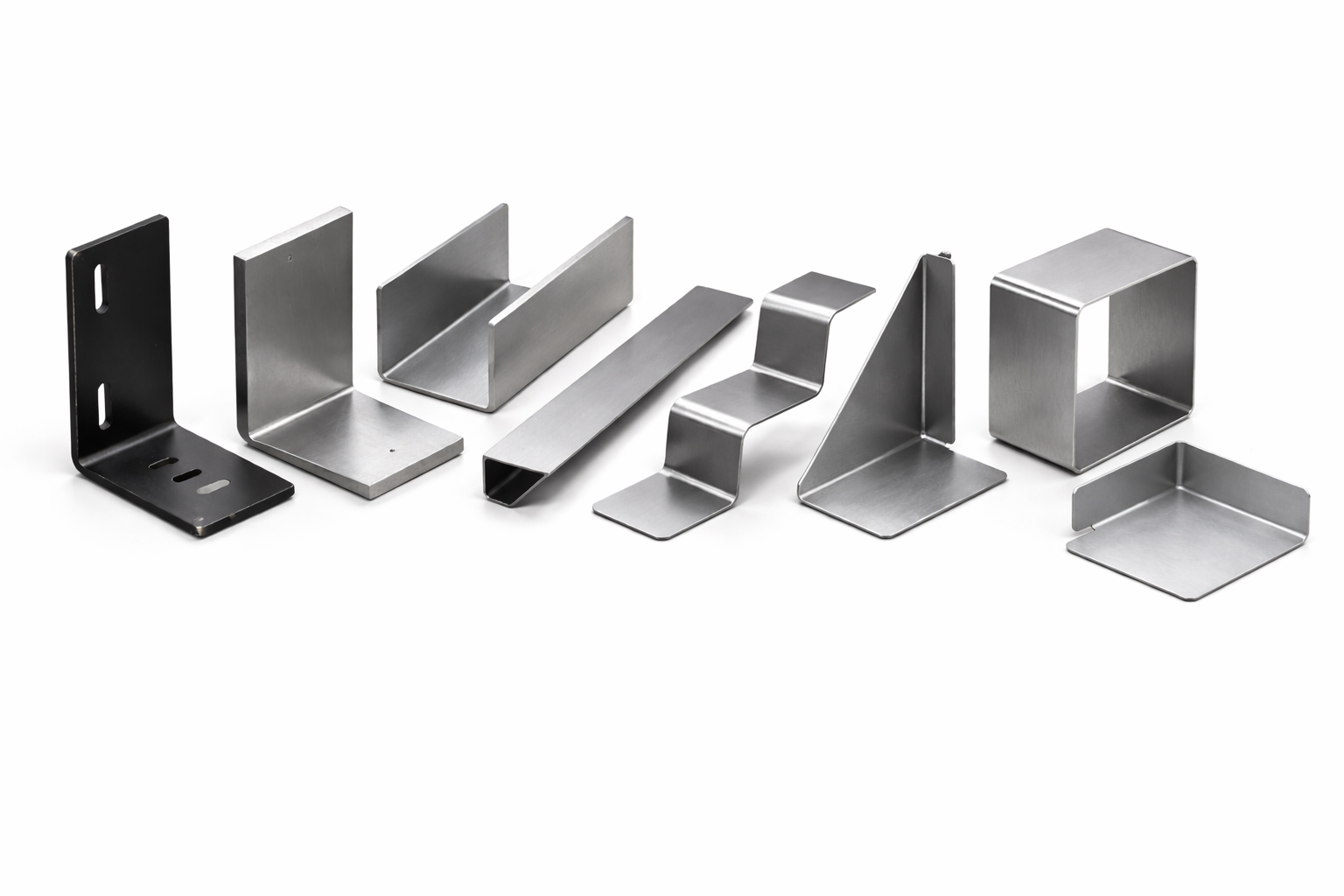
Total laser volume is not the addressable demand for a panel-bender cell. Neither is the number of parts that can technically be bent during a demonstration. The relevant volume is recurring work that can complete the intended route without an unsupported exception.
Imagine an annual demand file containing 100,000 laser-cut parts. A first CAD screen shows that 78,000 fall within the proposed panel bender’s broad dimensional and material limits. Grain and sheet-size restrictions remove 12,000 from the practical nesting strategy. Deburring, reorientation, part separation, or manual forming interrupt another 9,000. Transfer trials find that 11,000 more cannot be extracted, picked, identified, and presented consistently.
The nominal compatibility is 78 percent. Reliable end-to-end eligibility is only 46 percent. That difference can determine whether a hard-linked line is well loaded or underfed.
Screen the complete forming route
Create one record per part number and annual quantity, including material, thickness, blank dimensions, bend lengths, flange dimensions, angles, radii, bend count, and features that may interfere with gripping, rotation, tooling, or exit. Screen the data against the exact proposed machine configuration, not a generic specification.
A part is eligible only when its complete bending sequence works. A set of individually acceptable bends may still cause a collision, leave no stable gripping position, or prevent release. Use simulation and physical trials for borderline or commercially important parts. Report constraint hours as well as unit volume: 60 percent of annual units may represent only 20 percent of the bending time that limits shipments.
Do not place borderline parts in the fully automated category to improve the case. A part needing one manual bend may qualify for a hybrid route, but that route requires defined capacity, standard work, buffering, tracking, and re-entry control.
Separate repeatable families from high-mix exceptions
“High mix” is too broad to guide the decision. Size variation may be manageable through programmable positioning, while geometry variation can change gripping, bend sequence, collision risk, tooling, stacking, and downstream routing. Group demand by shared process behavior: stable programs, compatible materials, predictable setup, consistent identification and stacking, and few overrides.
Study when those families arrive. A compatible family running every week may keep a cell supplied even if orders are small. A larger annual family arriving in irregular campaigns may leave the bender starved. Recurring density of eligible work matters more than SKU count.
Test nesting and handling in production conditions
Grain direction, sheet-size rules, and handling restrictions can reduce the yield suggested by a free-rotation nest. Re-nest representative orders using approved materials and sheet sizes, required orientation, real spacing, cut-quality rules, part-retention and extraction requirements, release sequence, and restrictions on mixing routes. Compare purchased material and laser time per accepted eligible part, not merely parts per sheet.
Then follow a real nest after cutting. Parts may remain attached, require deburring or sorting, leave in the wrong orientation, or need manual forming. Classify each part as directly eligible, eligible through an engineered hybrid route, or exception work. Manual work is acceptable only when its capacity, standard work, tracking, buffering, and re-entry are defined.
Validate micro-tabs, skeleton removal, suction pickup, identity, orientation, stacking, and recovery. A tab that stabilizes a blank during cutting may prevent extraction; removing it may allow the part to shift. Use difficult geometries and normal material variation, and record autonomous transfer success, recovery time, damage, lost identities, wrong orientations, and operator calls.
The result should show whether the demand is a stable stream for hard linkage, an uneven stream needing buffers, or a small and changing stream better served by decoupled machines.
Choose Among Hard-Linked, Buffered, and Decoupled Flow
The architecture changes the radius of every disruption. A pickup fault that leaves one blank half-seated can block a hard-linked laser, fill a buffered queue, or be isolated in a decoupled system while other work continues. No machine has changed speed; the dependency has changed.
Hard-linked inline transfer
Inline transfer is strongest when the eligible family is stable, the blank exits cleanly, both machines are supplied at compatible effective rates, changeovers can be coordinated, and alternate routing is rare. Direct transfer removes staging, transport, repeated identification, and queue management that add no forming value.
The decisive condition is balanced effective output against takt, the production pace required by demand. A laser releases sheet-based batches, while a panel bender consumes individual blanks with cycle times that vary by geometry and bend count. Similar average rates can still create alternating periods of starvation and blocking.
Hard linkage earns its place when timing differences remain small enough for the line’s limited internal accumulation and when the removed transfer is an actual constraint. Maximum coupling also creates common fate: a bender fault can block cutting, a laser interruption can starve bending, and a linked changeover can idle both assets.
That exposure may be acceptable for a narrow, repeatable stream with fast recovery and little value in keeping either machine available for unrelated work. Without those conditions, proximity becomes dependency.
Buffered cells
A buffer gives completed blanks an address and lets one machine continue through normal timing differences. During a brief laser interruption, the bender draws from bend-ready work. During a longer bending cycle or changeover, the laser continues until storage reaches its limit.
Useful buffer capacity should be expressed as time covered for the constrained machine, with the correct material, orientation, family, and sequence available—not merely as the number of storage positions. A full buffer of the wrong work does not protect the constraint.
Dispatch logic must know which parts are complete, where they are stored, which program they require, and whether deburring, inspection, or another intermediate step has cleared them. Retrieval must keep pace with consumption, or waiting simply moves from the transfer path into storage access and sorting.
Buffered cells fit substantial but uneven demand: mixed nests, variable bend cycles, independent changeovers, or planned interruptions. Their value comes from keeping the constrained machine supplied with valid work while limiting failure propagation.
Decoupled automation
Some parts are suitable for panel bending until a flange proves unreachable by the available tooling. Other work may need a press brake, a manual operation, or a different downstream route. Decoupled automation treats these exceptions as normal rather than forcing every part through one physical path.
The laser, panel bender, press brake, inspection station, and intermediate processes can operate as separate resources connected by controlled transport and digital work instructions. Maintenance on one resource need not immobilize another. Rush orders can enter without waiting for a complete linked sequence to clear, and new equipment can be added without rebuilding a transfer path.
The trade-off is more transport, floor space, and distributed work-in-process. Parts can lose sequence, orientation, or identity unless software records location, priority, status, and route. Decoupling without digital discipline is just distance. With reliable data contracts, it can absorb routing variation that would repeatedly destabilize a hard-linked line.
Architecture comparison
| Decision factor | Hard-linked | Buffered | Decoupled |
|---|---|---|---|
| Floor space | Small transfer footprint, but fixed alignment and service access constrain the layout. | Requires staging or storage; vertical storage may reduce area but still needs access. | Needs transport lanes and parking, but allows more flexible machine placement. |
| Queue visibility | Few visible queues, with little warning before starvation or blocking stops the line. | Queue depth and composition reveal imbalance when reported clearly. | Queues are distributed, so digital location and priority tracking are essential. |
| OEE behavior | A stop at either serial operation can reduce line availability and suppress the other machine. | Short losses can be absorbed, making starvation and blockage easier to separate. | Individual OEE may look good while parts wait between assets; system throughput and lead time must be added. |
| Changeover flexibility | Changes tend to affect the whole line; campaigns work best. | One machine can change over while the other consumes or builds the queue within limits. | Machines can change over independently, although poor scheduling can create excess WIP. |
| Expansion | New processes may require transfer, guarding, and controls redesign. | Storage and process ports can be extended if planned early. | Resources can generally be added or reassigned more independently. |
The correct choice is the least rigid architecture that meets the required good-part throughput, lead time, labor, and service limits under realistic interruptions.
For application-specific equipment selection, contact ZWCNC.
Make the Cell Survive Production Exceptions
Physical compatibility is not enough. The cell must preserve the relationship between each physical part and its digital identity when parts are rejected, removed, reoriented, remade, diverted, or delayed.
Preserve identity and state
Sequence alone is fragile. Each blank needs a persistent identity tied to order, part number, revision, material, released programs, and route. This may use direct marking, controlled carrier positions, tracked stack locations, or pallet pockets. If parts can be rearranged outside that control, positive re-identification is required before processing resumes.
The record should move through explicit states such as cut, separated, queued, loaded, bent, inspected, rejected, remade, and complete. A transfer is complete only when the receiving operation confirms the correct part in the expected state. This prevents rejected parts being counted as finished, obsolete revisions being formed, or remakes being launched while the original is still active.
Exchange durable data
Laser nesting, bend programming, MES, ERP, and material handling can exchange files and still disagree about production truth. Usable integration should:
- preserve one stable identifier across nesting, handling, bending, inspection, and completion;
- reject incompatible program and drawing revisions;
- return machine-side status and operator changes to scheduling;
- acknowledge committed transactions so timeouts do not create duplicates;
- reconcile physical queue positions with digital records after interruption; and
- distinguish planned, cut, accepted, rejected, remade, and completed quantities.
Bidirectional coordination matters more than a single large software platform. Separate domains can recover independently when they share stable identities, versioned data, confirmed events, and explicit exception states.
Release only valid routes
Before a nest is released, confirm that each intended part has a valid bend program, has passed collision checks, and can run with tooling available on the scheduled machine. The drawing, laser program, bend program, inspection requirements, and route should form one consistent production package. Engineering changes must identify affected uncut material, WIP, remakes, and queued programs; automatic replacement is unsafe when earlier-revision blanks still exist.
Ineligible work should be held, routed elsewhere, or cut under an approved exception. A remake must remain linked to the rejected identity, restore the required order quantity, use the current revision, and prevent both original and replacement from being counted as good. Rush orders, remnants, scrap, full containers, and finished-part evacuation need the same explicit status and disposition rules.
Define ownership, recovery, and bypass
Assign authority for demand, released orders, revision status, routing, queue transactions, and safe machine motion. When communication fails, the system should stop new routing commands, identify the last committed transaction, reconcile digital and physical states, quarantine uncertain items, restart from a named checkpoint, and synchronize final quantities and locations.
Repeat-safe commands are important after timeouts because the controller may not know whether a command failed or only its acknowledgment was lost. Operators, maintenance, and production control also need defined override rights and reconciliation responsibilities.
A floor aisle is not a bypass. A real bypass needs a pickup point, alternate destination, identity capture at departure and arrival, and a transaction that allows work to rejoin the order without becoming duplicate or orphaned. Test diversion of unsuitable geometry, use of another downstream resource, controlled remakes, fault evacuation, and return to normal routing.
Build the Business Case Around Good Parts Shipped
An acceptance trial can end with higher machine cycle counts, fewer manual transfers, and no increase in complete accepted orders reaching shipment. The automation worked; the investment did not. Either the original constraint remained unchanged, the constraint moved downstream, or synchronization and quality losses consumed the nominal gain.
The controlling measure is incremental, demand-backed good-part throughput at the system constraint. When products use different amounts of constraint time, raw part counts distort the comparison. Use a fixed set of standard constraint minutes or another mix-normalized unit, and freeze those standards before the trial.
The financial model should follow the physical result:
Net annual benefit = incremental throughput contribution + avoided quality, material, and lead-time costs − added operating and support costs.
Payback uses installed investment, including software, integration, training, commissioning, infrastructure, and required support. It should not begin with theoretical machine hours or the number of touches a brochure says will disappear.
Establish a credible baseline
Follow actual orders from release to accepted completion across the intended families, lot sizes, materials, priority changes, staffing patterns, and failure conditions. Define the measures before comparing routes:
- Touch time: active loading, moving, inspecting, programming, sorting, and recovery.
- Queue time: waiting between steps, separated by scheduling, material, capacity, inspection, transport, or information cause.
- Changeover: last accepted part of one setup to first accepted part of the next, including trial pieces and approval.
- Availability: scheduled time when the resource is capable, authorized, and supplied to run.
- Staffing: direct operators plus recurring programming, handling, quality, maintenance, supervision, and production control.
- Quality loss: scrap, rework, remakes, downstream fitting, and constraint time consumed by defects.
- Order lead time: release to completion of the full accepted order.
Record results by eligible family and route. A plant-wide average can hide a business case that depends on a narrow repeatable subset.
Count labor honestly
Automation may remove repetitive handling without eliminating staging, identity confirmation, offloading, inspection, exception response, maintenance, troubleshooting, or schedule reconciliation. Separate cash savings from redeployable capacity and ergonomic improvement. Released time is not payroll savings unless a position, overtime, or outside service can actually be avoided.
The trial should demonstrate person-hours per accepted mix-normalized unit and show how peak fault coverage is staffed. “One operator can tend both machines” is not a financial result until retained and intermittent support labor is included.
Quantify synchronization and shared downtime
If cutting is two or three times faster than forming, a hard-linked flow will run at the slower dependent operation, reduced by starvation, blockage, changeovers, recovery, and quality loss. Track mutually exclusive states:
Good constraint time = scheduled time − planned changeovers − machine downtime − starvation − blockage − synchronization and recovery time.
Adjust the demonstrated rate for first-pass yield. Starvation means the constraint lacks the correct blank, program, tooling, or authorization. Blockage means it cannot release work because space, transport, inspection, or routing is unavailable. Synchronization loss includes sequence mismatch, data reconciliation, carrier positioning, and coordinated restart.
Count transfer, control, safety, and interface failures as joint production loss. Test one-resource stoppages and documented recovery, measuring accepted output lost across every dependent resource. Compare purchased material per accepted part, not nesting percentage alone, and treat scrap and usable remnants consistently in both cases.
Separate forming gains from integration gains
A panel bender may create major value on its own. A part that previously needed about ten minutes of manual fitting and spot welding may take roughly seventy seconds after redesign. Model three cases: the existing route; panel bending with redesign but without hard laser linkage; and panel bending integrated with cutting. This prevents the integration premium from receiving credit for standalone forming gains.
Measure first-pass yield, dimensional acceptance, cosmetic damage, downstream fitting, remakes, complete-order accuracy, and the additional planning burden of tighter routing. Avoid double counting: if reduced rework increases accepted constraint output, count separate material or labor savings only when they remain distinct.
Stress the payback
Test lower eligible demand, less favorable mix, longer recovery, and shorter product life. Reduce only work that can complete the automated route; replace repeat work with smaller lots, more ineligible geometry, different materials, and route changes; include queue reconciliation, restart scrap, dependent-resource loss, and the period in which qualifying demand is expected.
Turn the break-even results into thresholds: minimum eligible workload and accepted throughput, maximum support labor and recovery, required quality and yield, maximum synchronization loss, and latest acceptable payback. These limits should govern trials and contracts.
Prove the Flow Before Committing Capital
The capital request should define both no-go conditions and a test capable of reproducing normal production disorder. A supplier demonstration proves that machines can exchange favorable parts. It does not prove that the plant can sustain profitable flow.
No-go conditions for hard coupling
Reject hard coupling when eligible volume is sufficient only as an annual total but not by shift or product family; when ordinary mix variation repeatedly creates starvation or blocking; when system uptime and recovery cannot meet the production limit; or when the product family is likely to change faster than programs and interfaces can be validated.
If any one of these gates fails, redirect the project toward buffering, decoupling, or postponement. Several weak assumptions do not become one strong case when packaged as a line.
Design for uncertainty
When future mix is uncertain, specify buffer capacity in hours of tested constraint coverage, not only part count. Require bypass hardware and digital routing that preserve identity. Make controls modular enough for the laser, handling system, and panel bender to operate in defined degraded modes.
The specification should assign ownership for part identity, queue status, program release, alarms, acknowledgments, and restart authorization at every interface. It should also reserve practical interfaces for additional storage, alternate discharge, manual loading, or future routing where those options could preserve throughput.
Run representative trials
The plant should select the trial population from actual demand. Include common parts, borderline geometries, variable materials, small lots, mixed nests, cosmetic surfaces, revision changes, and parts that need alternate routes.
Run the proof in five stages:
- Part capability: Verify cutting, identification, transfer, bending, stacking, and dimensional acceptance.
- Mixed-flow operation: Process a realistic order sequence with actual lot sizes, nesting relationships, and downstream priorities.
- Exception insertion: Introduce a remake, rejected blank, rush order, ineligible part, and schedule change after work has entered the queue.
- Planned failure: Interrupt communication, block a destination, stop one machine, or simulate a handling fault under an agreed safe procedure.
- Sustained production: Operate long enough for replenishment, operator relief, minor stops, queue management, and schedule variation to affect the result.
Factory acceptance testing can establish basic capability in a supplier environment. Site acceptance must repeat the decisive scenarios with the plant’s layout, data, operators, materials, and downstream constraints.
Put measurable acceptance criteria in the contract
Acceptance should state what counts, over what period, under which operating conditions, and with what staffing. Four measures should govern:
- sustained good-part throughput at the agreed system exit;
- recovery time from fault initiation to stable, validated production;
- total direct and support labor, including manual overrides and schedule repair; and
- schedule performance for the required mix, rush work, remakes, and due-time window.
Only conforming parts with correct identity and revision status count as throughput. Partial orders that cannot proceed downstream do not count as schedule success.
The purchase agreement should include the trial dataset, staffing assumptions, operating window, failure scripts, data-access requirements, retest rules, and remedies. Payment milestones should follow demonstrated acceptance rather than equipment arrival or isolated machine commissioning.
Compare the alternatives under the same downside case
Passing an absolute output threshold does not justify the most integrated design. Full integration must outperform buffered or decoupled alternatives using the same order sequence, eligible workload, staffing, quality rules, disruption frequency, and recovery definition.
Reject full integration if its advantage exists only during uninterrupted production, disappears in mixed flow, or is consumed by recovery labor and shared downtime. Prefer buffering when short disruptions can be isolated and both processes retain productive work. Prefer decoupling when eligible demand is intermittent, alternate routes are frequent, or product change is likely to outlast the present automation logic.
Commit to full integration only when representative trials show higher sustained good-part throughput, acceptable recovery, realistic labor demand, and better schedule performance than the alternatives under credible downside conditions. The advantage must also repay the integration premium within the demonstrated benefit window.
Conclusion: Integrate Where It Creates Capacity, Decouple Where It Protects It
The question is not whether a laser can hand a blank to a panel bender. The question is whether the plant can keep shipping good parts when the handoff does not go according to plan.
Faster forming may create most of the capacity gain. Integration can preserve that gain by keeping the bender supplied, reducing handling, shortening queues, and protecting identity. It can also destroy value by blocking a productive laser, propagating a minor fault, forcing unsuitable geometry through one route, or hiding work-in-process behind a polished cell.
Use eligible volume, constraint load, mix stability, takt balance, quality, recovery, labor, and downstream throughput to separate process improvement from integration benefit. Use buffers when ordinary variation needs protection. Use decoupled automation when routing and product change matter more than immediate transfer. Hard-link only when a stable, sufficiently dense stream can prove that the extra coupling creates more good-part capacity than it removes in resilience.
The strongest capital case is therefore not the one with the highest brochure rate. It is the architecture that delivers the lowest total cost per good part, at the required service level, through the real constraint, including the days when production does not go according to plan.
Apply this guidance to your production
Share your material, thickness, part drawing, tolerance, and target output with the ZWCNC engineering team for an application-specific equipment review.
More news, insights, and updates from ZWCNC.
Panel Bender Advantages: Automation, Labor Savings, and Production Value
Automated Panel Bender Case Study: From Machine Speed to Shipped Orders
Fiber Laser Cutting for Kitchen Equipment: Parts, Quality, and Cost
Panel Bender Productivity: How to Increase Good Parts per Shift
Panel Bender ROI: Calculate Payback from Real Production Data