Licensed editorial adaptation
Adapted and localized by the ZWCNC Editorial Team from licensed technical material. The source record is published for traceability.
Technical boundary: confirm machine-specific capacity, configuration and safety requirements against the current quotation, manual and application review.
A panel bender can complete setup and bending much faster than a conventional press brake. Industry reports have described setup times of roughly three to five minutes for a panel bender, compared with 10 to 15 minutes on a press brake. At the machine, that difference looks decisive.
But machine time is only one part of production time. Blanks still have to be identified, staged, oriented, loaded, checked, unloaded, sorted, and released to the next operation. Programs must be prepared, first articles approved, faults recovered, and finished panels removed before they block the cell.
The investment question is therefore not simply, “How many seconds will this machine save?” The better question is:
How many additional good parts will the complete workflow release with the labor actually assigned to it?
This article explains how to answer that question, compare automation levels, qualify part families, and choose the smallest architecture that removes the shop’s real constraint.
Faster Bending Does Not Always Mean More Good Parts
Cycle time measures how quickly a machine completes a defined operation under specified conditions. It is useful for engineering comparisons, but it does not describe the output of the entire production system.
A production cycle begins before the first bend and ends after the accepted part reaches the next process. Material availability, program readiness, loading, inspection, unloading, sorting, and downstream capacity can all limit output. If blank preparation starves the bender or unloading repeatedly stops it, a faster bend cycle only creates idle capacity or a larger queue.
This makes machine speed a local property, not a business result. The panel bender may strengthen one link in the fabrication chain while shipment quantity remains unchanged.
Use Good Parts per Staffed Hour
Good parts per staffed hour is a more useful operating metric. It divides accepted output by all labor committed to producing it, including:
- Machine tending and material handling
- Programming and program verification
- First-article inspection and routine quality checks
- Loading, unloading, sorting, and part identification
- Routine fault diagnosis, recovery, and maintenance support
The numerator must include only parts accepted without scrap, rework, or routing correction. A completed machine cycle is not necessarily a good part. Gross cycle counts can reward speed while hiding defects, mixed parts, or downstream sorting problems.
Consider a hypothetical eight-hour shift. The ideal cycle is one part per minute, suggesting 480 parts. Six eight-minute changeovers consume 48 minutes. Material waits and blocked unloading consume another 55 minutes, while fault diagnosis and restart use 25 minutes. Productive time falls to 352 minutes. With 4% scrap or rework, the shift releases about 338 good parts.
With one employee assigned for eight hours, performance is about 42 good parts per staffed hour. If programming, inspection, sorting, and recovery require two additional labor hours from other employees, it falls to about 34. Neither figure resembles the nameplate implication of 60 parts per hour.
This metric also prevents a common accounting error: treating released labor as saved labor. If automation removes two hours of manual bending but adds one hour of programming and one hour of intermittent material support, touch time has shifted without reducing total staffed time.
Model the Losses in the Order They Occur
A practical capacity model starts with scheduled production time and removes setup, waiting, blocking, interruption, and recovery losses. The remaining run time is divided by the sustained cycle time, then adjusted for first-pass yield.
In simplified form:
Accepted output = usable run time ÷ sustained cycle time × first-pass yield
“Sustained” is critical. The fastest observed cycle may come from an easy demonstration part, a short uninterrupted trial, or material staged in advance. A defensible model uses the cycle rate the cell can maintain across the intended geometry, materials, batch sizes, and shift conditions.
Changeovers remove capacity in visible blocks. Interruptions can be more damaging because each stop has a recovery tail: diagnose the fault, clear it safely, correct orientation, restart, and verify the first part. A two-minute alarm may consume far more than two minutes of staffed attention.
Scrap causes a second loss. The rejected part has already consumed material, bending time, handling, and inspection. Its replacement must travel through the chain again, often as an exception that disrupts the schedule.
System availability must therefore be measured at the workflow boundary, not only at the bender. A reliable machine cannot produce when the loader lacks the correct blank, the unloading station is full, the program is unreleased, or the material identity conflicts with the schedule.
Use separate loss codes for machine faults, material waits, program issues, inspection holds, changeovers, blocked unloading, and operator unavailability. If every stop is labeled “downtime,” the shop may respond to low output by buying a faster bender even when the dominant loss is outside bending.
Automation Relocates Labor
When the operator no longer positions every flange, labor does not disappear. It moves into programming, staging, identification, replenishment, quality checks, unloading, maintenance, and recovery.
That relocation can be highly valuable. One employee may supervise the bender while performing useful work elsewhere. Automated handling may reduce strenuous lifting, improve consistency, and lower surface-damage risk.
However, intermittent labor is difficult to convert into savings. Forty minutes released in one block can be reassigned. The same time scattered across short loading, checking, and recovery tasks may keep an employee tied to the cell all shift.
The correct comparison is total recurring labor before versus total recurring labor after. Then ask whether the released time can support another machine, absorb another role, eliminate overtime, avoid a hire, or remove a scheduled position. If it cannot, it is theoretical availability rather than cashable savings.
What “Automated” Actually Means
Panel bender automation is not one product category. It is a boundary around work.
A narrow boundary may cover bend sequencing, automatic setup, blank referencing, and compensation while leaving material movement to an operator. A wider boundary may include loading, unloading, stacking, storage, inspection, tracking, and production-data exchange.
Each added function can remove another constraint. It also adds an interface that must be synchronized, maintained, and recovered after a fault.
Rather than comparing “low,” “medium,” and “high” automation, divide the system into four functional layers.
1. Offline Programming, Sequencing, and Simulation
Offline programming moves preparation away from machine time. Bend-sequencing software develops the operation order, while simulation checks loading, clamping, rotation, regripping, panel sweep, and unloading for predicted collisions.
Simulation is verification, not magic. Its accuracy depends on a virtual model that matches the installed machine, tooling, supports, guards, and accessories. Engineering revisions, unusual geometries, and real blank variation can still require correction at the cell.
Measure skilled programming hours per new or revised job, machine minutes used for prove-out, clearance interruptions, and operator edits. Separate first-run development from repeat-order preparation. Offline programming pays when it releases constrained machine time or scarce programming capacity. If the bender is already waiting for material, faster program creation will not increase output.
2. Automatic Setup, Referencing, and Bend Compensation
Machine-level automation controls what happens after a blank reaches the working area. Depending on the platform, it may manage tooling, locate the blank, reposition it through the sequence, and adjust the bending command to control variation.
These functions target setup time, positioning labor, first-piece correction, and process inconsistency. They do not automatically solve staging, identification, unloading, or downstream congestion.
For each representative family, measure setup and referencing time, first-piece adjustments, in-cycle interventions, and rejects caused by bend variation. Apply an automation-eligible percentage to the actual mix. A feature may run standard panels unattended but need manual support, special tooling, or a different route for other families.
3. Loading, Unloading, and Stacking
Handling automation expands a machine into a cell. The loader must receive the correct blank in the correct orientation. The bender must complete its internal movements, and the unloading or stacking system must clear the part before the next cycle is blocked.
Measure travel to retrieve blanks, orientation checks, lifting, placement, unloading, stacking, pallet changes, and time lost when either side of the machine is empty or full. Also record whether these tasks occur in a continuous block or repeatedly interrupt an employee.
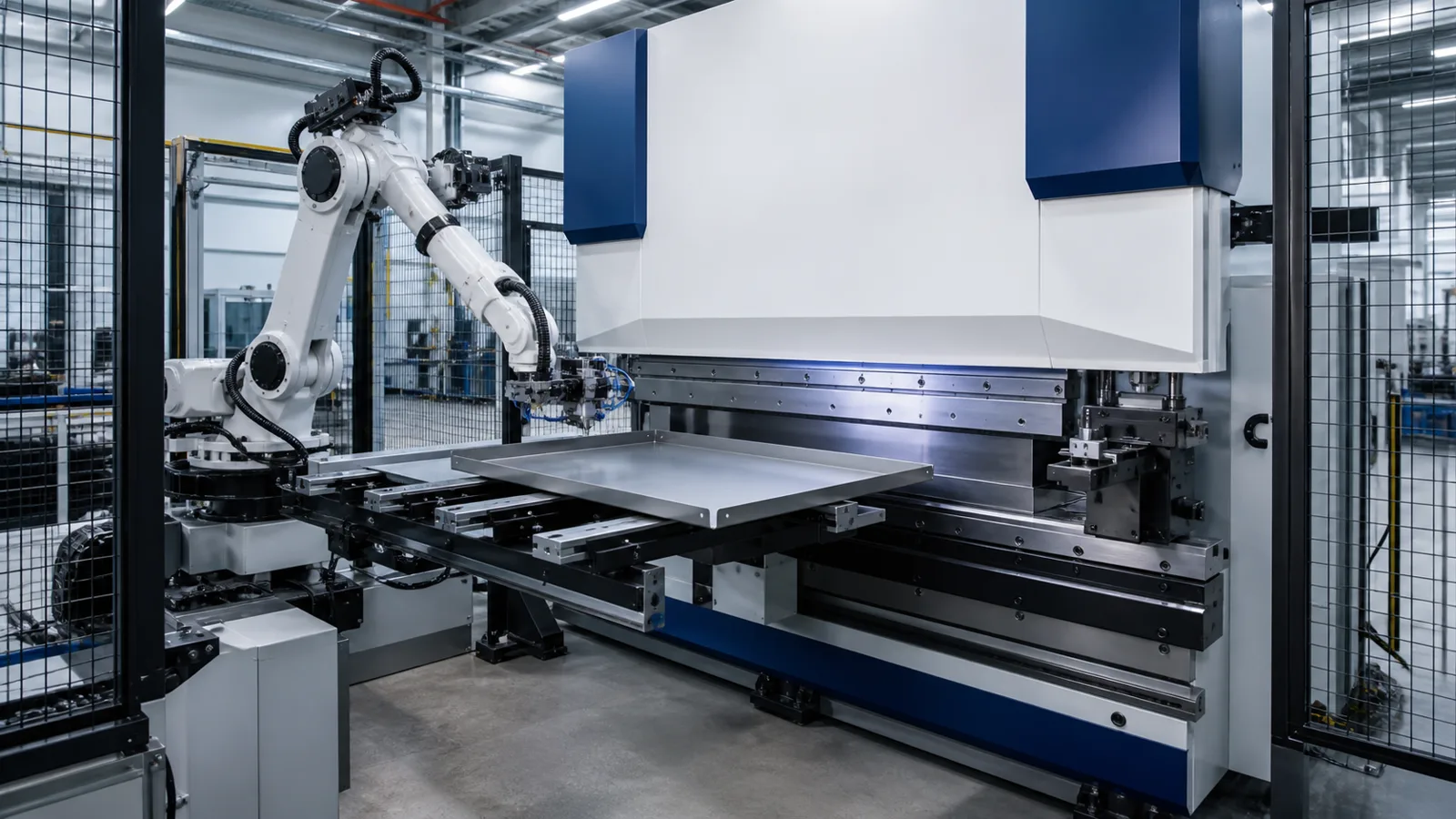
Connected installations show why the full loop matters. A panel bender paired with automatic loading and unloading, large-capacity storage, and 3D simulation is not simply a faster bender. It is a storage-to-software-to-bending system.
That system creates value only if demand and part flow keep it occupied. Unpredictable blanks, full discharge areas, and frequent manual exceptions can turn additional equipment into additional failure points.
4. Identification, Inspection, and Data Exchange
These functions solve different problems. Identification confirms which blank or finished part is moving through the cell. Inspection confirms whether it meets specification. Data exchange transfers job, material, schedule, status, and completion information between planning and production systems.
A scan proves identity, not quality.
This layer matters when the shop loses time to wrong programs, mixed materials, missing paperwork, manual data entry, inspection holds, or schedule changes that do not match physical material. It also raises the required level of data discipline. Incorrect revisions, unreliable inventory records, and inconsistent identifiers travel faster when exchanged automatically.
Data integration pays when information errors or scheduling latency constrain flow. It disappoints when the shop automates data it does not maintain reliably.
Retrofit, Standalone Cell, or Connected Line?
The main choices differ less in bending capability than in how much surrounding work falls inside the controlled system.
| Architecture | What it controls | Best fit | Main risk |
|---|---|---|---|
| Retrofit or feature package | Selected software, controls, sensing, referencing, compensation, or handling functions | A clear local loss on an otherwise capable machine | Compatibility limits and divided support responsibility |
| Standalone panel bender or bounded cell | Automated bending and repositioning, with optional local loading, unloading, or stacking | Bending or nearby handling is the constraint, but broader workflow remains variable | Local capacity may exceed upstream or downstream capability |
| Turnkey connected line | Storage or feed, identification, transfer, bending, discharge, tracking, and production-data links | Stable routing, repeatable eligible work, disciplined planning, and sufficient demand | More interfaces, deeper software dependence, and harder fault recovery |
A retrofit preserves most of the existing workflow. It is effective when the loss is narrow, such as slow at-machine programming, repeated setup correction, or a specific handling task. It is a poor response to unreliable material arrival or an aging machine that cannot meet the required geometry, accuracy, or availability.
A standalone cell can automate bending deeply while retaining simple boundaries. An employee stages verified blanks, supervises mixed work, and removes completed parts. This can outperform a fully connected line when batches vary and human judgment remains necessary at regular intervals.
A turnkey line earns its premium by controlling gaps between operations. Its business case must come from measured waiting, handling, identification, and coordination losses—not from the assumption that the highest automation level is automatically the most productive.
Find the Point of Diminishing Returns
Diminishing returns begin when the next automation layer removes less disruption than it introduces.
First, estimate additional accepted output using the lowest capacity in the revised chain: blanks upstream can deliver, parts the cell can complete, units downstream can absorb, and volume customers can consume. Capacity above the lowest limit has no immediate production value.
Second, calculate net staffed hours released. Subtract new programming, replenishment, monitoring, maintenance, exception-handling, and recovery work from the manual hours removed. Count the remainder as labor value only if it can eliminate a real cost or create additional useful output.
Third, compare the annual value of added good parts, realizable labor capacity, and avoided scrap with capital and recurring costs. Test lower demand, a less favorable part mix, more interventions, and longer recovery events. An investment that works only when every eligible part runs unattended is not robust.
The smallest sufficient architecture is the one whose control reaches the measured constraint and stops before complexity becomes the next constraint.
For application-specific equipment selection, contact ZWCNC.
Part Geometry and Production Pattern Decide the Fit
Average lot size is a weak filter for panel bender selection. Published cases show that linked blanking and panel bending can perform well even with lots of one to five pieces. The stronger test is whether the blank can be gripped and centered reliably, whether bends can be sequenced without access conflicts, and whether enough of the routing can be completed without manual rescue.
Recurrence then determines how often the shop can reuse the validated program, material compensation, and handling method.
Evaluate Bend Families, Not Only Part Numbers
The useful planning unit is the bend family: parts sharing enough envelope, datum structure, flange direction, material behavior, and sequence logic to use a recurring programming and handling approach.
A high-mix shop may have thousands of part numbers but only a modest number of bend families. That can be more automation-friendly than a smaller catalog of unrelated geometries.
For every candidate family, ask:
- Can the machine grip, reference, rotate, and support the blank throughout the sequence?
- Can the tools reach every required bend without colliding with completed flanges?
- Can the machine complete the part, or at least a stable and substantial stage, before another process intervenes?
A part that fits inside the nominal working envelope has passed only the first test.
Strong Candidates
These parts concentrate value in repeated handling. An operator may otherwise rotate a wide panel several times, control its weight, align it for every bend, and protect its surface. Automated gripping and repositioning remove this repeated work and can improve consistency.
“Shallow” is a functional description. Completed walls must remain clear of the blankholder, blades, supports, and machine structure as the part rotates. A box that appears simple in a drawing may become unsuitable when an early high flange blocks the next operation.
Stable blanks and repeatable materials strengthen the case. Springback depends on material properties, thickness, bend geometry, and rolling direction. If these inputs remain controlled, compensation and sequence knowledge can be validated and reused. If they vary unpredictably, the cell must correct the variation or return decisions to an operator.
Reliable upstream blank dimensions, edge quality, orientation, and identification are therefore part of the bend-family qualification.
Features That Cause Intervention
Deep boxes, return flanges, narrow channels, internal-window bends, and partial outer-edge bends commonly create access problems. A completed wall may collide with machine structure as the blank rotates. A return flange can narrow the tool path. Internal and partial bends may remain accessible on a press brake but sit outside the panel bender’s tooling reach.
Classify candidate parts as fully completable, partially completable, or unsuitable. A part that needs one secondary operation can still justify panel bending, but the handoff adds transport, staging, identification, and another setup.
A hybrid route is strong when the panel bender removes most handling and bend time, while residual press-brake work is limited and predictable. It becomes weak when nearly every part needs immediate brake completion and the press brake remains the constraint.
Surface-sensitive materials create another boundary. Gripping, sliding, rotating, and stacking can mark a coated surface even when dimensions remain correct. Protective film, special supports, and additional inspection may solve the problem, but their labor and consumable costs belong in the model.
Do not assume a platform’s published thickness range applies universally. Each material family must be qualified against the exact machine, tooling, radius, flange geometry, rolling direction, coating, and tolerance requirement.
Batch Size Matters Less Than Program Reuse
A five-piece kit repeated every week may be more attractive than a one-time large order because the recurring family keeps reusing its validated sequence and material rules.
Calculate family economics over a realistic planning horizon:
Net family gain = manual-route hours avoided − automated-route programming, validation, handling, intervention, and handoff hours
Keep initial development separate from repeat-order preparation. A first run may require model cleanup, simulation, prove-out, and inspection. A repeat run may need only program retrieval and material confirmation.
Batch-one capability usually means the machine can switch among compatible parts with little manual retooling. It does not mean every unique geometry is economical to engineer and validate for one piece.
Use routing history to record order frequency, quantity, first-run and repeat-run programming, completion without intervention, hands-on minutes, secondary operations, and material corrections. The automation boundary fits when recurring eligible work can occupy it and exceptions do not consume the labor it was meant to release.
The Workflow Must Feed and Clear the Bender
Industry cases have reported major productivity gains after connecting blanking and panel bending, including the elimination of hours spent searching for and gathering parts. The deeper benefit was not bending speed alone. It was control over where blanks were, when they arrived, and which operation came next.
A fast bender surrounded by mixed pallets, uncertain identities, missing programs, and overloaded downstream stations will alternate between starvation and blockage.
Some shops need an integrated blanking-and-bending line. Others need only disciplined nesting, labeled carts, validated programs, and a release rule tied to downstream demand.
Upstream Readiness
A blank carries material grade, thickness, grain direction, surface condition, geometry, revision, and order identity. Burrs, distortion, contamination, inconsistent dimensions, or incorrect orientation can interfere with sensing, positioning, and quality.
Upstream readiness is a connected sequence. Nesting must preserve material and orientation requirements. Blanking must hold the dimensions and surface condition needed for referencing. Deburring must remove disruptive edges. Storage must prevent mixing or damage. Identification must connect each physical blank to the correct program, route, and destination.
Not every shop needs automatic storage or robotic transfer. Stable work may run reliably with marked carts and fixed staging lanes. A high-mix shop releasing many similar blanks across multiple orders may need scanning, controlled storage, or direct transfer to contain identification errors.
The architecture should expand until upstream variation stops interrupting the bender—and no farther unless another measured loss justifies it.
Material Handoffs and Buffering
Keeping the machine fed requires more than having blanks nearby. The active blank must match the program, the following blanks must arrive in the intended order, and complete kits must remain coordinated.
Most shops use one of three handoff patterns: controlled manual delivery with verified carts; buffered storage that decouples cutting from bending while preserving identity; or direct connection through conveyors, robots, or integrated storage.
The most automated choice is not always the safest. A direct connection can transmit a cutting delay immediately to bending. A large uncontrolled buffer can hide shortages and mixed work. Buffer size and transfer method must reflect real variability between processes.
The required outcome is simple: the correct blank, in acceptable condition, linked to the correct program, arriving when the cell is ready.
Downstream Capacity
If bending output rises from 20 to 40 kits per shift but welding can accept only 24, only four additional kits represent system output. The remaining 16 become work in process that consumes floor space, handling, and working capital without moving shipments forward.
Finished panels may still need hardware insertion, welding, grinding, coating, assembly, inspection, or packaging. These processes have their own capacity limits, fixtures, staffing, and batch rules.
Compare output by routable unit, not only by pieces per hour. If an assembly needs several formed components, producing one component far ahead of the others raises inventory without completing kits. Schedule the bender around downstream units and demand, not maximum local utilization.
A controlled buffer can absorb normal variation. It cannot fix a structural capacity gap. If welding or finishing remains slower, the shop must add downstream capacity, limit release, redirect work, or choose a smaller bending architecture.
Scheduling, Programs, and Support
High-mix flow fails when physical material and digital instructions separate. Blanks may be ready while programs wait. Programs may be approved while material remains buried in storage. A revised drawing may reach programming but not the identifier attached to the blank.
A workable data path connects order release, nesting, blank identity, program approval, and production status. The solution may be a shared repository, disciplined naming, barcodes, and clear staging rules. More complex workloads may require scheduling and machine connections that synchronize revisions and priorities.
Release only executable jobs: approved programs, complete blanks, confirmed material data, and downstream capacity. This turns the queue from available work into ready work.
Also define failure ownership. Blank defects belong to cutting, material, or preparation controls. Program errors require simulation and revision ownership. Identification errors require traceability. Machine and software faults require diagnostics, spares, and responsive support. Geometric exceptions need a fallback route.
A press-brake fallback is not an admission of failure. It protects the automated boundary. The system becomes fragile only when minor exceptions require vendor intervention or stop an integrated line for long periods.
Build the Business Case Around the Whole Route
Machine brochures may quote impressive bends per minute, but return on investment depends on accepted products moving through the system.
Build the study with one row per representative bend family and one column per realistic alternative. Record scheduled time, accepted output, direct and support labor, changeovers, scrap, recovery, downstream effects, and recurring operating costs. Weight the result by expected annual demand rather than by the easiest demonstration part.
Use three related measures:
- Good parts per scheduled machine hour for capacity
- Good parts per staffed hour for labor productivity
- Total cost per good part for overall economics
Total cost per good part should include labor, scrap, consumables, maintenance, software, handling, downtime, and allocated capital cost.
Annual return comes from the difference between alternatives. Include cashable labor savings, avoided overtime or outsourcing, reduced scrap and expediting, and contribution from additional capacity the shop can actually use or sell. Subtract added programming, maintenance, software, support, and operating costs.
Never count the same labor hour both as a wage saving and as capacity for extra production.
The installed investment also extends beyond the machine quote. Include integration, software, tooling, fixtures, guarding, training, launch support, utilities, floor changes, handling equipment, and production disruption during commissioning.
Compare the Real Alternatives
Do not compare an old, poorly organized press-brake process only with a new panel bender. Test the same representative mix against:
- The observed existing press-brake route
- A disciplined or modernized press-brake route
- A panel bender retrofit
- A standalone automated panel bender
- A fully integrated bending line
The disciplined baseline matters. Correct obvious tool staging, scheduling, program control, and material presentation problems before crediting a new machine for solving them. The existing route may still lose decisively, but the result will identify whether the true constraint is setup, skilled labor, bending capacity, quality variation, or external flow.
A modern press brake may add offline programming, improved controls, automatic tooling, lifting aids, or robotic handling while retaining flexibility for unusual geometry. If product families are unstable and program reuse is low, that option may deliver better staffed-hour economics.
A retrofit can target loading, unloading, identification, buffering, or connectivity around an existing panel bender. Its lower capital cost is attractive only if the retained machine has enough remaining life, accuracy, capacity, support, and interface compatibility. Custom integration and divided supplier responsibility can consume the apparent saving.
A standalone panel bender is attractive when bending is the verified constraint and existing staff can reliably manage the cell boundaries. A fully integrated line is justified only when linked storage, blanking, sorting, transfer, bending, and discharge must be controlled to sustain output or enable unattended operation.
Include Commonly Missed Costs
Small recurring losses become important in high-mix production. Track forklift moves, first-piece approvals, family-specific tooling, program revisions, expediting, overtime, material searches, and exception routing.
Programming includes new-family development, simulation, proving, revision handling, data cleanup, and first-production support. Tooling costs include purchase, replacement, storage, inspection, changeover, protective arrangements, and secondary-operation fixtures.
Software requires more than a license. Interfaces to scheduling, nesting, identification, reporting, and revision control need configuration, updates, testing, and administration.
Training must cover operators, programmers, quality staff, maintenance personnel, and safe recovery—not simply cycle start. Include ramp-up losses and future coverage for turnover.
Preventive maintenance consumes labor and scheduled capacity but protects availability. Model internal maintenance, service visits, calibration, critical spares, and expected replacements. Support response must match the intended shift pattern; nights and weekends create different exposure from a single staffed shift.
Finally, measure the complete occupied area. Include guarding, service access, loading and unloading zones, buffers, aisles, inspection points, and fallback or rework space. Add safety systems, utilities, network connections, carts, lifting aids, conveyors, robots, or storage only where the tested workflow requires them.
Make the Vendor Demonstration Prove the Model
The vendor trial should convert financial assumptions into observed evidence. It is a controlled production test, not a product presentation.
Send the test matrix, drawings, materials, blank tolerances, staffing requirement, inspection method, and pass criteria in advance. State which programs may be prepared beforehand and which tasks must occur during timed testing. Hidden preparation can otherwise make launch work disappear from the demonstration.
Use typical and difficult shop parts, including repeaters, mixed-volume jobs, known geometry challenges, representative materials, and hybrid routes. When practical, provide production-quality blanks from the normal cutting and deburring process.
Run parts in a realistic mixed sequence instead of grouping every easy job. Record failures by origin: geometry, blank quality, programming, handling, machine behavior, or acceptance criteria.
Measure the following at minimum:
- Setup-to-good-part time, from the end of one job to an inspected acceptable part from the next
- Repeated changeovers, not one rehearsed event
- Accepted throughput at the tested workflow exit
- Scrap and rework by cause
- Sustained unattended duration without required intervention
- Stop recovery from alarm to conforming production
- Direct and support labor used during the trial
Stop recovery must include diagnosis, safe access, reset, material correction, requalification, and queue cleanup. A fast system that needs specialist intervention after ordinary stops may underperform a slower but recoverable alternative.
Acceptance criteria should reflect the assumptions that cleared the financial hurdle. If the business case requires a particular staffing level, setup-to-good-part time, first-pass yield, unattended duration, mixed-family throughput, or system availability, those values belong in the contract.
For integrated lines, acceptance must measure good output at the agreed system exit. Define buffer capacity, routing logic, tracking, interface ownership, fault classification, restart procedures, fallback modes, and remedies when individual machines pass but the full line does not.
How to Choose the Right Automation Level
The final decision can follow a consistent sequence:
- Locate the verified constraint and quantify the good output it suppresses.
- Eliminate architectures that cannot process the required geometry and material mix.
- Define minimum output, staffing, quality, availability, return, and risk thresholds.
- Compare every viable option using the same bend families and workflow boundary.
- Select the lowest-complexity option that passes all thresholds under realistic scenarios.
- Make contract acceptance reproduce the evidence supporting approval.
Choose a retrofit when the existing machine remains accurate, reliable, supported, and capable, but a specific control or handling loss limits output.
Choose a standalone automated panel bender when recurring part families fit the process but upstream schedules, batch priorities, or downstream routes remain too variable for full synchronization. Controlled queues can provide useful decoupling.
Choose an integrated line when the constraint spans several operations and prepared blanks follow a repeatable route through storage, cutting, bending, sorting, and discharge. Integration must control normal imbalance with appropriate buffers and recovery paths.
Keep or modernize press brakes when internal features, deep forms, unusual profiles, specialized tooling, frequent design changes, and low program reuse make flexibility more valuable than automated repeatability.
Choose not yet when qualifying demand, blank quality, programming capacity, maintenance coverage, vendor support, or downstream capacity is too unstable to support the business case. Turn those weaknesses into readiness gates with owners, evidence, and review dates.
Conclusion
The right panel bender is not necessarily the fastest machine or the most integrated line. It is the least complex production architecture that raises accepted output across the real workflow, with labor the shop can actually assign and support.
Measure good parts per staffed hour, not only bend cycle time. Qualify bend families by grip, access, sequence, material stability, and intervention. Confirm that upstream operations can deliver the right blanks and downstream processes can absorb the output. Include programming, handling, maintenance, recovery, software, training, and floor-space costs in the economic model.
Then require the vendor trial and acceptance agreement to prove the exact assumptions behind the return.
Every automation architecture decides where variability will live. Automate the dependency that is truly binding, preserve buffers where variation still needs room, and connect another process only when that connection can pass the same operational and financial gate as the bender itself.
Apply this guidance to your production
Share your material, thickness, part drawing, tolerance, and target output with the ZWCNC engineering team for an application-specific equipment review.
More news, insights, and updates from ZWCNC.
Panel Bender Advantages: Automation, Labor Savings, and Production Value
How to Program a CNC Panel Bender: A Collision-Free Workflow
Panel Bender ROI: Calculate Payback from Real Production Data
Panel Bender for Job Shops: When It Beats a Press Brake
Auto-Tool Panel Bender vs. Press Brake: Which Machine Fits Your Parts?