
Licensed editorial adaptation
Adapted and localized by the ZWCNC Editorial Team from licensed technical material. The source record is published for traceability.
Technical boundary: confirm machine-specific capacity, configuration and safety requirements against the current quotation, manual and application review.
Two identical brackets leave a press brake with matching angles and clean, straight flanges. The result looks impressive. However, the next jobs may include a panel longer than the machine bed, a heavy plate requiring more force, or a one-off repair part that takes longer to set up than to bend.
In each case, the machine may perform perfectly while still being the wrong investment. A press brake creates value only when its precision, capacity, and flexibility solve recurring production problems often enough to justify the total cost of ownership.
Related: Press Brake Capacity, Tonnage Limits, and Hidden Bending Costs Explained
What a Press Brake Does Best
A press brake forms sheet or plate by placing the material between a punch and die. The ram drives the punch downward along a straight line, while a backgauge positions the workpiece so the bend occurs in the correct location.
This operating principle makes the press brake particularly effective for parts built from straight bends. Typical applications include brackets, flanges, channels, boxes, enclosures, and structural components.
Different punches and dies allow manufacturers to produce a wide range of angles, radii, and profiles. CNC controls can manage ram depth, backgauge position, bend sequence, speed, and, on some machines, crowning or angle correction.
Material behavior still affects the result. Thickness variation, hardness, grain direction, tooling condition, and springback can all change the final angle. A press brake does not eliminate these variables, but it provides a controlled process for compensating for them.
That control is most valuable when a job repeats. Once a program, tool arrangement, bend sequence, and correction history have been proven, the process can be recalled for future orders. A one-off component may require nearly the same planning and setup without providing the benefit of reuse.
Accuracy and Repeatability Are Not the Same
Accuracy describes how closely a finished bend matches its specified target. Repeatability describes how consistently the machine produces the same result under the same conditions.
For example, a machine that produces every bend at 90.8 degrees instead of the required 90 degrees is not yet accurate, but it is repeatable. The consistent error can usually be corrected through programming, tooling, or bend compensation.
A machine producing angles between 89.5 and 90.5 degrees may occasionally hit the target exactly, but its variation is harder to control. Operators must chase changing errors, inspection becomes less predictable, and downstream assembly problems increase.
Production normally requires both accuracy and repeatability. However, repeatability is what makes improvement reusable. It enables stable correction, predictable inspection, and consistent assembly across batches and shifts.
Main Advantages of a Press Brake
Consistent Bends Reduce Rework and Scrap
A stable bending process keeps ram movement, tooling position, and backgauge location consistent. This reduces variations in bend angle and flange dimension that can lead to rebending, sorting, remaking, or assembly problems.
The financial benefit extends beyond the value of the sheet. A rejected part may already contain the cost of cutting, handling, bending, inspection, welding, or finishing. Preventing a late-stage defect can therefore save much more than the raw material alone.
Repeatability may also reduce inspection time, but only after production records prove that the process is stable. A quality plan should not move from full inspection to first-piece and sample inspection merely because a new machine displays precise numbers.
Manufacturers should track first-pass accepted parts, corrected parts, scrapped parts, and inspection minutes for each recurring part family. These records show whether bending variation is a real cost and whether a new process has actually reduced it.
Flexible Tooling Supports Different Part Profiles
Interchangeable punches, V-dies, radius tools, and special profiles allow one press brake to serve multiple product families. A tool purchased for a bracket may also form an enclosure, channel, or stiffener, spreading its cost across several orders.
This flexibility is valuable only when tooling is genuinely reused. Tools still need to be located, inspected, installed, aligned, and sometimes segmented. Quick clamping and standardized tool heights can reduce changeover time, but they cannot remove it completely.
Geometry creates additional limits. Deep channels, very short flanges, return bends, and parts requiring repeated rotation can be difficult or impossible to form because of interference with the punch, holder, ram, die, backgauge, or machine frame.
CNC Backgauges and Stored Programs Improve Recurring Work
For application-specific equipment selection, contact ZWCNC.
The largest saving often appears on the second production run. Programming, test bends, and first-piece corrections from the original order become reusable process knowledge. This can shorten setup and make production less dependent on one operator's memory.
A complete program record should include material specification, thickness, grain orientation when relevant, punch and die selection, bend sequence, setup notes, and first-piece corrections. Axis positions alone are not enough when a new material lot behaves differently.
CNC is a control system, not a bending method. It can execute stored instructions accurately, but it cannot create missing tonnage, compensate for worn tooling, correct an impossible bend sequence, or make inconsistent material uniform.
Controlled Force Expands Forming Capability
Available tonnage allows a press brake to form thicker materials and longer bends, while controlled ram movement helps maintain consistent results. Deflection compensation or crowning can also improve angular uniformity across long parts.
Required force depends on material strength, thickness, bend length, die opening, and forming method. A machine that can bend a short piece of thick plate may not have enough capacity to make the same bend across its full working length.
Tool ratings must be checked as carefully as machine tonnage. Nominal capacity does not permit the full force to be applied through any tool or concentrated at any point on the bed.
Die selection introduces another tradeoff. A wider V-opening generally reduces required force but produces a larger inside radius and may require a wider minimum flange. A narrower opening can create a tighter bend but raises force demand and tool stress.
Automation Can Increase Productive Capacity
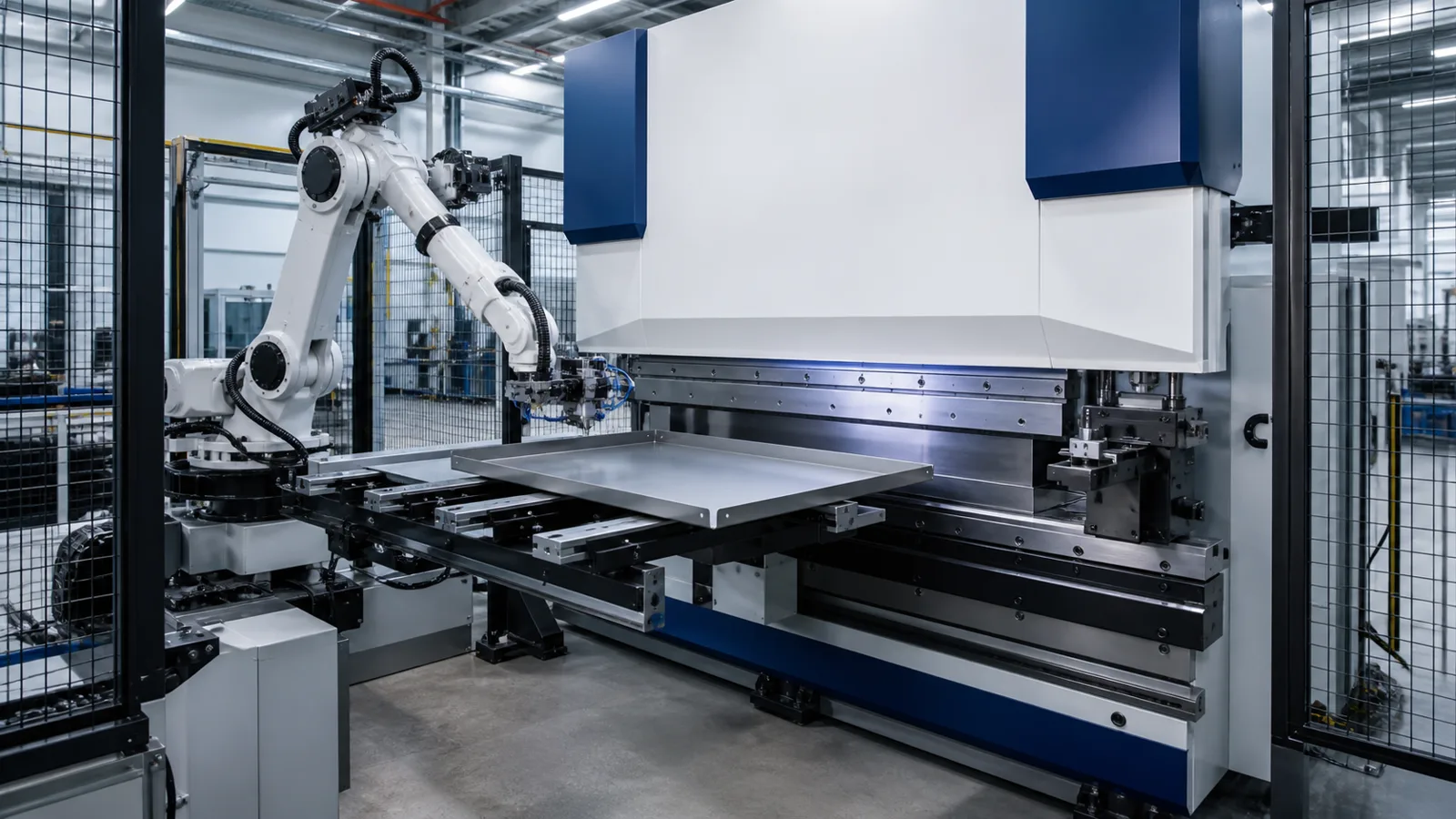
Press brake automation can benefit both high-mix production and longer repetitive runs. In recurring high-mix work, stored programs, shared tooling, guided setup, and automatic backgauge movement reduce the cost of frequent transitions.
In longer runs, automation can reduce operator handling and create steadier production flow. Robotic loading, automatic tool changes, angle measurement, and offline programming may improve throughput when the workload is stable enough to keep those features productive.
Pure one-off work is different. If every drawing requires new programming, new tools, and a new prove-out, high mix becomes repeated setup rather than reusable flexibility.
Very high volumes can also weaken the press brake case. When a part is stable and demand is sufficient, stamping or dedicated tooling may provide a faster cycle with less handling.
Main Disadvantages of a Press Brake
Setup Can Exceed Bending Time
The production clock starts before the first stroke. An operator must interpret the drawing, select and inspect tooling, plan a collision-free sequence, create or retrieve the program, install and align the tools, form a test piece, inspect it, and correct the process.
For a small or irregular batch, these activities may consume more time than productive bending. Setup burden per good part equals total setup and correction time divided by the number of accepted pieces. The burden falls across a large or recurring run but remains high when every order is unique.
Automatic tool setup, offline programming, guided bend sequences, and angle measurement can reduce manual work. However, they shift part of the burden into compatible tooling, accurate digital data, integration, training, and higher capital cost.
Physical Limits Can Exclude a Part
Four basic limits can reject a job before precision matters: tonnage, bend length, daylight, and throat depth.
Tonnage determines whether the machine and tooling can safely generate the required force. Bend length determines whether a continuous bend fits along the usable bed. Trying to form an overlength bend in overlapping sections can create visible transitions and dimensional mismatch.
Daylight is the open vertical space between the ram and bed. Tooling and adapters consume part of this space, while previously formed flanges may prevent the workpiece from being inserted, rotated, or removed.
Throat depth determines how far the sheet can extend behind the bend line before contacting the frame. A wide panel may require little force and have a short bend, yet still be impossible to position correctly.
Large panels introduce handling limits even when they technically fit. As the flange rises, the panel's center of gravity changes. The workpiece may sag, move away from the backgauge, damage a finished surface, or enter the operator's space.
Sheet followers, lifting aids, extra operators, and robotic handling can help, but they add cost and floor-space requirements. A technically formable part is not automatically safe, repeatable, or economical to produce.
Material Variation Can Defeat a Proven Program
Springback is the partial return of metal toward its original shape after forming force is removed. Its magnitude varies with material type, strength, thickness, bend radius, grain orientation, tooling, and bending method.
A program that produced the correct angle on one batch may require adjustment for another material lot. Changes in thickness affect how the sheet sits in the die, while harder material may require more force and recover more after bending.
First-piece inspection therefore remains essential unless the machine can reliably measure and correct the angle during the cycle. Even automatic correction depends on compatible geometry, sensing access, clean surfaces, and suitable correction rules.
Air bending offers low force requirements and the ability to produce several angles with one tool set. Bottoming provides stronger geometric control but uses more force and more specific tooling. Coining reduces springback further through very high localized force, but it increases machine and tooling demands.
The choice is a tradeoff: greater flexibility and lower force on one side, or more committed tooling and higher force for tighter geometric control on the other.
Long Bends Require Deflection Control
Under load, the ram, bed, and tooling can deflect slightly. The center of a long workpiece may receive a different effective punch penetration from the ends, causing angle variation across one bend.
Crowning counters this effect by applying a controlled compensation curve along the bed. Correct compensation depends on bend length, material, force, tooling, and machine condition.
Operators should measure long bends at several points. A center measurement alone may hide problems caused by incorrect crowning, tool misalignment, wear, or material variation.
Skilled Labor and Supporting Costs Remain Necessary
An operator must understand drawings, blank orientation, tooling limits, bend sequence, collision risks, material behavior, part support, and first-piece inspection. Advanced controls assist this work but do not remove the need for process knowledge.
Guarding, light-based protective systems, interlocks, foot controls, and safe handling procedures also shape the workflow. Awkward workarounds used to gain clearance or support large parts can reduce both safety and productivity.
Maintenance includes cleaning tool seating surfaces, inspecting punches and dies, maintaining guides and backgauges, checking sensors and guards, and servicing the drive system. Poor maintenance may create dimensional drift before it causes obvious downtime.
The installation requires more than the machine footprint. Tool storage, maintenance access, material movement, lifting equipment, electrical service, and safe loading and unloading space all belong in the total project cost.
Choosing the Right Type of Press Brake
Mechanical press brakes use a flywheel, clutch, and crank mechanism. They can cycle quickly on repetitive work but offer less flexibility in ram speed, stopping position, and dwell. They are generally less suitable for frequent setup changes and highly controlled motion.
Hydraulic press brakes use pressurized fluid and cylinders. They provide substantial force and flexible control over approach, bending speed, reversal, and dwell, making them suitable for long bends, thick material, and demanding forming methods.
Their disadvantages include pumps, valves, seals, filters, hydraulic fluid, and temperature management. Leaks or pressure problems can create significant downtime.
Electric press brakes use servo-controlled mechanical drives. They offer responsive movement, repeatable positioning, low idle energy use, and fast cycling for light- to medium-gauge work.
However, their advantages become less attractive as required tonnage rises. Electric machines eliminate hydraulic-fluid maintenance, but drive components, guides, lubrication points, sensors, and electronics still require service.
Hybrid machines typically use servo-controlled pumps to create hydraulic pressure on demand. They can reduce idle energy while retaining hydraulic force delivery, but owners must maintain both hydraulic and electronic systems.
The best drive technology is the one that matches the required force, working length, production pattern, maintenance capability, and realistic utilization. The newest or most efficient machine is not automatically the most economical choice.
When Another Bending Process Is Better
Folding machines and panel benders are often better for large, relatively thin panels with multiple simple flanges. They support more of the sheet during bending, reduce operator handling, and may lower the risk of marking finished surfaces.
Roll benders are the natural choice for cylinders, broad radii, and continuous curves. A press brake can approximate a curve through many shallow bends, but this bump-bending method adds cycles and may leave visible facets.
Stamping presses and dedicated dies can outperform press brakes in stable, high-volume production. Their high tooling cost is justified only when enough conforming parts are produced to benefit from short cycles and reduced handling.
Hand tools, bench folders, and simple jigs may be more economical for occasional light-gauge parts with short bends and moderate tolerances. Using a press brake for a one-off part may consume more time in setup than the job itself requires.
Outsourcing is often the strongest option when demand is sporadic, a part exceeds in-house capacity, or specialized processes are needed infrequently. It converts equipment, training, maintenance, and idle capacity into job-specific costs.
Outsourcing also brings freight, lead-time, inspection, scheduling, and supplier-dependence risks. Frequently repeated work may eventually cost less in-house, but occasional work should not be treated as recurring demand simply to justify a machine purchase.
How to Decide Whether a Press Brake Is Worth the Investment
Begin with actual part families, not headline specifications. For each family, record material grade and thickness, longest bend, required force, smallest flange, largest panel size, bend sequence, annual quantity, setup time, cycle time, inspection time, scrap, rework, and handling requirements.
For readers who want detailed materials, brochures is a useful follow-up resource.
Classify each family as feasible, conditionally feasible, or unsuitable. Conditional work may require special tooling, material controls, trials, or handling equipment. Unsuitable work should be assigned to folding, rolling, stamping, manual forming, or outsourcing.
Define the tolerances customers genuinely require, including angle, flange length, straightness, surface condition, and assembly-critical dimensions. Paying for precision that does not reduce cost, protect quality, or support revenue creates no investment return.
Measure practical utilization rather than calendar hours. Include planned maintenance, operator availability, changeovers, meetings, breaks, and expected downtime. Place annual demand on a monthly or weekly schedule so short-term bottlenecks are not hidden by a low annual average.
The annual production requirement for a part family can be estimated as:
Annual hours = annual setups x setup hours + annual pieces x run hours per piece + inspection, rework, and handling hours
Then calculate the full annual burden:
Annual ownership cost = capital charge + tooling + labor + training + maintenance + service + energy + consumables + floor space + handling + downtime cost
Compare it with measurable annual gains:
Annual credits = avoided outsourcing + labor savings + avoided scrap and rework + usable added capacity + avoided delay costs
Released labor should be counted as a cash saving only if it reduces overtime, avoids hiring, or lowers payroll. Otherwise, treat it as added capacity and assign value only when profitable work can fill those hours.
The central decision is:
Net annual advantage = annual credits - annual ownership cost
Test the result under low, expected, and high demand. A purchase that works only under optimistic assumptions is not a reliable investment case.
Buy a press brake when suitable work recurs often enough to recover setup and ownership costs, and when the shop can support the required tooling, training, material control, maintenance, and operating discipline.
Upgrade an existing machine when its force, length, and geometry remain suitable but losses come from outdated gauging, controls, tooling, or slow changeovers. Automate when programming, setup, handling, or loading is the measured constraint and recurring work can keep the automation productive.
Choose another forming process when geometry or volume points elsewhere. Continue outsourcing when demand is irregular, work exceeds in-house limits, or capital flexibility is more valuable than the supplier's margin.
Conclusion
A press brake earns its place through repeatable straight bends, flexible tooling, controlled force, reusable programs, and dependable production. The same machine also creates setup costs, skill requirements, maintenance duties, physical limits, and the risk of idle capacity.
The correct decision may be a combination of approaches: bring recurring straight-bend families in-house, automate only the stable workload, and leave oversized, curved, highly specialized, or irregular jobs to other processes or suppliers.
Precision justifies the investment only when it improves the economics of real parts. A press brake should be judged by lower rework, faster recurring production, usable capacity, and total cost per acceptable component—not by an impressive demonstration or a specification sheet alone.
Apply this guidance to your production
Share your material, thickness, part drawing, tolerance, and target output with the ZWCNC engineering team for an application-specific equipment review.
More news, insights, and updates from ZWCNC.
Press Brake Solutions: How Rushing to All‑Electric Could Bottleneck Your Fabrication Shop
Panel Bender Advantages: Automation, Labor Savings, and Production Value
The Ultimate Guide to Hydraulic Presses: Why Tonnage Is a Trap
Press Braking, Stamping, and Roll Forming Explained

Power Plate Press Brake: How to Identify and Buy the Right Machine