Licensed editorial adaptation
Adapted and localized by the ZWCNC Editorial Team from licensed technical material. The source record is published for traceability.
Technical boundary: confirm machine-specific capacity, configuration and safety requirements against the current quotation, manual and application review.
A laser advertised as “metal capable” may produce a sharp white logo on painted steel but fail to cut a bracket from the same sheet. The claim is not necessarily false—the problem is that marking, engraving, and cutting are very different processes.
Before choosing a machine, define the required result. Specify the exact metal and thickness, part geometry, edge quality, production volume, and whether the profile must separate cleanly without manual finishing. Once the application is clear, you can evaluate the laser source, power, assist gas, machine configuration, and total production cost.
Related: Types of Laser Cutting Machines
First Decide Whether You Need to Mark, Engrave, or Cut the Metal
A mark changes the appearance of a surface while removing little or no base material. An engraving removes material to create measurable depth. A through-cut separates the finished part from the surrounding sheet along the entire profile.
These processes require fundamentally different machines. A pulsed marking laser delivers short, intense bursts while galvo mirrors move the beam rapidly across a small field. It is ideal for text, serial numbers, logos, and surface patterns, but high peak power does not provide the sustained heat, melt removal, or motion control needed for sheet-metal cutting.
Through-cutting requires the beam to pierce the sheet, maintain a molten cut front through the full thickness, and follow the contour while assist gas ejects material from the kerf, or narrow slot created by the beam. The cutting head, focusing system, gas delivery, motion platform, work bed, cooling, and fume extraction must all support the process. For most sheet-metal applications, this means a purpose-built machine with a continuous-wave (CW) fiber source.
Desktop diode and CO2 lasers have much narrower metal capabilities. They can often remove paint, coatings, or anodized finishes, producing a result that looks like engraving even when the base metal is almost untouched. Some diode systems can mark certain bare metals with a marking compound or surface reaction. Typical desktop CO2 engravers can also make useful coated-metal marks, but neither becomes a practical sheet-metal cutter simply by making more passes.
Industrial CO2 metal cutters do exist, but they combine high power with specialized optics, cutting heads, assist gas, automatic height control, rigid motion, and extraction. A desktop engraver does not have these capabilities merely because it uses the same source family.
Treat vague claims such as “metal capable” with caution. A photo of dark lettering on a stainless tag proves only that the machine produced that specific surface result. For a meaningful test, give the supplier your exact alloy, thickness, smallest features, required edge condition, and actual CAD file. Ask the supplier to cut the hardest recurring part—not a specially selected demonstration coupon.
Why the Laser Source Matters More Than Advertised Wattage
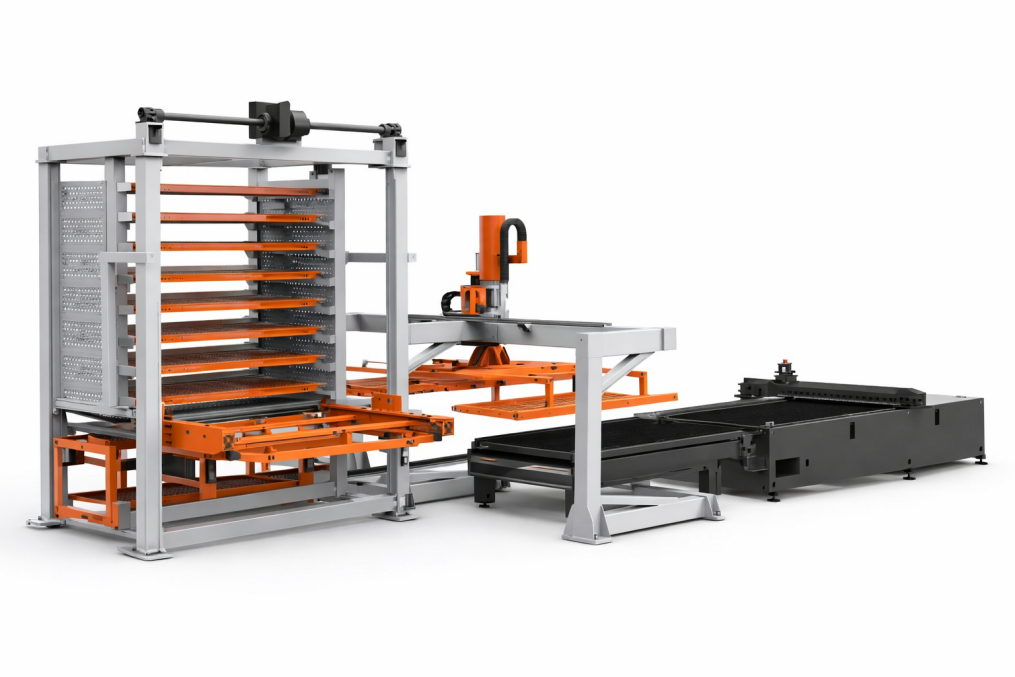
A fiber laser typically operates near a wavelength of 1.06 micrometers, while a CO2 laser operates near 10.6 micrometers. Metals generally absorb the fiber wavelength much more effectively. Therefore, two sources with the same rated wattage can produce very different results at the workpiece.
Rated power describes the optical output of the source, not the useful energy absorbed at the cut front. Some light is reflected, some spreads outside the productive area, and some becomes heat without removing material. Wavelength is the first filter; beam quality, which determines how tightly and consistently the beam can be focused, is another. A stable, concentrated lower-power beam can outperform a poorly focused higher-power beam.
Adding power to a standard desktop CO2 or diode machine does not correct weak metal absorption or add the missing cutting head, gas system, focus control, motion accuracy, enclosure, or protection from reflected energy. Surface coatings can improve initial absorption, but they disappear once the beam reaches bare metal and cannot stabilize the process deep inside the kerf. Repeated passes often spread heat, distort features, and create slag without completing a clean cut.
Industrial CO2 machines can cut some metals because the entire system is designed for the task. Oxygen assist is especially useful on carbon steel because the reaction between oxygen and hot iron adds chemical heat and helps eject material. However, it also leaves an oxidized edge. In some very thick carbon-steel applications, an industrial CO2 system may still offer useful edge or speed advantages, but that exception does not make a hobby CO2 machine suitable for production cutting.
Fiber lasers are now the standard choice for carbon steel, stainless steel, aluminum, brass, and copper because their wavelength provides a strong foundation for metal absorption and high power density. The assist gas can then be selected for the material and required finish: oxygen may improve carbon-steel speed, while nitrogen is commonly used for a bright, oxide-free edge on stainless steel and aluminum.
Brass and copper remain challenging because they are highly reflective and conduct heat rapidly. A suitable fiber source makes them practical to cut, but the machine still needs back-reflection protection, compatible optics, and validated parameters for the exact alloy and thickness.
It is also important to distinguish a pulsed fiber marker from a continuous-wave fiber cutter. Both use fiber technology, but a marker sends short bursts through galvo mirrors for localized surface work. A CW cutter supplies sustained energy through a cutting head while assist gas clears the kerf. For ordinary sheet profiles, continuous output and a complete cutting architecture are essential.
Match Fiber-Laser Power to the Metal, Thickness, and Required Edge Quality
Laser power is important, but doubling power does not double practical cutting thickness. As material becomes thicker, the beam must sustain a molten front farther below the surface, focus becomes harder to maintain, heat spreads into the sheet, and assist gas must clear molten metal through a longer kerf. More power improves speed, piercing, and process margin before it produces a proportional increase in thickness capacity.
The following matrix is a planning guide for carbon or mild steel, not a guaranteed capacity chart. It assumes a purpose-built CW fiber cutter, suitable gas, correct optics and parameters, and normal profile cutting. “Production” means repeatable single-pass cutting with an acceptable edge—not eventual separation.
| Sheet thickness | 1 kW | 2 kW | 3 kW | 4 kW | 6 kW |
|---|---|---|---|---|---|
| 1 mm | Routine production | Routine production | Routine; more speed | Usually oversized for this work alone | Difficult to justify for this work alone |
| 3 mm | Routine production | Routine; good speed margin | Strong production range | Suited to higher throughput | Usually oversized unless other work requires it |
| 6 mm | Validate speed, piercing, and dross | Practical production range | Strong production range | Strong speed and piercing margin | High-throughput range |
| 10 mm | Demonstration territory; weak buying basis | Requires part testing | Practical starting range | Preferred when 10 mm is common | Strong choice when speed and duty cycle justify it |
| 12 mm | Not a defensible production baseline | Boundary range; require proof | Occasional work after validation | Practical for intermittent thick work | Preferred when 10–12 mm and thicker work is regular |
Part geometry can move a job into a higher power range. A large rectangle with one pierce is much easier than a dense nest containing small holes, narrow slots, sharp corners, and hundreds of starts. Test the geometry that controls production.
Do not buy according to the advertised maximum thickness. A maximum rating may mean that a machine separated a favorable sample under selected conditions. Clean production thickness must remain stable through repeated pierces, small features, normal sheet variation, worn consumables, and a full production nest while meeting requirements for dross, taper, roughness, discoloration, dimensions, and throughput.
Slower speeds and multiple passes are not reliable substitutes for adequate capacity. Excessive dwell enlarges the heat-affected zone, increases distortion, rounds edges, and allows molten metal to solidify underneath. A second pass encounters an irregular channel containing oxide and dross, which disrupts both beam interaction and gas flow. A cut that repeatedly needs rescue is not production capacity.
For copper and brass, nominal power is only part of the safety question. Reflected energy can travel back through the cutting head toward the optics and source. Require approved alloy and thickness ranges, documented back-reflection protection, fault detection, compatible optics, warranty coverage, and proof cuts on the real material.
Account for the Complete Cutting System, Not Just the Fiber Source

The weakest supporting subsystem can waste correctly specified laser power. A damaged or misaligned nozzle, for example, can direct assist gas unevenly and create one-sided dross. A contaminated protective window can absorb energy and degrade the beam even though the source still reports full output.
Assist gas directly changes cutting speed, edge chemistry, dross, and cost:
- Oxygen adds reaction heat when cutting carbon steel and can increase thickness or speed at relatively low pressure, but it leaves an oxidized edge.
- Nitrogen mainly shields the cut and ejects molten metal, producing a cleaner, oxide-free edge. It can require high pressure and substantial flow, so pipes, valves, storage, and vaporizers must maintain pressure during cutting—not only while idle.
- Compressed air can reduce purchased-gas cost in suitable applications, but its oxygen content does not produce the same finish as nitrogen. The system also needs adequate flow, duty cycle, drying, filtration, storage, and condensate control.
Specify gas type, purity, dynamic pressure, flow, nozzle size, expected consumption, permitted pressure loss, and supply method for every critical material and thickness. Cylinders may suit intermittent work, while sustained nitrogen cutting may require bulk supply. Compressed air can reduce gas purchases but adds electricity, noise, heat, maintenance, and air-treatment costs.
The cutting head must also be rated for the source power and intended metals. Lens focal length and programmed focus determine how energy is distributed through the sheet. Automatic focus and capacitive height control must maintain the correct nozzle stand-off even when material bows or small parts tip. Nozzle centering, collision protection, optic monitoring, and replacement-consumable availability all affect uptime.
Piercing deserves separate evaluation. Thick material may need staged changes in power, focus, gas, and timing before profile cutting begins. One successful pierce does not prove that a machine can process a nest with hundreds of starts without excessive delay or contamination.
Motion accuracy becomes increasingly important at high power. Small holes and tight corners force the gantry to accelerate and change direction while the controller adjusts laser output. A powerful source on a slow or flexible platform can overheat corners and produce less accurate parts than a well-integrated lower-power system.
Bed design, fume extraction, cooling, and electrical service are equally important. Slats must support the work without excessive reflection or difficult slag buildup. Effective zoned extraction protects optics, rails, electronics, and shop air. The chiller must handle the proposed power and duty cycle in the shop’s actual environment. Electrical planning must include the source, chiller, drives, extraction fan, compressor, dryer, controls, and automation.
Inspect repeated parts for striations, taper, dross, discoloration, heat-affected zones, and pierce damage. Compare early and late parts from the same nest to reveal declining gas supply, optic contamination, thermal drift, or consumable wear. Define acceptance limits before testing: whether dross may wipe off, how much taper is permitted, whether heat tint is acceptable, and whether grinding is part of the planned route.
Decide Whether Buying a Fiber Laser Is Better Than Using Another Process
Compare processes using the cost of a part that actually passes inspection:
Cost per acceptable part = total production-period cost ÷ accepted parts
For an owned laser, include financing or depreciation, service, software, floor space, utilities, gas equipment, extraction, cooling, maintenance, labor, consumables, setup, scrap, downtime, rejected parts, and post-processing. Compare this with the full cost of plasma, waterjet, machining, or outsourcing using the same alloy, thickness, quantity, tolerance, finish, and delivery requirement.
Plasma may be more economical for thicker carbon steel when wider kerfs, more taper, dross, and a larger heat-affected zone are acceptable or the edges will be ground and welded. Include cleanup, hole finishing, distortion, and additional scrap in the calculation.
Waterjet is attractive for reflective metals, thick plate, and heat-sensitive parts because it removes material by abrasive erosion rather than melting. It avoids a laser heat-affected zone but may be slower and adds abrasive use, pump maintenance, wet handling, sludge, taper, and changing edge roughness through thick material.
CNC machining remains necessary for blind pockets, threads, counterbores, bearing bores, three-dimensional surfaces, and high-precision features. A laser may create the outer profile and rough holes before machining, but the complete route must include programming, fixtures, transfers, datum recovery, deburring, inspection, and work-in-process delays.
Outsourcing often wins for occasional projects, uncertain demand, seasonal work, frequent alloy changes, limited floor space, or limited operator availability. Ownership becomes more attractive when suitable work recurs, lead-time control has measurable value, proprietary work must remain in-house, and external prices consistently exceed the full internal cost.
Turn Your Hardest Real Part Into a Purchase Specification
Use the hardest recurring part that is economically sensible to bring in-house—not the thickest one-off job—as the machine’s final exam. Pair it with a representative high-volume nest so extra thick-plate capability does not compromise the work that generates most of the return.
Record the following:
- Exact alloy, grade, condition, thickness range, and surface finish
- Sheet dimensions or tube profile, wall thickness, and length
- Part drawing, original CAD file, and production nest
- Smallest holes, slots, corner radii, and webs
- Dimensional and positional tolerances
- Acceptable taper, dross, burr, striation, heat tint, and oxide
- Downstream welding, coating, bending, plating, or machining needs
For teams evaluating practical options here, press brake solutions is a relevant next step.
- Batch size, annual volume, and accepted parts required per shift
Size the machine for repeatable accepted production, not a one-time penetration record. Include piercing, rapid moves, loading, unloading, sheet changes, nozzle checks, inspection, and secondary work when calculating throughput.
Send vendors your own files and require repeated cuts in the exact alloy, thickness, and surface condition. Keep parts from different table locations and runs, then measure critical features and test downstream operations. A supplier-selected coupon cannot reveal the limitations hidden by difficult geometry or sustained production.
Confirm that the demonstration uses the quoted source, power, cutting head, lens, nozzle, assist gas, gas pressure and purity, focus, speed, pierce method, software, table, chiller, compressor, extraction, and automation. Record total cycle time and gas consumption—not only beam-on time. Optional equipment or a more powerful demonstration machine does not validate a lower-specification quotation.
Finally, use five pass-or-fail acceptance criteria:
- Material: The exact specified alloy, thickness, condition, and format were tested.
- Quality: Dimensions, features, taper, dross, oxide condition, and downstream requirements passed.
- Throughput: Repeated nests achieved the required accepted parts per shift.
- Configuration: The source, gas, optics, software, automation, and support equipment matched the quotation.
- Economics and safety: Full-route cost met the target, and electrical service, gas installation, enclosure, interlocks, extraction, fire controls, and handling fit the shop.
Use these criteria for both factory acceptance before shipment and site acceptance after installation. The best purchase is not the machine with the most impressive wattage. It is the complete system that repeatedly produces your real parts—cleanly, safely, and at the required cost and throughput.
For application-specific equipment selection, contact ZWCNC.
Related Resources and Next Steps
- For teams evaluating practical options here, press brake solutions is a relevant next step.
- For teams evaluating practical options here, press brake solutions is a relevant next step.
Apply this guidance to your production
Share your material, thickness, part drawing, tolerance, and target output with the ZWCNC engineering team for an application-specific equipment review.
More news, insights, and updates from ZWCNC.
How to Choose a Metal Laser Cutting Machine by Real Production Needs
Can Laser Cutting Machine Cut at an Angle? Bevels, Tapers, and Real Hardware Limits
Can Laser Cutting Machine Cut Aluminum? Fiber Laser Power, Physics & Real-World Limits
Laser Welding Aluminum: How to Produce Strong, Clean Welds
Laser Welding Machine Materials: Metals, Plastics, Thickness, and Wavelength