Licensed editorial adaptation
Adapted and localized by the ZWCNC Editorial Team from licensed technical material. The source record is published for traceability.
Technical boundary: confirm machine-specific capacity, configuration and safety requirements against the current quotation, manual and application review.
A 40 W CO2 desktop laser may cut material around 1/4 inch thick. A diode machine may also be sold as a laser cutter, yet it often handles only thin stock and spends most of its working life engraving. The missing detail reveals the real problem: 1/4 inch of what material?
“Laser cutter” describes a broad equipment family, not a predictable level of performance. CO2, fiber, diode, crystal, and UV lasers interact with materials in different ways. Even machines using the same source can vary greatly in power, motion, work area, cooling, extraction, gas delivery, and production capacity.
The right machine is therefore not the most popular or the most powerful. It is the one that repeatedly produces an acceptable part from your actual material, within the required time and at a sustainable cost.
Define the Job Before Comparing Machines
Begin with the output, not the equipment. A machine that eventually cuts a sample after multiple slow passes may be technically capable but commercially unsuitable. Repeated passes increase cycle time, operator attention, heat exposure, and the risk of poor edges or incomplete separation.
Write one clear purchasing statement: “This machine must primarily produce this result, on this material and thickness, at this batch size.” That sentence should guide every later decision.
Distinguish the required operations:
- Cutting penetrates the full thickness and separates the part from the sheet.
- Engraving removes or alters surface material to create depth, texture, or contrast.
- Marking creates identification or contrast with little or no meaningful depth.
A machine advertised as performing all three may do only one at a commercially useful speed. Rank the operations by machine hours, quality requirements, and revenue. If cutting occupies most of the schedule, engraving should remain a secondary criterion even when it appears on more product designs.
For every routine job, record the exact material, surface condition, maximum normal thickness, part and sheet dimensions, required quality, batch quantity, available production time, and expected operating hours. These facts determine the appropriate wavelength, power, work area, motion system, duty cycle, and supporting infrastructure.
Material Compatibility Comes First
Different materials absorb, transmit, or reflect different laser wavelengths. Only absorbed energy performs useful work. Energy that passes through a transparent material contributes little to the cut, while energy reflected from a shiny surface may create inconsistent results and dangerous back reflections.
Increasing wattage helps only after the wavelength and material are reasonably matched. More poorly absorbed energy can increase risk faster than it improves production.
Material names alone are not enough. Clear and opaque versions of the same plastic may behave differently. Paint, anodizing, pigments, fillers, protective films, adhesives, laminates, and polished finishes can change the process or introduce hazardous fumes. A supplier’s demonstration on generic “acrylic” or “aluminum” is not proof unless it uses the buyer’s exact material and surface state.
Material compatibility should act as a veto rather than one feature score among many. If the exact workpiece cannot absorb the wavelength effectively, or cannot be heated safely, that machine should leave the shortlist.
Wood, Leather, Fabric, and Paper
Wood, leather, fabric, and paper generally absorb the wavelengths used by CO2 and many diode lasers. Diodes can be sensible for engraving and occasional cutting of thin compatible stock. CO2 machines are usually stronger candidates when cutting is routine, materials are thicker, batches are larger, or the shop handles a wider range of nonmetals.
The exact composition still matters. Plywood contains adhesives, finished leather may carry coatings, and fabrics may be synthetic, laminated, or flame-retardant. These differences affect smoke, odor, charring, melting, and fire risk. Good extraction, suitable air assist, correct focus, proper bed support, and active flame supervision are essential parts of the process.
Clear Acrylic and Transparent Materials
Clear acrylic illustrates why wavelength matters. Much of a visible diode beam may pass through the material instead of heating the intended cut line. CO2 wavelengths are generally absorbed much more effectively, making CO2 the normal choice for clear acrylic cutting.
Colored or opaque acrylic may behave differently because pigments alter absorption. A coating may let a diode create a visible mark, but marking a coating is not the same as cutting the transparent substrate. For acrylic production, test the exact clear, colored, coated, or mirrored grade and evaluate edge finish, distortion, dimensional accuracy, pass count, and total cutting time.
Bare, Coated, and Anodized Metals
“Metal marking” can describe several different processes. A laser may remove paint from steel, change the anodized layer on aluminum, engrave measurable depth into bare metal, or cut completely through a plate. These capabilities are not interchangeable.
CO2 and diode systems may mark certain coated metals without being able to engrave or cut the substrate. Fiber lasers are the usual starting point for bare-metal marking and cutting because their wavelength is better matched to many metals. Industrial CO2 systems can cut some metals, but only when supported by sufficient delivered power, suitable optics, a cutting head, assist gas, cooling, extraction, and appropriate safety systems.
Reflective metals such as copper and brass require extra care. Back-reflected energy can damage the source or optical path. The supplier must confirm that the proposed source and complete machine are designed for the exact alloy, finish, thickness, gas, and operating method.
PVC and Unknown Plastics
PVC should not be laser processed because heating chlorine-containing material can produce toxic and corrosive byproducts. Strong extraction does not make incompatible chemistry safe; it may simply move contamination into filters, ducts, equipment, or the surrounding environment.
Unknown plastics should also be refused until their full composition is confirmed. Base polymers may contain pigments, fillers, flame retardants, adhesives, or coatings that change their behavior. Do not use an improvised burn test or a successful mark as proof of safety. Obtain reliable material identification and safety documentation, or choose an appropriate mechanical process.
Main Laser Source Types
CO2 Lasers: The Nonmetal Workhorse
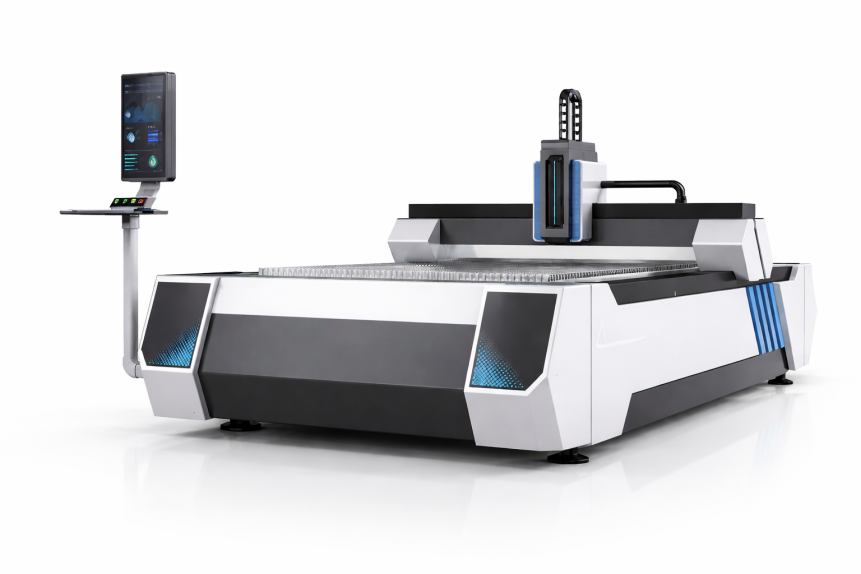
CO2 lasers are widely used for wood, acrylic, leather, fabric, paper, and many other nonmetals. Their broad compatibility makes them a practical foundation for sign making, packaging, crafts, displays, and mixed nonmetal production.
Results still depend on the complete machine. Air assist, extraction, focus control, motion quality, cooling, and flame management influence edge quality and repeatability. A desktop CO2 engraver and an industrial CO2 cutting cell may share a source label while offering completely different capabilities.
CO2 sources also differ in construction. Glass tubes usually reduce purchase cost and can suit intermittent broad cutting, but they depend heavily on cooling and are commonly treated as replaceable components. RF-excited metal tubes cost more but often provide faster modulation and better low-power control, which can improve fine engraving, sharp starts and stops, and repeated switching between cutting and marking. Serviceability, replacement availability, downtime, and workload should decide which ownership model is better.
Fiber Lasers: The Metal Specialist
For application-specific equipment selection, contact ZWCNC.
A fiber marker is not the same as a fiber cutter. Marking systems often use galvanometer-driven mirrors to move the beam rapidly across a limited field. Sheet cutters require a cutting head, focus control, assist gas, piercing strategy, motion system, material bed, enclosure, and extraction.
Fiber earns its higher cost when repeated metal throughput justifies it. Stainless steel, aluminum, brass, and copper each behave differently according to grade, finish, and thickness. As thickness increases, source power, focal control, nozzle condition, gas pressure, rigidity, and reflected-energy protection become more important.
Fiber is usually a poor all-purpose choice for wood, clear acrylic, leather, and general craft materials. It is not a universally better laser; it is a better laser for many metal processes.
Diode Lasers: Affordable but Limited
Diode machines can be compact, simple, and affordable. They are often excellent entry tools for engraving wood or leather and for occasional cutting of very thin compatible materials.
Their limitations become clear when meaningful cutting thickness or daily volume is required. Slow travel and multiple passes keep the machine occupied, increase heat exposure, and demand more supervision. Compare delivered optical output rather than electrical input or an impressive model name, then test the required material at an acceptable edge quality and cycle time.
A diode is economical when engraving carries the workload and cutting is secondary. When multi-pass cutting defines the schedule, the low purchase price can create an expensive production bottleneck.
Crystal and UV Lasers: Specialized Process Tools
Nd:YAG and Nd:YVO4 crystal lasers serve narrower precision applications. Depending on the source design, they can suit fine metal marking, controlled pulses, drilling, or specialized welding. Fiber has replaced crystal sources in many routine workflows, so a crystal laser should be chosen only when a tested application proves a specific technical and economic advantage.
UV lasers are valuable for heat-sensitive plastics, electronics, fine codes, and micro-features. Their higher-energy photon interaction can limit heat spread compared with conventional thermal ablation, although “cold processing” does not mean zero heat. UV systems usually prioritize controlled material removal and precision rather than bulk sheet cutting.
Source Type Is Only Half the Machine
The source generates the beam, while machine design controls how it reaches the work. Confusing these two layers leads to poor comparisons.
A gantry moves the head, the workpiece, or both across a relatively large area. It suits sheet cutting and widely distributed paths. A galvo system steers the beam rapidly with small mirrors, making it highly effective for dense marking within a limited field. An enclosure is a safety and workflow feature and may surround either system.
Nominal bed dimensions can also mislead. Clamps, frames, extraction zones, head travel, and fixtures may reduce the real processing area. Confirm that the routine sheet and fixture fit without repositioning and that doors, service access, stock handling, and part removal are practical.
Focus control matters as well. Autofocus may establish the initial focal position without continuously compensating for warped stock or uneven supports. The machine should prove acceptable results across the working area and the full production geometry.
Thickness, Quality, and Production Performance
Advertised maximum thickness often describes a boundary condition: one slow straight cut, perhaps with multiple passes. Reliable thickness lies inside a stable process window where ordinary variation in material, flatness, focus, optical cleanliness, and gas delivery does not create scrap.
Test the routine thickness first and the occasional maximum second. Include long profiles, internal contours, small holes, corners, and repeated features near the center and edges of the usable bed. Repeat the run after the machine reaches operating temperature.
A successful cut means more than the part falling out of the sheet. Inspect kerf width, taper, dimensions, roughness, charring, oxidation, dross, melted residue, heat distortion, and the heat-affected zone. Kerf variation changes slot sizes, mating fits, and nesting allowances.
Total cycle time must include piercing, acceleration, cornering, positioning, gas delays, loading, unloading, sorting, inspection, and cleanup. The useful productivity measure is accepted parts per staffed hour, not headline travel speed.
Assist Gas and Air
Assist gas changes both the process and the operating cost. Oxygen can add chemical energy when cutting suitable metals, often increasing capability but leaving an oxidized edge. Nitrogen suppresses oxidation and can produce a cleaner edge, but its required flow may be expensive. Compressed air may reduce consumable cost for some jobs, although compressor capacity, air quality, and final finish must be validated.
For nonmetals, air assist helps clear particles, protect surfaces, and reduce sustained flaming. Nozzle alignment, pressure stability, gas purity, compressor duty, and supply capacity all affect results. Gas consumption should be measured during the sample trial rather than estimated from a brochure.
Duty Cycle
Duty cycle is the proportion of scheduled time the equipment can operate at the required load while maintaining quality. It belongs to the entire system: source, power supply, chiller, optics, motion components, extraction, compressor, gas supply, controls, and material handling. The weakest subsystem sets the production limit.
A short demonstration tests a sprint, not a shift. Production qualification should include repeated cutting, normal loading, job changes, extraction, gas demand, cleaning, and planned breaks. Track thermal drift, alarms, incomplete cuts, cooling pauses, lens cleaning, nozzle replacement, and recovery time.
Compare Cost per Accepted Part
Purchase price is only the visible portion of cost. A commissioned-process budget should include freight, installation, electrical work, extraction, filtration, cooling, compressed air, gas equipment, software, fixtures, training, and suitable fire protection.
Recurring cost includes labor, electricity, gas, filters, protective windows, lenses, mirrors, nozzles, cutting supports, maintenance, scrap, downtime, and downstream finishing. Support also has financial value: response time, remote diagnosis, technician availability, replacement parts, warranty exclusions, and preventive-maintenance requirements should be documented in writing.
Use three simple measures:
Accepted yield = accepted parts ÷ attempted parts
Effective time per accepted part = total elapsed production time ÷ accepted parts
Cost per accepted part = total cost of the comparison workload ÷ accepted parts delivered
These measures prevent a fast but unstable process from hiding rejects and cleanup behind an attractive cutting-speed claim. They can also show when two specialized machines are more economical than one compromised system. A CO2 machine for regular nonmetal work and a fiber machine for metal may improve throughput and scheduling, although duplicated floor space, extraction, maintenance, training, and software must be included in the comparison.
Size the purchase around the recurring queue rather than a rare exception. Occasional oversized, unusually thick, or incompatible jobs may be cheaper to outsource. Future capacity deserves investment when it is supported by a named program, forecast, or strategic requirement—not merely by “we might need it someday.”
A Five-Step Buying Process
- Identify the primary material. Record exact grade, surface, coating, thickness, and operation, then eliminate unsafe or poorly matched wavelengths.
- Define thickness, size, and quality. Specify routine and occasional maximum thickness, sheet and part dimensions, smallest features, tolerances, kerf, edge finish, and acceptable heat effects.
- Set the production target. State lot size, accepted parts per shift, changeover frequency, available hours, peak demand, and duty cycle. Calculate takt time from available productive time divided by accepted parts required.
- Compare the trade-offs. Decide whether limited material range, lower output, or higher ownership cost is acceptable. Use the same workload and costing assumptions for every candidate.
- Test the actual job. Give each shortlisted supplier the same production file, actual material, required quantity, quality criteria, and expected schedule.
Require every attempted part back, not only the best samples. Record complete cycle time, kerf, edge finish, repeatability, pass count, post-processing, gas use, consumables, rejects, and interruptions. Document power, speed, focus, optical setup, and assist gas, and confirm that these are sustainable production settings rather than short demonstration settings.
The trial should become the basis of the commissioning agreement. After installation, the machine should reproduce the validated output under agreed conditions.
Final Decision: Make the Vendor Prove the Fit
The best laser cutter is not defined by source type, wattage, bed size, or popularity alone. The source must match the material. The power and optics must handle the required thickness. The motion system and usable work area must suit the part. Extraction, cooling, gas, safety, and duty cycle must support the workload.
Most importantly, the complete process must deliver acceptable parts at the required rate and cost.
Start with the recurring material and job, remove incompatible technologies, and test the remaining machines using the same real production package. Measure accepted yield, staffed time, finishing, operating inputs, and downtime. Then place that evidence beside the quotation.
The right machine is the one that can reproduce the required result after installation—and keep reproducing it when the order book, rather than the sales demonstration, sets the pace.
Apply this guidance to your production
Share your material, thickness, part drawing, tolerance, and target output with the ZWCNC engineering team for an application-specific equipment review.
More news, insights, and updates from ZWCNC.

Types of Fiber Laser Cutting Machines: Selection Guide
Panel Bender and Laser Cutting Integration for Higher Throughput
Laser Welding Machine Types: How to Choose the Right System
12 kW Laser Cutting Parameters: Baselines, Testing, and Process Tuning

How to Prevent Burn Marks During Laser Cutting: A Troubleshooting Guide