
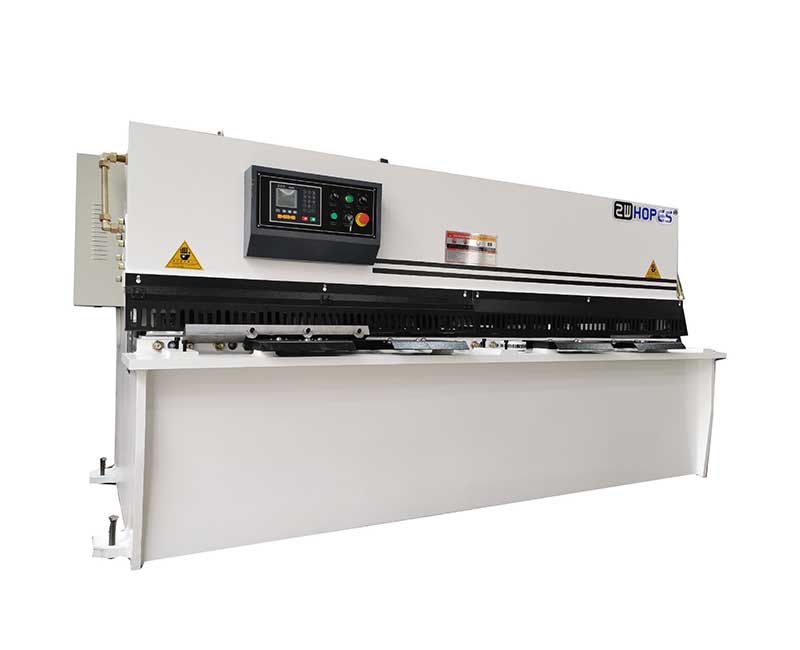
Licensed editorial adaptation
Adapted and localized by the ZWCNC Editorial Team from licensed technical material. The source record is published for traceability.
Technical boundary: confirm machine-specific capacity, configuration and safety requirements against the current quotation, manual and application review.
A shearing machine can cut a stack of sheet metal in seconds. That does not automatically mean the shop has produced usable parts. The first blanks may still need deburring, flattening, sorting, trimming, or dimensional correction before they can enter forming, welding, stamping, or assembly.
This distinction is central to machine selection. A shear is highly productive when it repeatedly makes straight-sided blanks with acceptable edges and stable dimensions. It is a poor universal solution when the part needs curves, internal holes, tight contour accuracy, a nearly finished edge, or minimal distortion.
The right comparison is the total time and cost required to deliver an accepted blank or finished part to the next operation. This guide shows where shearing creates an advantage and how to validate the choice with representative trials.
Shearing Works Best as a Fast Blanking Process
Blanking means separating stock into pieces that will become parts or feed another operation. Rectangles for press-brake forming, strips for stamping, plate sections for machining, and enclosure panels are typical shear applications. The geometry is simple, the cut path is straight, and the edge is acceptable or economical to finish.
The definition of “acceptable” depends on what happens after cutting. A blank for a covered welded bracket may tolerate a visible fracture edge. A blank that will be bent across the cut edge may need controlled burr direction and sufficient edge integrity to avoid cracking. A visible appliance panel may need protection from scratches and a cleaner edge than an internal component.
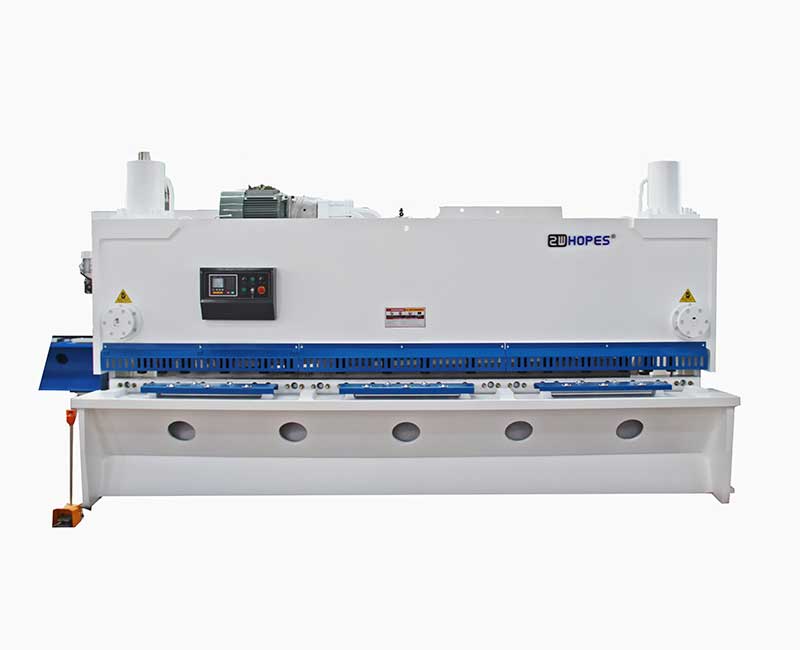
Shearing is valuable because it separates material mechanically. A typical guillotine shear holds the sheet with hold-downs while an upper blade moves past a lower blade. Blade clearance, the small gap between the cutting edges, lets the material deform and then fracture along the intended line. The process does not melt a path through the sheet and normally does not generate a stream of chips like sawing or machining.
The lack of concentrated cutting heat can be a major advantage. Shearing does not create a heat-affected zone, meaning an area whose properties have changed because of thermal cutting. It also avoids thermal slag. That can simplify later welding, coating, forming, or handling when heat-altered edges or cleanup would cause problems.
Mechanical cutting still changes the edge. The material is compressed and rounded at the entry side, creating rollover; a smoother burnished zone follows before the remaining thickness fractures. The exit side may carry a burr. Blade sharpness, clearance, rake, material strength, thickness, and support control the severity.
Clearance deserves particular attention. Too little clearance can raise cutting force and accelerate blade wear. Too much can increase rollover, fracture angle, and burr. A machine rated to cut a certain thickness has therefore answered only the force question. It has not proved that the edge, flatness, squareness, or dimensional repeatability will satisfy the drawing.
Count the route from raw sheet to an acceptable input for the next station, including loading, alignment, gauging, cutting, unloading, sorting, scrap handling, deburring, flattening, inspection, rework, and work-in-process movement. Shearing earns its place when that complete route is faster and simpler than the alternatives.
What Determines Whether a Straight Blank Is Useful?

For application-specific equipment selection, contact ZWCNC.
For a press brake, consistent blank width may control bend location and flange size. For stamping, burr direction and edge condition may affect die life or later forming. For welding, squareness and fit-up can determine whether a fixture holds the assembly without correction. For manual handling, a sharp edge may require deburring even when its dimensions are acceptable.
Tolerance is a system result rather than a back-gauge number alone. Sheet flatness, edge alignment, hold-down performance, blade clearance, frame rigidity, blade wear, support arrangement, and operator technique all affect the finished blank. Repeated cuts can also accumulate error if each new dimension is measured from a previously sheared edge instead of a controlled reference.
Material handling is part of the same calculation. Large sheets can sag away from the gauge, narrow strips can curl or twist, and long offcuts can fall or swing when the final section separates. Supports, conveyors, lift assistance, scrap bins, safe access, and suitable controls may determine whether the advertised cycle rate is achievable in daily work.
The best application profile has several features:
- The material is within the machine’s rated conditions after strength and surface corrections.
- The part or blank has mainly straight boundaries.
- The cut edge and resulting flatness meet the next operation’s requirements.
- The sheet can be supported and aligned consistently.
- Repetition is high enough to reward fast cycling and repeatable gauging.
- Secondary finishing, inspection, and handling do not erase the cutting-time advantage.
Applications Where Shearing Delivers the Most Value
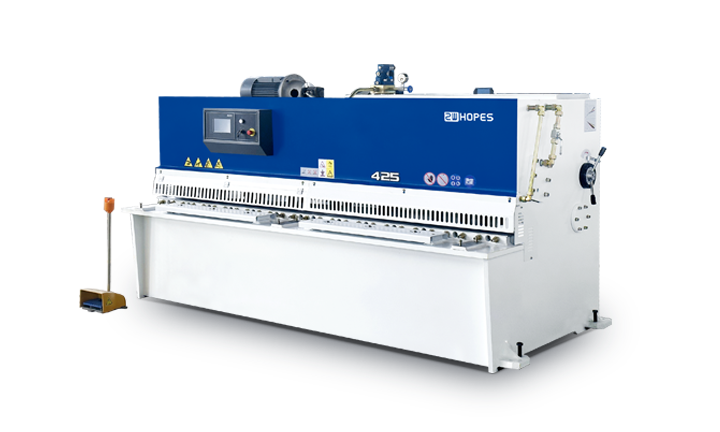
HVAC and ductwork
Duct shops often start with galvanized sheet cut into rectangles for notching, bending, rolling, seaming, and assembly. The shear quickly establishes the outside dimensions without introducing a heat-affected zone or thermal slag. This is especially useful when the material is coated and the blank will proceed directly to a forming operation.
Shearing does not replace the rest of the duct-production system: corners, holes, curved transitions, and fitting details still require other equipment. The shear is most productive as the rectangular-blank stage.
Thin galvanized sheet also requires proper support and clearance. A large sheet can sag against the gauge, while a poor setup can increase burrs or distortion. Table supports, non-marring contact surfaces, and a safe method for catching the offcut are part of the application, not optional accessories.
Fabrication shops
Brackets, trays, frames, covers, and welded assemblies frequently begin with a simple blank. A common route is to square the stock, cut it to length, and send it to a press brake, roll, punch, or welding fixture. A shear fits this workflow because one straight cut can prepare material for several downstream processes.
Its flexibility is mainly across blank sizes, not shapes. It can change efficiently among rectangular parts when the back gauge and supports permit quick positioning; radii, internal features, irregular profiles, and complex notches need other equipment.
The decisive measure is first-pass usability. If the forming operator must correct squareness, remove a heavy burr, or fight a curled blank, the shear has transferred labor downstream rather than eliminating it.
Automotive and appliance production
Repeated panels and components create a strong case for powered shearing. Once material, blade settings, gauging, handling, and inspection are controlled, a shear can supply a steady stream of blanks for stamping, forming, or assembly. Programmable back gauges, conveyors, stackers, and automated loading can extend the advantage.
High volume magnifies small problems. A minor dimensional error repeats across the batch, and a cut edge that looks acceptable may become a crack starter during forming. Advanced high-strength steel is a boundary case: its blank may pass dimensional inspection but still have reduced edge formability.
The production question is therefore not only “Can the machine cut this material?” It is “Can the edge survive the next forming operation at the required rate?” If the answer is uncertain, a slower blanking process may create the lower cost per accepted part.
Electrical enclosures and control cabinets
Cabinet doors, sides, back panels, mounting plates, and internal pieces often begin as rectangular blanks. Outside dimensions establish bend locations, flange widths, door clearances, and assembly alignment. A back-gauged shear is suitable when its achievable squareness and dimensional variation match the enclosure design.
Openings change the process. Cable entries, ventilation patterns, instrument cutouts, and mounting holes require punching, machining, laser cutting, or another feature-making operation. Shearing remains useful for the perimeter blank when it reduces the total route.
Surface condition should also be included in the specification. Prepainted or coated sheet needs clean supports and controlled handling, while the edge requirement should reflect whether the cut will be folded inward, covered, deburred, or left accessible.
Roofing and construction work
Flashing, trim, cladding components, and other light-gauge construction pieces often need long, straight cuts. Shearing can size these parts without thermal distortion and send them directly to bending or installation when the edge is acceptable.
Long material is the practical challenge. Flexible sheet needs support before, during, and after the cut. Without it, the sheet can shift away from the gauge, bend under its own weight, or become hazardous as the offcut drops. A machine with enough nominal blade length but inadequate support may deliver neither accuracy nor useful output.
Profiled or formed stock requires caution. A conventional sheet shear is not automatically suitable because the material is light gauge; stock shape, hold-down action, tooling, and machine rating must support the cut.
Steel service centers and job shops
Service centers may cut standard rectangles, strips, or shorter stock from larger sheets so customers receive material closer to a usable production size. Fast straight cutting can reduce preparation time across many orders, and repeatable gauging supports common dimensions and inventory programs.
Material variety is the pressure point. Shear capacity is often stated for a reference material, while equal thicknesses can require different force when tensile strength, hardness, or condition changes. A machine selected around gauge alone may handle one mild-steel order comfortably and be poorly matched to a stronger grade of the same thickness.
Job shops face setup pressure. Throughput remains valuable only when operators can change material, clearance, gauging, and supports without consuming the time saved during cutting.
Maintenance, education, and prototype shops
A maintenance technician may need one replacement cover. A student may need a rectangular blank for a forming exercise. A prototype shop may need several pieces before the design stabilizes. In these cases, a shear can provide a direct route from sheet to usable blank without programming a contour-cutting system.
Low volume weakens the case for a large powered machine. Floor space, guarding, maintenance, training, inspection, and safe handling remain even when it cycles occasionally. A smaller manual, bench, pneumatic, or light powered shear may be a better fit if its capacity and controls match the work.
Material Behavior Changes Practical Cutting Capacity
Thickness is only one input to shear selection. Strength, hardness, ductility, surface condition, coating, and internal construction change how material responds when the blades enter it. A machine rated for 1/2-inch mild steel may not have the same practical capacity for 1/2-inch stainless steel.
Mild steel as the reference material
Mild steel is commonly used as the basis for a shear’s thickness rating. The rating normally assumes low-carbon steel under defined conditions, with suitable clearance, sharp tooling, a manageable sheet width, and a machine in good condition.
This baseline is useful but not universal. A flat mild-steel blank and a harder, coated, or finish-critical sheet of the same thickness may both pass through the blades, yet the second job can demand more force, a different setup, and more downstream work.
Industrial hydraulic shears may handle mild-steel plate from roughly 6 to 25 mm, while heavy-duty models can reach about 45 mm. Such figures are reference ranges, not promises for every grade and width. Force, blade length, clearance range, hold-down performance, frame rigidity, and production rate all matter.
Stainless steel and capacity derating
Stainless steel often requires substantially more cutting force than mild steel. Depending on grade and machine conditions, practical capacity may be reduced by roughly 40–50 percent. A machine that comfortably cuts its mild-steel rating may stall, slow down, wear tooling quickly, or produce a poor edge on the same thickness of stainless.
Capacity derating means reducing the nominal rating to account for stronger material. A rough first estimate can scale the mild-steel rating in proportion to the reference material’s tensile strength compared with the job material’s tensile strength. This is only a screening estimate; blade geometry, clearance, sheet width, machine condition, and actual grade must be verified through testing.
Watch for higher power demand, unstable cutting, increased rollover, larger burrs, and more distortion. Repeated work near the limit can also stress the drive, frame, hold-downs, and blades. If the blank will be formed later, inspect the edge for cracking risk rather than judging it only by visual straightness.
Aluminum, copper, and brass
Soft nonferrous metals may require less force than steel, but they are not automatically easy to shear cleanly. Aluminum, copper, and brass can drag across the tooling, transfer material to the blades, or leave a smeared edge when clearance or blade condition is wrong.
Galling occurs when material adheres to a tool surface and then pulls or tears additional material as the cut continues. The machine may have ample force while the part shows scratches, raised material, or a distorted edge. Blade sharpness, clearance, rake, lubrication policy, cleanliness, and work support all influence the result.
Surface damage matters differently for different parts. A mark on an internal bracket may be harmless, while a scratch on an appliance panel or conductive copper component may cause rejection. Protective film, clean tables, non-marring supports, and controlled movement can be necessary.
Galvanized and prefinished sheet
Coated sheet adds a surface that must survive feeding, clamping, cutting, and stacking. A hold-down can dent the finish, a dirty support can scratch it, and a burr trapped beneath the sheet can mark the surface during repositioning. The offcut can also scuff the finished face as it slides or falls.
Review the entire material path: table supports, ball transfers, guides, hold-down faces, back-gauge contact points, and the method used to catch and stack parts. The cut edge exposes the underlying metal, so the downstream process may also require touch-up, sealing, deburring, or corrosion protection.
The right specification therefore includes surface protection. A fast cut that damages a visible panel has simply moved the defect earlier in the line.
Rubber, plastics, and composites
Non-metallic materials cannot be evaluated with steel ratings. Rubber, plastics, fiber sheets, laminates, and composites behave according to elasticity, temperature sensitivity, reinforcement, thickness, and layer construction.
Rubber can deform away from the blade before separating. Some plastics stretch, crack, or melt locally. Reinforced composites may separate unevenly because their fibers and matrix respond differently to the blade. A conventional metal shear may have enough force but lack the blade profile, clamping control, clearance range, or support needed for stable cutting.
Specialized shears may process these materials, but the result must be tested under actual conditions. A rough edge hidden inside an assembly may be acceptable; a visible gasket, insulating layer, or composite panel may need a more controlled process.
Hardened, brittle, laminated, or unusual stock
Hardened material may overload tooling. Brittle material may chip or fracture unpredictably. Laminated sheet can split between layers or delaminate, and corrugations, ribs, formed flanges, holes near the cut, or uneven thickness can change where force is concentrated.
A successful trial cut does not always establish a production process. The first piece may be better supported, cut in a more favorable location, or handled more carefully than the real batch. Representative testing should examine force demand, edge condition, dimensional stability, surface damage, operator handling, blade wear, and performance in the next forming or assembly step.
Choose the Machine Type Around the Workflow
Machine selection must include setup behavior, not only maximum thickness. For example, a shop may set blade clearance around 0.05–0.07 mm for 0.40–0.80 mm sheet, while 1.0–2.0 mm stock may require about 0.15 mm. These are illustrative starting points, not universal settings; the correct value depends on the material, blade condition, and desired edge.
Rake angle, the angle that controls how the blade enters the sheet, affects cutting force and distortion. Hold-downs must restrain the work without marking it. Tables, guides, ball transfers, supports, and back gauges must keep the material flat and aligned through the stroke. A machine that requires constant manual correction may be technically versatile but commercially inefficient.
| Machine type | Strongest fit | Main qualification |
|---|---|---|
| Hydraulic guillotine | Full-sheet, controlled straight cuts and repeatable blanks | Verify gauge range, support, cycle sequence, and edge results |
| Swing-beam shear | General fabrication across ordinary sheet and plate formats | Clearance, support, and mixed-job changeover control matter |
| Mechanical shear | Fast, repetitive production cycles | Handling, guarding, and stable part flow must match the speed |
| Pneumatic or bench shear | Thin stock, small parts, repair, and light workshop work | Limited capacity, table size, and large-sheet support |
| Rotary or slitting shear | Continuous strip, coil processing, and longitudinal trimming | Feed, tension, entry/exit support, and scrap removal are critical |
| Alligator or scrap shear | Size reduction of irregular stock and offcuts | Precision is secondary; loading and guarding dominate |
| Portable or specialty shear | Roofing, construction, repair, and on-site cuts | The tool must match the profile and available support |
Hydraulic guillotine shears
A back gauge supports rectangular production, but its range must match the part family. A hydraulic guillotine manual may specify a 10–1,000 mm range and return within 0.5 mm. Verify such positioning claims with finished blanks; they do not prove overall part accuracy.
Test the whole sequence: load, align, clamp, cut, remove, stack, and repeat. Large sheets and unsupported offcuts can erase the expected productivity.
Swing-beam shears
Swing-beam machines suit general fabrication across varied sheet sizes when clearance, support, and positioning are controlled. They work well without a dedicated high-speed line, but become less attractive when each material change demands extensive adjustment or manual compensation.
Mechanical shears
Mechanical shears fit stable, repetitive work. A flywheel or other drive can provide rapid cycles, but stops, tables, conveyors, stackers, part removal, and scrap handling must keep pace.
High cycle rates increase exposure to the blade zone, so guarding, interlocks, emergency stops, visibility, and maintenance isolation are essential. This class is less suitable for low-volume jobs with frequent setup changes.
Pneumatic and bench shears
Pneumatic and bench shears serve small workshops cutting thin sheet for enclosures, duct components, signs, trim, repairs, or prototypes. They are economical when a full-size hydraulic machine would be excessive.
Their limits are capacity, support, and repeatability. Thin sheet can still flex, and a small table may make large blanks awkward or unsafe. Choose this class for genuinely small or thin work with modest tolerance requirements.
Rotary and slitting shears
Rotary or slitting shears guide a continuous strip through rotating circular knives or paired cutting tools. They are designed for coil processing, narrow-strip production, and longitudinal trimming rather than isolated rectangular blanks.
The surrounding line is decisive. Decoiling, leveling, entry guides, tension control, side support, scrap removal, recoiling, or stacking must keep the strip on the intended path. In coil-side trimming for electric-resistance-welded pipe, inadequate entry or exit support can let the strip move away from the cut, increasing trimmed width beyond the target.
An edge miller may remove roughly 10–15 mm per side at typical production rates. That illustrates why trimming must be evaluated as part of the entire line, including yield and scrap, not as an isolated knife specification.
Alligator, scrap, and portable shears
Alligator or scrap shears reduce irregular offcuts, structural pieces, or bundles for sorting, transport, or further processing. The output is feedstock or scrap, not a precision blank; jaw opening, loading, guarding, and material containment matter more than edge appearance.
Portable and specialty shears address roofing, construction, installation, and repair work when the tool must travel to the material. Limited support, visibility, footing, weather, finished surfaces, and offcut behavior must be considered.
When Shearing Loses Its Speed Advantage
The decisive question is what leaves the cutting area. A square, flat, usable blank preserves the advantage. A distorted or incomplete blank waiting for profiling, holemaking, deburring, flattening, or corrective trimming does not.
Curves, holes, notches, and nested profiles
A conventional squaring shear makes a straight separation across the material presented to the blades. It cannot follow a curve, stop midway to make an internal feature, or create a hole, slot, or complex corner. Those features require punching, laser cutting, plasma, waterjet, machining, or another operation.
Consider a bracket with angled sides, a curved end, and three mounting holes. A shear could reduce the sheet to a rectangle, but the rectangle would still require profiling and holemaking. Each transfer adds loading, alignment, work-in-process storage, inspection, and opportunities for dimensional error.
Nesting also matters. Profile-cutting equipment can arrange irregular parts to use more of the sheet area. Straight blanking is naturally efficient for rectangles and strips, but it can leave large amounts of material around complex profiles.
Tight flatness, edge, and dimensional requirements
Shearing can achieve useful precision under controlled conditions. Practical total tolerances around 0.5–1.0 mm may be achievable on squaring shears, and figures near ±0.4 mm are associated with some 1.6 mm material applications. These ranges may suit blanks that will be formed, welded, or machined.
They are not universal guarantees. Alligator shears, for example, may operate around a much broader 1.6 mm practical tolerance. Material variation, support, blade wear, clearance, and operator setup can push a process outside its expected range.
Edge quality is a separate issue. A sheared edge contains compression, burnished, and fracture regions rather than one uniform finished surface. Flatness can also change when cutting releases residual stress, especially in narrow strips. If leveling or flattening follows every batch, that labor belongs in the cutting cost.
Thick or high-strength stock
As tensile strength rises, allowable thickness falls at the same nominal machine capacity. Running close to the limit narrows the process window, raises tooling load, and makes clearance and edge fracture more consequential. An occasional successful cut does not prove a sustainable production rating.
Obtain the rating basis for every material family. Check the thickest, strongest, and widest planned cut, and consider doubled material, local hard spots, inconsistent plate, and offcut behavior. Capacity without acceptable cut quality is not usable capacity.
Alternatives for profiles and demanding parts
Laser cutting is a strong alternative when the part combines an outside contour with holes, slots, notches, or identification features. It may take longer for the primary cut but can produce several features in one programmed setup, eliminating transfers and secondary work. Its heat input and edge condition must still be checked.
Plasma cutting is useful for thicker conductive metals and flexible profiles. It can outperform a shear-centered route when the alternative is to cut a rectangle first and remove a large amount of material later. Evaluate kerf, taper, dross, heat input, hole quality, and cleanup.
Waterjet cutting produces complex profiles without a heat-affected zone. It is attractive for heat-sensitive materials, distortion-sensitive parts, and applications where thermal edge changes are unacceptable. Cutting rate, consumables, taper, piercing, water management, and handling still affect cost.
Punching suits repeated holes, slots, louvers, forms, and notches that match available tooling. Sawing is more appropriate for bars, tubes, beams, channels, and other three-dimensional sections that require clamping and controlled crosscutting. The right process is the one that delivers the accepted part with the lowest complete route cost.
A Practical Checklist for a Defensible Machine Specification
1. Build a material and size matrix
Record every grade or strength range, thickness, maximum sheet width, surface condition, coating, temper, and expected variation. Include the thinnest and smallest work as well as the thickest and strongest. Define combinations that the machine must cut and combinations that operators must not run.
Capacity must cover the strongest material at its maximum thickness and cut width. A nominal rating based on mild steel should be corrected for stainless or other high-strength grades. Also consider whether the cut edge will be bent, welded, coated, machined, or exposed.
2. Define finished-part acceptance
State dimensional tolerance, squareness, flatness, bow, twist, burr height and location, rollover, visible deformation, and allowable hold-down marks. Define how each characteristic will be measured and on what inspection surface.
Burr height below 10 percent of sheet thickness is a common target for conventional steels, but it is not a universal definition of an acceptable edge. Forming-sensitive parts need limits based on bend or stretch performance. Separate machine-positioning acceptance from part acceptance: a repeatable back gauge does not guarantee a stable blank.
3. Calculate accepted throughput and cost
Record batch size, cuts per part, setups per shift, material changes, inspection frequency, number of operators, loading time, repositioning, unloading, sorting, and scrap handling. Use actual product mix rather than an ideal continuous run.
For comparison, use the same cost boundary for every process. A useful production measure is:
accepted parts per shift = completed parts − rejected parts − parts awaiting corrective work
Cost each route through finished-part acceptance, including material and scrap, programming, setup, tooling, machine time, labor, handling, inspection, maintenance, secondary operations, rework, and rejected material. Keep queue time visible when delivery or work-in-process inventory matters.
Handling capacity must match cutting capacity. Wide or flexible sheets may need supports, lifting equipment, powered transfers, or a second operator. If material cannot be loaded and removed safely at the advertised speed, the extra cycle rate is not usable throughput.
4. Specify the cutting system, not only the frame
Require blade material, usable cutting edges, sharpening limits, maintenance method, and any restrictions for strong, abrasive, coated, or surface-sensitive stock. Specify an adjustable and repeatable clearance range appropriate to each material family.
Technical guidance commonly places normal shearing clearance around 4–10 percent of material thickness, with recommendations near 7–8 percent when minimizing burr is a priority in some conventional applications. These figures are starting points. The machine should be tested at the proposed settings, and operators should have a defined method for verifying clearance.
Also specify rake behavior, hold-down pressure and surface protection, table support, side guides, back-gauge range, repeatability, zeroing method, and changeover time. Ask how the setup is verified after blade service and how operators compensate for blade wear. Accuracy that takes too long to recover between jobs is not production accuracy.
5. Include safety, access, and material flow
Review front and rear guarding, point-of-operation access, controls, emergency stops, setup access, maintenance isolation, and obstruction-clearing procedures. Safeguards must remain practical during loading, unloading, and inspection.
Plan for the material after the final cut. Large blanks can shift their center of gravity, narrow offcuts can fall or jam, and all cut edges can injure hands. Include conveyors, bins, lifting devices, extraction space, stacking methods, and safe scrap routes in the layout.
Training should cover material identification, approved clearance settings, back-gauge checks, edge inspection, blade deterioration, safeguarding, and stop-work conditions. Maintenance personnel need clear adjustment and blade-service procedures as well.
6. Validate with representative sample cuts
Use buyer-supplied material from the real operating envelope. Test the thickest, strongest, widest, thinnest, and most edge-sensitive combinations, including coated or finish-critical sheet. A demonstration on convenient mild steel proves only that the machine can cut convenient mild steel.
Run complete sequences, not isolated strokes. Include loading, gauging, repeated cutting, part removal, inspection, changeover, and setup verification. Measure dimensions, squareness, flatness, burr, rollover, deformation, surface marking, cycle time, operator effort, and drift across a meaningful number of pieces.
Then send the blanks through the actual next operations. Bend forming-sensitive edges in the intended orientation and inspect for cracks. Check welded assemblies for fit-up, gaps, distortion, and any edge preparation the shear makes necessary. If parts will be coated, machined, or assembled, test those steps too.
The trial record should show accepted parts, labor time, machine time, tooling condition, scrap, inspection effort, secondary work, and rejects. Use the resulting accepted-part cost to compare shearing with laser, plasma, waterjet, punching, sawing, subcontracting, or purchased blanks.
7. Use more than one process when the workload demands it
Group parts by material, geometry, quality requirement, volume, and downstream route. Straight blanks with stable tolerances may justify shearing. Contoured parts, forming-sensitive grades, structural sections, and precision-edge work may belong to another process.
Forcing every job through a machine selected for the average part often creates the most expensive compromise. A mixed process strategy can assign each family to its lowest-cost validated route while retaining the shear for the straight, repetitive work it does best.
Final Decision Rule
Shearing machines deliver the most value when compatible material, thickness, straight geometry, achievable tolerances, manageable stock dimensions, and repeat volume come together. They provide a fast, heat-free route to blanks for forming, stamping, welding, assembly, or later machining.
They lose that advantage when the cut edge triggers cracking, deburring, flattening, or machining; when the blank is distorted; when material strength reduces practical capacity; or when the part needs curves, holes, notches, nested profiles, or tight finished contours. A slower process can be the better production choice if it removes more downstream work.
The final purchase should therefore be based on two documents: a tested application envelope and a finished-part cost sheet. Approve the shear only where representative trials prove throughput, edge condition, flatness, dimensional accuracy, safety, surface protection, and downstream performance across the stated material range.
The goal is not to buy the fastest stroke. It is to create the lowest-cost, most predictable route from raw stock to an accepted part.
Apply this guidance to your production
Share your material, thickness, part drawing, tolerance, and target output with the ZWCNC engineering team for an application-specific equipment review.
More news, insights, and updates from ZWCNC.
What Is a Shearing Machine? Physics, Types, Capacity & Laser vs Shear Comparison
Press Brake Applications Across 16 Industries: Selection Guide
What Is a Press Brake Used For? From Brute Force to the Precision Backbone of Modern Manufacturing
Sheet Metal Shearing Process: Setup, Cut Quality, and Defect Control
Fiber Laser Cutting for Kitchen Equipment: Parts, Quality, and Cost