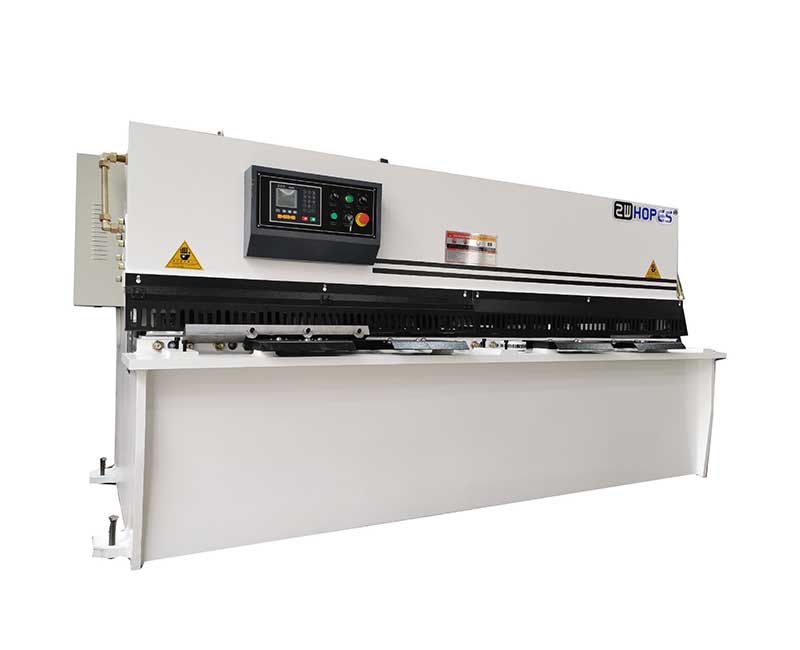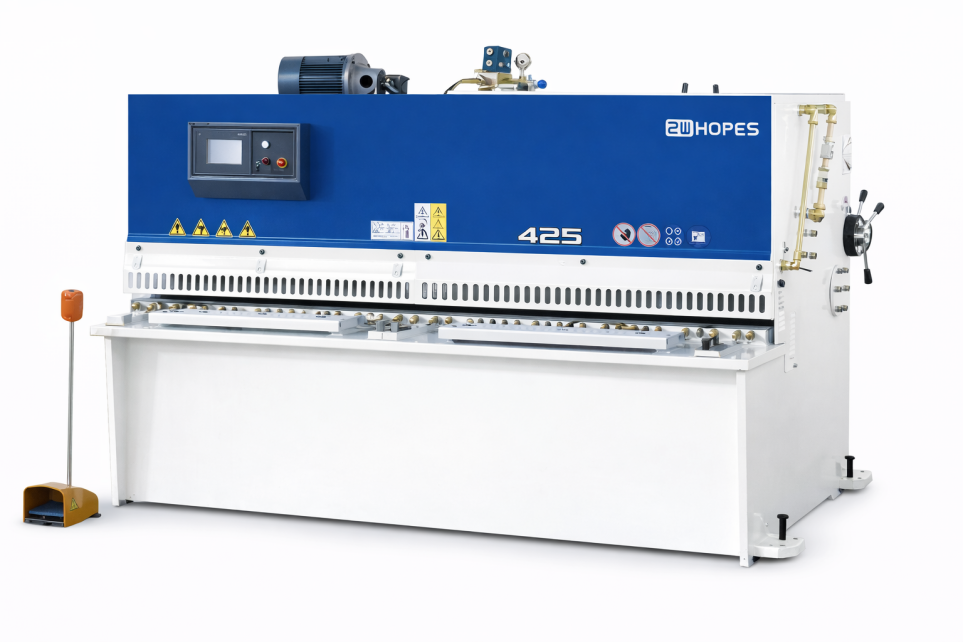
Licensed editorial adaptation
Adapted and localized by the ZWCNC Editorial Team from licensed technical material. The source record is published for traceability.
Technical boundary: confirm machine-specific capacity, configuration and safety requirements against the current quotation, manual and application review.
Imagine walking through your shop on a Tuesday afternoon, weaving past stacks of half-finished sheet metal and dodging the forklift. Every square foot feels like an expensive luxury you cannot afford. Then a vendor shows you a glossy brochure for an integrated shear-and-bend machine—a single unit that replaces two large footprints with one compact frame. It looks like a miracle cure for a crowded floor.
But shop owners who buy based on the tape measure often find themselves constrained by the very efficiency they thought they were purchasing. In the rush to reclaim floor space, many unknowingly give up their most valuable asset: the ability to do two things at the same time.
Related: Ironworker vs. Press Brake vs. Shear
The "Two-for-One" Illusion: Why Space Savings Are Often the Wrong Metric
The Seductive Pitch: Solving the Floor Space Crisis in Small-to-Midsize Shops
A sales rep will often begin by measuring the "dead zone"—the six-foot gap between your standalone guillotine shear and your press brake where pallets of work-in-progress (WIP) sit and collect dust. They argue that by combining these two operations into a single footprint, you are not just saving space; you are eliminating the "transportation waste" of moving a sheet from one station to the next. For a shop manager looking at a building expansion quote that resembles a phone number, the idea of reclaiming 300 square feet while theoretically maintaining production capacity feels like an obvious choice.
The logic is appealing because floor space is the most visible constraint in any facility. You can see the clutter, feel the cramped corners, and calculate the rent per square foot with painful precision. When a machine promises to do the work of two in the space of one and a half, it appeals to the basic instinct to bring order to the chaos of a busy floor.
Yet does a cleaner floor plan actually lead to a more profitable day of production?
The Hidden Assumption: Why "Integrated" Doesn't Automatically Mean "Faster"
Integrated machines are built around a "one-piece flow" philosophy, in which a sheet enters as raw stock and leaves as a finished, bent part. This works very well if you are manufacturing ten thousand identical panels for a server rack. However, the engineering of these machines requires the part to follow a very specific, rigid sequence of operations. The machine assumes that every part you run needs exactly the same amount of time under the shear as it does under the bending tools.
In the real world of job shops, balance is a myth. You might have a job that requires ten complex bends on a small bracket, followed by a job that is only a simple rectangle with one fold. In a standalone setup, your shear operator finishes the simple cuts and moves on to the next job, while the brake operator takes the necessary time with the complex bends. In an integrated system, the shear often has to wait for the bending cycle to finish before it can process the next sheet. You have effectively synchronized your most efficient process to the pace of your slowest one.
If the machine cannot stay busy on both ends at the same time, what exactly are you doing with the extra floor space you fought so hard to save?
The Idle Asset Trap: Is half of your machine always asleep while the other half works?
When you buy two separate machines, you have two independent revenue engines. If the shear breaks a blade or needs a hydraulic seal replaced, your press brake can still work through the backlog of blanks that were already cut. In an integrated unit, a single sensor failure on the sheet-handling arm does not just stop the shearing; it stops the bending as well. You have concentrated your risk into a single point of failure, turning a minor maintenance issue into a complete facility standstill.
Even when the machine is running perfectly, you are often paying for a “thousand-pound paperweight.” If your current production mix is 70% flat parts that only need shearing, the bending side of your expensive integrated machine sits idle, consuming overhead and depreciating while doing no work. You have invested six figures in a specialized tool that lacks the modularity to handle the unpredictable shifts in customer demand that define the modern market.
The question then becomes: under what narrow set of circumstances does this major trade-off actually pay for itself?
The Winning Profile: Factories Where Integration Truly Improves the Bottom Line
The High-Mix, Low-Volume Rule: Why prototype shops and job shops benefit most
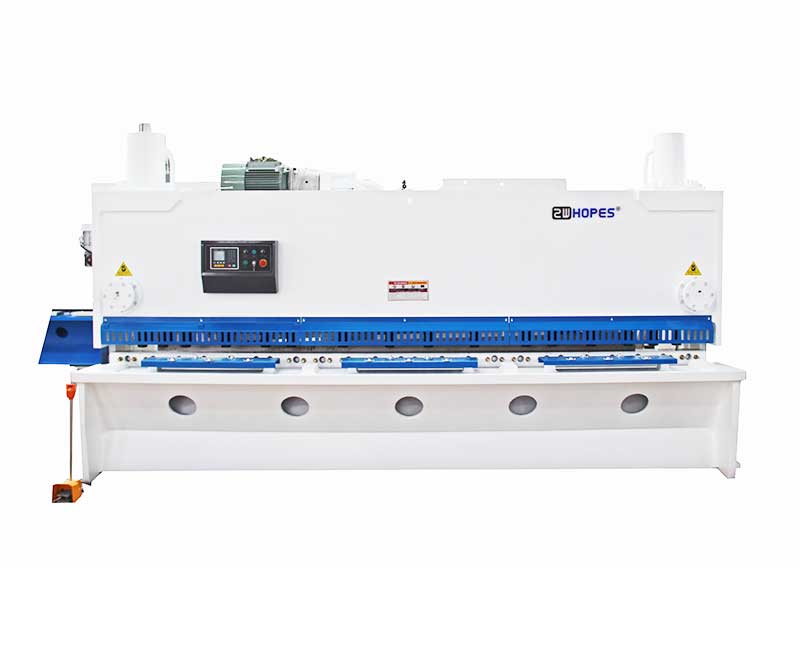
A prototype shop building a custom medical-grade stainless enclosure does not care that its shear-and-bend unit is “slow”—it cares that it has only one operator, and that operator cannot be in two places at once. In these environments, you are not fighting for seconds of cycle time; you are fighting the “setup tax.” If a job involves cutting three unique panels and putting two specific bends in each, the time spent walking from a standalone shear to a press brake, setting the backgauges twice, and verifying the first-off part is often longer than the actual fabrication.
Integrated machines thrive here because they reduce “non-touch” time. When the machine knows the dimensions of the sheet it has just sheared, it can automatically calibrate the bending tools for the next move without the operator re-measuring or re-homing the workpiece. For a job shop running fifty different part numbers a day in batches of five, the “inefficiency” of a sequential machine is actually a gain. You are paying to eliminate human error during the hand-off between two different workstations.
In this scenario, the machine is not a production workhorse; it is a high-precision assistant that keeps the “mix” from overwhelming the “volume.”
But what happens when the parts are not unique, but the sequence is fixed?
Sequential Logic: When part flow is strictly linear and never parallel
Look at a company like Worksport, which reshored its production of tonneau covers by using an integrated bending and shearing line as part of a complete factory redesign. They did not just buy a machine to save space; they adopted a philosophy in which part flow is strictly linear. In their case, raw material enters the line, and a finished, multi-component assembly exits the other side. This is “one-piece flow,” a lean manufacturing concept in which Work in Progress (WIP)—those half-finished parts sitting on pallets—is treated as a poison to be eliminated.
When your product design is fixed and the sequence is always A followed by B, the “bottleneck” of an integrated machine becomes a heartbeat. You synchronize the entire assembly line to the pace of that one machine. This avoids the “overproduction” trap, where a standalone shear can run 500 parts per hour but the press brake can bend only 100, leaving 400 parts cluttering the floor and tying up capital in raw steel. In a tightly coupled system, the machine acts as a governor, keeping the shop’s rhythm steady and predictable.
Integration wins when the goal is a “straight-line” factory where nothing stops or waits in a pile.
Does this logic still hold when you factor in the cost of the person standing at the controls?
The Staffing Factor: Maximizing a Single Operator in a Low-Throughput Environment
In a small shop, labor is usually your most expensive and least reliable variable. If you have a standalone shear and a standalone press brake, a high-volume day requires two sets of hands to keep both machines running. But on a slow Tuesday, one of those operators may be sweeping the floor or looking for something to do. An integrated machine allows a single, highly skilled operator to manage the entire fabrication lifecycle from one HMI (Human Machine Interface, the touch-screen controller).
This “labor density” is a godsend for shops in regions where finding experienced sheet metal workers is nearly impossible. You are essentially using the machine’s software to replace the “tribal knowledge” needed to coordinate two separate departments. The operator does not need to communicate with a “shearing department” to ensure the grain direction is correct for the “bending department,” because the machine manages those constraints internally.
You are effectively trading machine speed for human simplicity.
But we need to see this trade-off in a real-world stress test to understand where it breaks.
Case Study Snapshot: The Maintenance Shop vs. the Production Floor
Consider a municipal maintenance shop responsible for repairing snowplow blades and salt spreaders. Its “production schedule” is dictated by the weather, not by a sales forecast. The shop might not touch its metalworking equipment for three weeks, then suddenly need to fabricate twenty custom bracing brackets in a single night. For this kind of shop, an integrated machine is a hero because it is a “Swiss Army Knife” that stays tucked in a corner until needed, taking up minimal space while providing complete capability.
Contrast this with an HVAC duct manufacturer running three shifts. In that environment, the integrated machine is a disaster. The moment the “shear” side of the machine pauses to let the “bend” side finish a complex flange, the duct manufacturer is losing money. They need the shear running at 100% capacity to feed three different bending stations at the same time. In the maintenance shop, the machine’s “idle time” is irrelevant; in the production shop, “idle time” is a terminal illness.
The integrated machine is a specialist’s tool disguised as a generalist’s solution.
The real risk emerges when a shop manager sees these “winning” niche profiles and assumes the same logic can be scaled into high-volume manufacturing.
The Efficiency Paradox: Hidden Ceilings in Geometry and Throughput
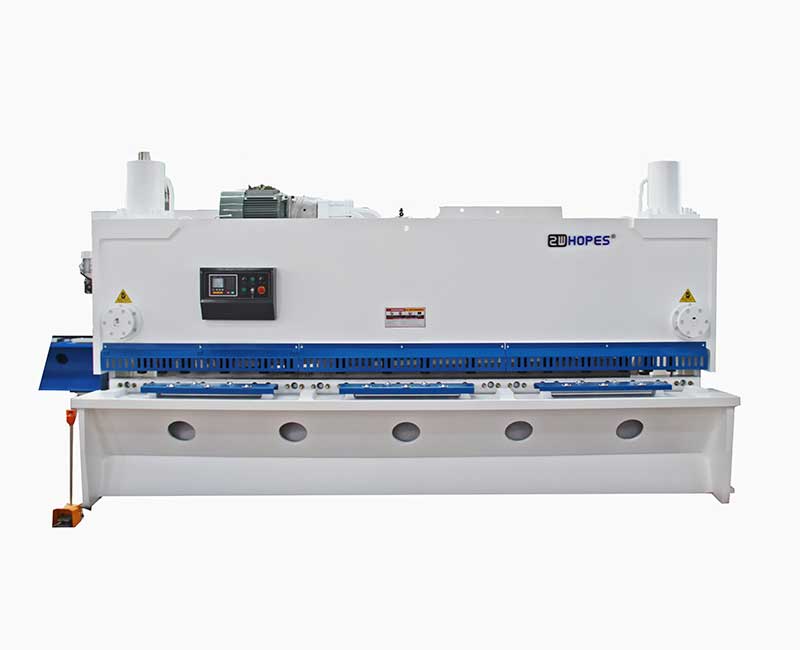
In a recent throughput test using standard 500mm panels, an integrated shear-bend line produced 42% fewer parts per hour than a parallel setup with a dedicated shear and press brake. The integrated line claimed a 30% smaller footprint, which looks excellent on a facility floor plan.
But the floor plan does not show the machine stopping.
Every time the integrated unit completed a cut, it required a 1.8-second pause to switch its internal tooling into bending mode. That small delay captures the efficiency paradox. You trade parallel processing for sequential processing, and in doing so, you run into a firm mathematical ceiling. A machine cannot cut and bend the same piece at exactly the same time, nor can it cut piece B while bending piece A if both rely on the same handling gantry. You have successfully reduced your footprint, but you have also reduced your capacity.
The “Wait State” Bottleneck: How Shared Stations Create Internal Queues
When you run a standalone shear and a standalone press brake side by side, your internal queue sits on a pallet. The shear operator stacks blanks, and the brake operator pulls from that stack. If one operator steps away, the other can keep working. Inside an integrated machine, that queue exists within the frame, creating what engineers call a “wait state.”
For shops trying to exceed 2,000 parts per day, this wait state becomes an unbreakable barrier. The machine must physically stop the shearing blade, retract the material, index the bending tools, and re-engage. You are no longer managing a workflow; you are managing a traffic jam at a single intersection. No amount of automated material handling or software optimization can overcome the basic physics of two separate operations sharing one set of mechanical rails. The machine is always waiting on itself.
Physical Limits: Why Combined Frames Often Struggle with High-Precision Tolerances and Throat Depth
Time is only half of the penalty; the other half is geometry. A mid-sized automotive parts supplier in Germany recently learned this the hard way. They replaced their dedicated machines with a single integrated unit to free up aisle space. Within six months, they won a contract requiring 1,400mm-wide busbars. The problem was that their new integrated frame had a maximum throat depth of exactly 1,200mm.
For application-specific equipment selection, contact ZWCNC.
Tooling Compromises: The Difficulty of Managing Complex Bend Sequences in a Shared Workspace
Even if your parts fit within the throat, bending them creates a completely different challenge. Complex parts that require three or more bends at varying angles need a carefully coordinated sequence of specialized punches and dies. On a standalone press brake, an operator can stage multiple tool sets across a wide bed and move the part down the line in one smooth motion.
In a shared workspace, the tooling magazine is extremely constrained because it shares space with the shearing mechanism. Installation guides for these combined units explicitly warn that programming complex bend sequences takes roughly 40% longer and carries a 25% higher risk of tool collision. The machine simply cannot hold the full range of specialized punches required for highly complex parts without constant manual reconfiguration. You end up stopping the machine mid-cycle just to swap out a gooseneck punch. This turns a high-value, multi-bend job into a frustrating exercise in tool management, raising an unavoidable question about what happens when this single, overworked spindle eventually breaks down.
The Single-Point-of-Failure Risk: When One Repair Shuts Down Two Departments
The Maintenance Math: Doubling Complexity While Halving Availability
When a $15 proximity sensor on the shear blade glitches in an integrated cell, it does not just stop cutting; it shuts down the bending station that was halfway through a critical rush order. In a standalone setup, that sensor failure is a nuisance that sidelines the shear for twenty minutes while the press brake continues working through the existing stack of blanks. In an integrated unit, that same sensor acts as a kill switch for your entire production line. You have effectively linked the Mean Time Between Failures (MTBF)—a metric that measures the average time a machine runs before failing—of two different technologies.
Mathematically, you are gambling against the house. If a dedicated shear has a 98% reliability rate and a dedicated press brake is also at 98%, they operate independently. If the shear goes down, you lose half of your process, but your bending department remains operational. In an integrated machine, reliability becomes multiplicative: 0.98 times 0.98. Your theoretical uptime drops to 96% because the machine only runs when both systems are perfect. You have not just bought one machine; you have bought a system where the “weakest link” is the entire machine.
This compounding risk is the part the sales brochure conveniently leaves out. By packing a computer-controlled shear and a multi-axis bending bed into one box, you have doubled the number of solenoids, limit switches, and hydraulic seals that can trigger a safety E-stop. Every additional moving part is another way for the machine to decide it will not work today. If a single I/O (Input/Output) module on the main control board burns out, it does not matter that the hydraulic ram is perfectly healthy.
The machine is either 100% operational or a zero-percent-utility boat anchor.
Why a Shared Hydraulic System Is a Liability for High-Uptime Environments
Most integrated units share a single hydraulic reservoir and pump to maintain that compact footprint, creating a shared circulatory system for two very different types of stress. A shear is a violent, high-impact tool; a press brake is a precision instrument. When the shearing blade hits a piece of 10-gauge stainless, it sends a massive pressure spike through the manifold (the block that directs oil flow). Over time, these repeated shockwaves fatigue the O-rings and valve seats that the bending side depends on for delicate, sub-millimeter positioning.
If a seal fails on the shear side and releases microscopic metal shavings into the oil, those contaminants do not remain in the shear circuit. They migrate. Within hours, those fragments can score the polished pistons in your bending cylinders and jam the proportional valves that control your flange angles. At that point, you are no longer just repairing a leak; you are flushing an entire system and potentially replacing high-precision components in two different "machines" at the same time.
Shared infrastructure saves costs for the manufacturer, but it creates a "contagion" risk for the owner. In a high-uptime environment, you want precision bending isolated from the pounding, vibrating world of heavy shearing. When the oil is shared, a minor mechanical failure in the "dumb" end of the machine—the shear—can effectively lobotomize the "smart" end. This leaves the production manager with a grim question: what does a total stop actually cost once the repair clock starts ticking?
The Cost of "Total Halt": Comparing Downtime Impact Against Two Standalone Machines
Imagine a main logic board failure on an integrated unit on a Tuesday morning. Because these machines are specialized hybrids, you cannot simply go to a local industrial supplier for a generic replacement; you have to wait for a proprietary part from the OEM (Original Equipment Manufacturer). For the next 48 hours, your output is zero. You cannot shear blanks to send to a local partner for bending, and you cannot bend the blanks already sitting on your floor. Your entire sheet metal department becomes a ghost town.
Compare that with a shop that has two standalone machines. If the press brake's controller dies, the shear keeps running. You can shear your entire week's inventory and then truck those blanks to a friendly competitor down the road to use their brake. You stay in business. You keep your promises to your customers. The standalone model gives you "degraded operation"—it is not ideal, but it is not a blackout.
The "Total Halt" of an integrated machine is catastrophic because it removes all your tactical options. You have no workaround because you have no independent stages. The floor space you saved by choosing the integrated unit is now only empty, expensive air that could have held a secondary machine to keep revenue flowing during a crisis. It forces the realization that true efficiency is not only about how fast a machine runs when it is healthy, but also about how much it hurts your bottom line when it is not.
When to Pivot: Alternatives That Preserve Your Production Agility
A hiker packing for a three-day trek appreciates a multi-tool because it saves weight and space in a backpack. But you will never see a professional chef run a busy commercial kitchen with one. The chef needs a dedicated knife for chopping and a dedicated stove for boiling, because professional volume requires specialized, independent tools. If the stove breaks, the chef can still prep vegetables. When you buy an integrated shear-and-bend machine to save floor space, you are essentially buying a 10,000-pound camping tool for a commercial factory.
So, if bolting two machines together creates a fragile environment where one glitch causes a total halt, how do you achieve the seamless workflow the sales brochure promised?
You decouple the hardware.
Digital Synchronization: Using Software to Link Separate Guillotine Shears and Press Brakes
The main case for integrated units is that they close the communication gap between cutting and bending. A flat blank goes in, a formed part comes out, and the operator does not have to manually program two separate controllers. That sounds extremely efficient until a shared hydraulic valve fails. But we no longer operate in an era when machines must share a steel frame to share a brain.
Software is lighter, cheaper, and far more reliable than shared hydraulic fluid.
The Modular Path: Why independent machines offer a better upgrade cycle for growing shops
Beyond daily uptime, independent hardware protects your capital upgrade cycle. Shops rarely outgrow their cutting and bending capacity at exactly the same pace.
Growth is uneven.
You might win a lucrative contract that requires forming complex, high-tolerance brackets. Suddenly, you are pushing the limits of your press brake's tonnage and axis capabilities, while your shear sits idle for half the day. If you own an integrated unit, you are stuck. You cannot replace the bending half with a heavier, multi-axis model without discarding a perfectly good shear. To get the bending capacity you need, you have to buy an entirely new standalone brake anyway, which completely defeats the original purpose of the integrated footprint.
Beyond Straight Lines: When a Fiber Laser/Brake combo makes shearing obsolete
Sometimes the best alternative to an integrated shear-and-bend machine is to bypass traditional shearing altogether. Mid-sized sheet metal shops often find that their real bottleneck is not the transfer time between cutting and bending. It is the geometric limitation of straight-line cuts.
A modern fiber laser paired with a standalone press brake delivers a major increase in operational agility. The laser handles complex geometries, intricate hole patterns, and non-standard nesting that a guillotine blade cannot manage. While the laser quietly works through a nest of curved blanks, the press brake operator can form the previous batch. You get true parallel processing. If you still process a high volume of simple rectangles, a basic, inexpensive standalone shear in the corner can handle the bulk trim work without tying up your laser.
This pairing undermines the core argument for the integrated unit. It shows that true modernization is not about forcing legacy processes into a smaller box. It is about using specialized, independent tools that keep production moving even when the unexpected happens.
The 4-Question Reality Check: Evaluating Your Part Flow Before You Buy
Question 1: Is your bottleneck currently at the cutting stage or the bending stage?
In a typical sheet metal shop, the guillotine shear is the rabbit and the press brake is the turtle. A shear can process a full day’s worth of rectangular blanks in two hours, while the brake needs detailed setups, tool changes, and careful handling for every single bend. When you buy an integrated machine, you are effectively making the rabbit run at the turtle’s pace, because the two operations are physically linked by a shared transfer system.
If your data shows that your cutting department is already faster than your bending department, integration gives you no gain.
You are paying for a high-speed cutting head that will spend 75% of its service life idle, waiting for the bending cycle to clear the previous part. In a decoupled shop, that shear would have finished its work by mid-morning and moved on to preparing kits for the welding department or a secondary manual brake. By choosing integration, you are not only saving space; you are deliberately limiting the capacity of your fastest asset so it matches the speed of your slowest one.
Does your current production volume truly benefit from having your most expensive assets wait for each other?
Question 2: Can your production schedule tolerate a single point of failure?
Look at your “Must Ship Today” list and imagine it completely stalled because a $50 proximity sensor on a shared transfer rail has failed. In a standalone environment, a broken shear is a problem; you outsource cutting for a day or draw from safety stock while the brake keeps running. In an integrated environment, a broken shear is a cardiac arrest for the entire cell.
You have traded the “redundancy of space” for the “efficiency of footprint.”
Floor space is often treated as a liability—a cost per square foot that needs to be minimized. But in a high-stakes production environment, those extra few yards between machines are actually your buffer zone. They let you stack work-in-progress (WIP) and shift your labor to where value is being produced. When you remove that space, you remove your ability to respond to a mechanical crisis.
Is the 200 square feet you saved worth the risk of a Wednesday with zero output?
Question 3: Does your part geometry require specialized tooling or high-tonnage precision?
Integrated machines are designed for the middle of the road: they perform best on light-gauge, repeatable parts with simple 90-degree bends. To fit both cutting and bending mechanisms into a single frame, manufacturers often have to compromise on “throat depth” (the space behind the tools) or the maximum tonnage the machine can apply. If you move from thin-gauge ductwork to heavy industrial enclosures next year, that integrated unit may not have the power to keep up.
Standalone machines allow for “best-of-breed” selection.
You can pair a high-precision, 150-ton electric press brake with a basic hydraulic shear if that is what your specific part mix requires. With an integrated unit, you are limited to the specifications the manufacturer decided were “good enough” for a hybrid. You are betting the future of your shop on the assumption that your customers’ needs will never exceed the average capabilities of a general-purpose tool.
What happens to your ROI if your biggest client suddenly switches to a material thickness that your hybrid machine cannot bend?
Question 4: Is floor space truly more expensive than your hourly throughput?
The final sales pitch for integration almost always centers on real estate, but machines do not pay rent—parts do. A shop with two standalone machines that produces 30% more parts per shift because both can run simultaneously will pay off the “extra” floor space in a matter of months. The footprint is a fixed cost, but throughput is the engine of growth.
True efficiency is measured at the dock, not on the blueprint.
If you are a small prototyping shop where one person does everything and volume is low, the integrated machine’s small footprint and easy setup might make sense. But for any shop trying to scale, the extra square feet required for standalone machines are the best investment you can make. They represent the freedom to run two jobs at once, the ability to upgrade one process without scrapping the other, and the security of knowing that one mechanical glitch will not turn your entire production floor into an expensive parking lot.
Are you building a shop that fits into a small room, or a shop that actually ships orders on time?
Apply this guidance to your production
Share your material, thickness, part drawing, tolerance, and target output with the ZWCNC engineering team for an application-specific equipment review.
More news, insights, and updates from ZWCNC.
Ironworker vs. Press Brake vs. Shear: The Ultimate Guide to Selection and Operation
How to Compare Sheet Metal Equipment Quotations Beyond Headline Price
Can You Bend Tube on a Press Brake? Physics, D/t Ratio, and When It Actually Works
Press Brake and Shearing Machine Overwiew
Guide to Hydraulic Shearing Machine Blades