Licensed editorial adaptation
Adapted and localized by the ZWCNC Editorial Team from licensed technical material. The source record is published for traceability.
Technical boundary: confirm machine-specific capacity, configuration and safety requirements against the current quotation, manual and application review.
The hydraulic default optimizes for the hardest possible bend—not the work that pays the bills
When a shop selects a press brake, the thickest or longest part often takes over the discussion. Its tonnage requirement is circled, the hydraulic quotation looks safest, and the work that fills most shifts becomes secondary. A brake that cannot make a required bend is disqualified, but maximum force only proves that a machine can enter the shop; it does not show whether it will earn its keep every day.
Treat the purchase like hiring for a shift. Build the job description from recurring work, set the hardest necessary bend as a non-negotiable qualification, and do not confuse qualification with suitability.
Related: Types of Press Brakes
Separate the dominant weekly workload, the 95th-percentile job, and the rare part that could be outsourced
Use several months of routing records and sort the work into three groups. Count brake hours or strokes rather than drawing numbers: a part family that runs every week matters more than ten drawings released once.
The first group is the dominant workload—the materials, bend lengths, batches, tolerances, and changeovers that repeatedly generate revenue. It determines normal cycle time, power use, operator effort, and correction time. The second is the 95th-percentile job: the demanding upper edge of normal production, not the single worst drawing in the archive. The third is the rare tail: an unusually thick or long part that may be outsourced.
Compare outsourcing with ownership for that rare tail, including transport, inspection, lead-time risk, rework, and customer exposure. Some urgent or proprietary parts must remain in-house; others should not force the entire machine to carry exceptional capacity. The practical question is not, “Which brake can make every conceivable part?” It is, “Which parts are valuable enough to define every working day?”
Why unused force capacity can impose daily penalties in energy, heat, maintenance, and return on capital
On a conventional fixed-speed hydraulic brake, the ram may be waiting while the motor and pump continue moving oil. Pressure losses become heat, the cooler removes it, and components accumulate operating hours without forming a part. Variable-speed hydraulics and hybrids can reduce these losses; servo-electric machines avoid most oil circulation, although their controls and mechanical components still consume energy.
Claims of savings “up to 80%” depend on the baseline and duty cycle. Measure representative parts instead of applying a brochure percentage to the annual electricity bill. Oil, filters, seals, valves, cooler cleaning, and leak control also belong in ownership cost. Buying them for sustained heavy bending may be sensible; carrying them mainly for one occasional plate job is expensive insurance. Capital tied up in capacity must produce margin or strategic protection.
Treat tonnage as a pass-or-fail requirement; use precision, duty cycle, and part mix to choose the drive
First reject any machine that cannot meet required force, bed length, tooling loads, off-center limits, material variation, and duty-cycle requirements with a sensible margin. Among the machines that pass, another ten or fifty tons should not decide the purchase.
For application-specific equipment selection, contact ZWCNC.
Follow the power path: Equal-tonnage press brake systems do not behave or cost the same
Three brakes with the same rated force can take very different routes from wall power to the tooling: motor, pump, valves, and cylinders in a conventional hydraulic machine; motors and a mechanical transmission in a servo-electric machine; or servo-controlled pumping and cylinders in a hybrid. The path determines acceleration, standby draw, heat, wear, troubleshooting, and service exposure.
Conventional hydraulic systems deliver sustained force through pump-driven cylinders
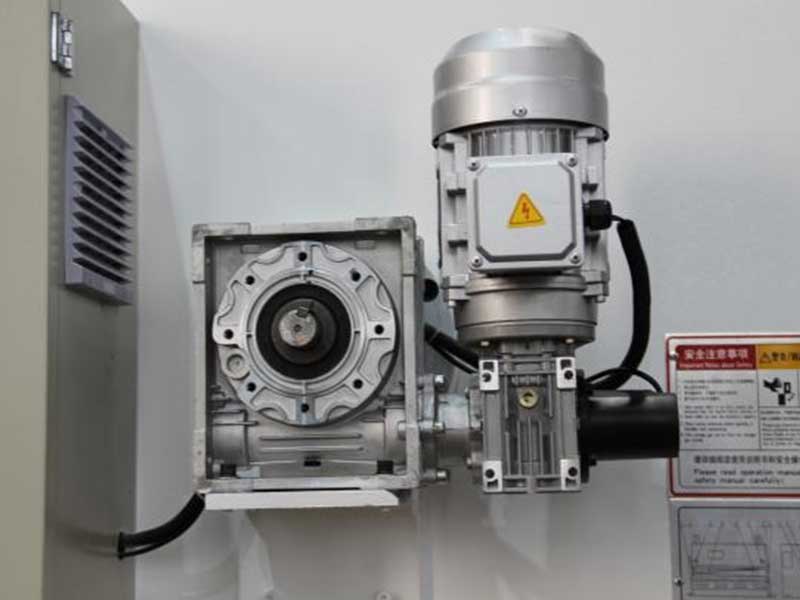
In a typical hydraulic circuit, an electric motor turns a pump, valves direct oil into synchronized cylinders, and pressure acting on piston area creates forming force. Linear scales synchronize the ram. During a dwell, the circuit maintains pressure; large cylinders can deliver and hold force through long strokes, which is why hydraulic systems remain strong for thick plate, long beds, and continuous loading.
The trade-off is that pump inefficiency, leakage, throttling, pressure drops, and oil circulation become heat. Fixed-speed pumps may continue turning between cycles. Variable-displacement pumps can destroke and reduce idle draw, but they are not completely off; motor speed is a separate design choice.
Hydraulics do not eliminate deflection: frame stiffness, cylinder placement, tooling, off-center loading, and crowning still matter. Their advantages are usable force, familiar service networks, and sustained loads when properly sized for cooling and filtration.
Servo-electric systems create force on demand through motors and mechanical transmissions
A servo-electric brake converts electrical energy into controlled rotation, then uses screws, belts, gears, linkages, or combinations of these to move and load the ram. Encoders enable rapid, repeatable stops. The main drive does not circulate oil while waiting, but holding a load may require motor torque, a brake, or a lock; “servo-electric” does not mean zero power at rest.
Fast response and repeatable positioning are valuable in thin-gauge, high-cycle work with short strokes and frequent reversals. The advantage is smaller when handling, tooling, inspection, or material waiting dominates the order.
Force must pass through motors, screws or belts, bearings, mounting points, and the ram. Long dwells and near-capacity bends increase stress and temperature; long beds require synchronized force and stiffness. Ask for force-versus-speed curves, continuous-duty limits, off-center load, stroke, opening, and load distribution. Maintenance has moved to screws, belts, bearings, gears, brakes, encoders, drives, and cooling systems.
Hybrid systems retain hydraulic cylinders but use servo-controlled pumping to meter flow on demand
A hybrid brake still contains cylinders, oil, seals, and pressure lines. Upstream, a servo motor drives the pump according to CNC demand instead of running a conventional power unit continuously and throttling most motion through valves. Hydraulic pressure still supplies forming force, preserving a broad force envelope and load holding.
Approach, forming, dwell, return, and waiting require different flow and pressure. A servo-controlled pump can slow or stop between commands, reduce throttling and heat, and sometimes support a smaller reservoir. The result depends on the circuit, not the label. Near-continuous heavy work leaves less idle loss to remove, so the system must still be rated for sustained duty.
Hybrid maintenance includes oil, filters, seals, pumps, valves, sensors, servo motors, drives, encoders, and cooling. Lower temperature and fewer pump hours are valuable, but troubleshooting and service must cover both hydraulic and electrical domains.
Classify machines by their actual motor, pump, and force-transmission architecture—not vendor labels
Terms such as “eco-hydraulic,” “servo-hydraulic,” “electric,” and “hybrid” are not enough. Require schematics, component lists, and maintenance schedules, then ask: What consumes power while the ram waits? What holds force during dwell? Is tonnage peak or continuous-duty capability? Which parts require factory-specific support? Classify the real power path and compare cold-start and sustained behavior.
Material thickness sets the force floor; tolerance, duty cycle, and part mix decide the drive
Material and bend geometry establish the non-negotiable requirements: force, working envelope, and tooling capacity. Once those gates qualify the candidates, recurring tolerances, sustained loading, and part mix separate them. A thick short part may fit a servo-electric machine, while a thinner full-bed bend in high-strength material may require a larger hybrid or hydraulic brake.
There is no universal thickness cutoff between hydraulic, servo-electric, and hybrid
Required force depends on tensile strength, bend length, thickness, die opening, radius, angle, and forming method. For air bending, a simplified relationship is:
Force = K × tensile strength × bend length × thickness² ÷ die opening
The constant depends on units and geometric assumptions. Force rises with tensile strength and length, approximately with the square of thickness, and inversely with die opening. Bottoming and coining require separate calculations, and tooling ratings may limit the process before the frame does. Use upper material limits, tooling data, and machine load charts, then validate on representative parts.
Verify capacity where force is applied. Partial-length and off-center bends can twist the ram and bed, distribute load unevenly, accelerate wear, and create angle taper. Check concentrated load, minimum loaded length, approved off-center zones, force at the required stroke and speed, and the limits of punches, dies, holders, and clamps.
Ram repeatability is only one contributor to finished-part accuracy
Position repeatability does not control springback, tensile variation, grain direction, tooling wear, flange length, deflection, backgauge accuracy, or thermal drift. A tighter Y-axis specification is valuable only when ram position drives rejects or adjustment time. Change bend depth by the claimed increment in a controlled trial and measure the angle response. If material variation dominates, angle correction and process control may produce more conforming parts than a tighter encoder.
Distinguish peak force from the load the machine must sustain throughout the shift
A demonstration bend proves that a machine can reach a force once. Production may repeat it hundreds of times, hold pressure, or alternate heavy work with short recovery. Evaluate torque, flow, temperature, cooling, transmission loading, holding method, and recovery. Record bending, dwell, setup, idle time, cycles per part, and shifts per day. The duty curve—not maximum thickness alone—exposes the fit.
Confirm that stroke, daylight, throat depth, tooling limits, and bed geometry support the intended parts
Lifecycle economics can reverse the operational winner—but only with an honest baseline
For every technically qualified machine, build one ledger:
Installed and financed cost + energy + planned maintenance + expected repairs + downtime + training and spares − residual value
Divide it by expected conforming output, not calendar years alone. Measure at the same electrical boundary with the same material, tooling, program, and auxiliaries. Separate bending, holding, idle, standby, and cooling, and count scrap and rework as consumed energy. The useful metric is kilowatt-hours per conforming part.
An “up to 80%” saving usually compares a new system with an older fixed-speed hydraulic brake; modern variable-speed hydraulics or hybrids may narrow the gap. Use the actual machine being replaced as the baseline, while checking that poor condition or operation is not giving the new machine an artificial advantage.
Let utilization determine whether efficiency can repay higher capital cost
Calculate energy by operating state:
Annual energy cost = electricity rate × the sum of hours in each state × that state’s measured kilowatts
Keep idle and active hours separate and model single-shift, expected, and credible multi-shift cases. Credit faster motion only when the shop can turn it into conforming output. Include financing, installation, service, training, demand charges where applicable, and ownership period. A seven-year energy payback does not justify a premium on a machine replaced in five years.
Compare maintenance risk profiles rather than assuming one drive is maintenance-free
Hydraulic ownership includes oil, filters, seals, hoses, valves, pumps, leaks, cooler cleaning, and heat-related wear. Servo-electric ownership shifts exposure to belts, screws, bearings, gears, lubrication, motors, drives, encoders, cooling, and power quality. Hybrid reduces pump running and heat but retains fluid-power components and adds servo electronics. Compare frequency, labor, price, lead time, and production consequence.
Service coverage can outweigh a narrow energy advantage. Ask who answers after hours, which faults are remotely diagnosable, where critical parts are stocked, how programs and parameters are restored, and what internal technicians can do. Price downtime from the real schedule, including lost contribution, labor, overtime, outsourcing, freight, and work recoverable on another brake. Rank lifecycle cost per conforming part beside credible outage cost; if they disagree, delivery exposure should decide.
Production scenarios reveal where each press brake drive earns its place
Predominantly thin-gauge, high-cycle, tight-tolerance work favors servo-electric when every part remains inside its force envelope
Short strokes, frequent backgauge moves, repeated bends, and little time near maximum force allow responsive motion and low waiting consumption to create value. Confirm that the longest recurring bend, strongest material, tooling load, stroke, daylight, bed length, and off-center limits remain within the machine’s continuous envelope. Precision still depends on material consistency, tooling, deflection control, programming, and angle correction—not the drive alone.
Mixed sheet and moderate plate with regularly recurring heavier jobs favors hybrid
When light work dominates hours but moderate-heavy work recurs too often to outsource, a hybrid can retain hydraulic-level forming capability without running a conventional power unit continuously. Test both ends of the workload. Record cycle time, energy, oil temperature, angle consistency, flange accuracy, dwell behavior, and operator intervention. The architecture earns its place only if light work avoids an idle penalty and heavy work avoids a capacity struggle.
Thick plate, long beds, and sustained high-tonnage production still favor hydraulic
A 70/30 workload with only occasional heavy parts requires an outsource-versus-ownership calculation
The denominator matters: 30% by part count may consume most brake hours, while 30% by orders may mean only a few annual bends. Compare incremental ownership cost—premium, financing, space, handling, energy, maintenance, tooling, labor, and lost light-work throughput—with outsourcing price, freight, inspection, inventory, rework, lead time, and customer risk. Own the extra capability when avoided outsourcing cost and protected production value exceed its annualized cost. Otherwise, pair a suitable servo-electric or hybrid machine with a qualified supplier.
In high-mix, low-volume shops, changeover time may outweigh differences in drive speed
Measure from the last conforming part of one job to the first conforming part of the next. Tool clamping, tool libraries, offline programming, backgauge axes, angle correction, part support, drawing interfaces, and program retrieval can matter more than ram speed. Include those features, software, tooling, training, and backups in the base quotation, and time an unstaged changeover with a normal operator.
Make each machine prove the fit on your parts before the brochure chooses the drive
One polished sample can hide a poor fit. Define the job, freeze the scoring rules, run controlled trials on actual parts, and compare complete five-year costs.
Build a weighted five-year scorecard before scheduling demonstrations
Use two layers. First, set pass-or-fail gates for force, geometry, safety, tooling, duty cycle, and part quality. Second, score the survivors. For every metric, define the unit, weight, evidence source, test method, minimum result, and whether the result becomes a contract obligation. Base weights on routing data: brake hours, setup frequency, tolerance exposure, energy, labor, maintenance, serviceability, capital cost, and the financial effect of delay or rejection. Avoid double counting items already included in cost per part.
Test the longest heavy bend, the tightest-tolerance light part, and the most frequent setup
Give every supplier identical drawings, tolerances, quantities, timing rules, inspection methods, and operator conditions. Use production-grade materials, documented thickness and grain direction, specified punch and die, clamping, bend sequence, dwell, and normal off-center conditions. Run the heavy part to representative temperature, repeat the precision part after production, and introduce ordinary variation such as a thickness change, restart, or new operator. A machine that works only while a supplier’s technician continuously corrects it has not passed.
Measure angle and dimensional spread, cycle time, setup time through the first conforming part, kilowatt-hours per conforming part, idle draw, temperature change, alarms, operator interventions, and rejected or reworked parts. Count only conforming output. More strokes with more rework is not higher throughput; it is cost moved into inspection and correction.
Normalize every quotation before comparing total cost
Issue a common bid sheet and mark every item included, excluded, optional, or supplied by the buyer. Match usable tonnage and working length, bed, stroke, daylight, throat, crowning, gauges, clamping, tooling, controls, programming, guarding, automation, part support, warranty, training, and service. If automation or special tooling is necessary to meet the demonstrated result, it is not an optional extra.
Calculate:
Five-year cost per conforming part = normalized five-year ownership and production cost ÷ forecast conforming parts
Include acquisition, installation, financing, energy, tooling, consumables, machine-dependent labor, planned maintenance, repairs, rejects, rework, and downtime consistently across all candidates. Keep support risk visible through written response commitments, parts access, internal repair capability, backup recovery, and outage exposure.
Reject any drive that misses a force, geometry, safety, duty-cycle, or quality gate. Among the survivors, servo-electric wins when recurring light precision work converts repeatability, setup behavior, and low idle demand into the best conforming-part economics. Hybrid wins when mixed-force production rewards efficient power delivery and broad hydraulic capability. Hydraulic wins when sustained heavy or long-bed output makes dependable force, thermal endurance, and service recovery worth the ownership cost.
Put successful demonstration parts, measurement methods, acceptance limits, training, service obligations, and remedies into the purchase agreement. Repeat critical tests after installation under shop conditions. Write the specification around the recurring workload, disqualify machines that miss a quality gate, and let measured cost per conforming part choose the drive.
Apply this guidance to your production
Share your material, thickness, part drawing, tolerance, and target output with the ZWCNC engineering team for an application-specific equipment review.
More news, insights, and updates from ZWCNC.
The Small Press Brake Trap: Why Servo-Electric C-Frames Are Replacing Downsized Hydraulics
Press Brake Solutions: How Rushing to All‑Electric Could Bottleneck Your Fabrication Shop

Power Plate Press Brake: How to Identify and Buy the Right Machine
Panel Bender for Job Shops: When It Beats a Press Brake
Hydraulic Press Brake Diagram: Fluid Flow, Force, and Troubleshooting