Licensed editorial adaptation
Adapted and localized by the ZWCNC Editorial Team from licensed technical material. The source record is published for traceability.
Technical boundary: confirm machine-specific capacity, configuration and safety requirements against the current quotation, manual and application review.
Walk into almost any fabrication shop that’s struggling, and you’ll spot the same scene: a pristine set of European-style punches neatly racked beside a thirty-year-old mechanical press brake. The owner just invested fifteen thousand dollars chasing the promise of elite precision, convinced that a 13mm tang would be the silver bullet for long setup times.
But tooling is a force multiplier—not a magic wand. If the underlying equation is flawed, multiplying it with higher-end components only amplifies the problem.
In many cases, the real bottleneck isn’t the punch or die—it’s the machine beneath them. An outdated mechanical press brake without modern backgauge control, repeatability, or programmable angle correction simply cannot deliver the consistency that advanced tooling is designed to support. Upgrading to a modern press brake solutions often produces a far greater return on investment than tooling alone, because it addresses the root variables: positioning accuracy, stroke control, and repeatability.
The “European Upgrade” Myth: When Precision Tooling Doesn’t Solve Setup Delays
Is your real bottleneck the tooling—or are you compensating for weak production scheduling?
Watch an operator tear down a setup to bend three brackets, only to rebuild that exact configuration two hours later for a different job. A catalog salesperson sees the downtime and pitches quick-change European tooling to shave minutes off each swap. On the surface, it sounds like a rational upgrade. But the math doesn’t lie. If your production schedule forces six punch changes per shift because you batch by assembly instead of by V-opening, faster clamps won’t rescue you. The real loss isn’t in the tooling—it’s in inefficient routing. Are you truly constrained by hardware, or are you investing in expensive bandages for a broken schedule?
The “Frankenstein” Brake: How Adapter Plates Undermine the Tolerances You Paid For
Start with a legacy American press brake—a dependable workhorse with a wide ram machined decades ago. To mount that sleek new European punch, you bolt on an adapter plate. Now consider the physics. Every additional mating surface introduces another tolerance variable. You have the ram-to-adapter interface, the adapter body itself, and the adapter-to-punch connection. You paid a premium for tooling ground to ±0.0004 inches, yet you’re stacking it onto an adapter that can deflect under load. A press brake is a rigid mechanical equation—and you’ve just inserted a floating variable. When the ram drives into a quarter-inch plate, that layered assembly shifts, and your bend angle drifts with it. Why invest in elite precision if your clamping ecosystem ensures you’ll never realize it on the shop floor?
If the goal is true precision and repeatability, the conversation must include the machine itself—not just the tooling. A modern press brake solutions with an integrated clamping system eliminates the tolerance stack-up created by adapter plates and allows European or New Standard tooling to seat exactly as engineered.
Why Treating Euro Tooling as the Default Standard Overlooks the Realities of Your Machine’s Native Ecosystem
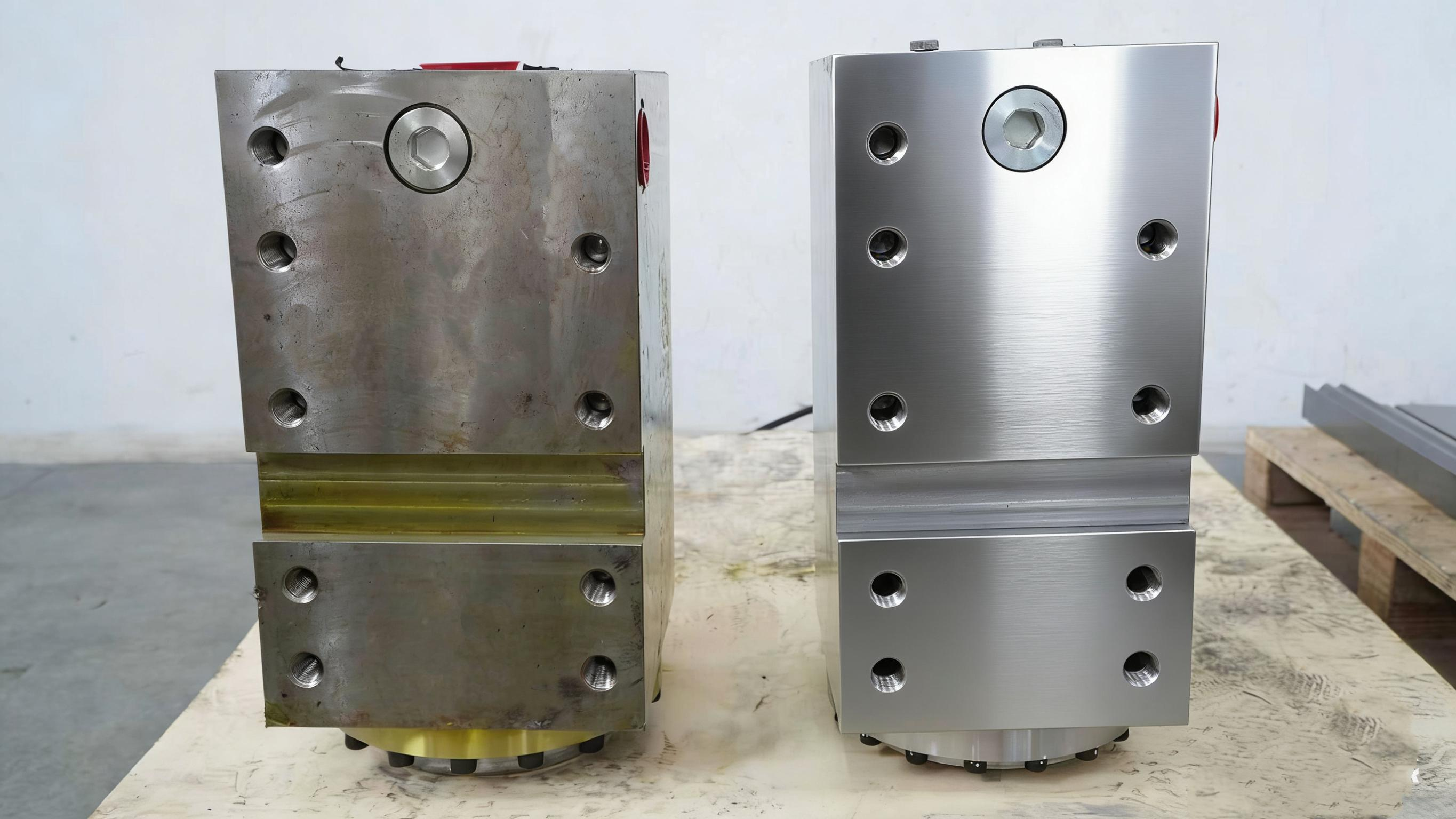
Consider the physical footprint of the tooling itself. A shop forming heavy-gauge, high-strength steel needs serious load-bearing stability. Traditional American-style tooling—or the New Standard system—features a wider, taller tang that seats deep into the ram, spreading extreme tonnage across a broad contact surface. By contrast, the European profile uses a narrow 13mm tang engineered for fast changeovers and precision work.
Force that slender tang to bottom-bend thick plate on an older brake with worn clamping surfaces, and the physics quickly turn against you. The punch wants to rock. The clamp struggles to keep it square. The operator ends up fighting the machine just to maintain a clean 90-degree bend. You can’t push a quick-change geometry into heavy-tonnage duty without respecting the mechanical limits built into its shape. So what really happens when that 13mm tang meets the unforgiving reality of high clamping forces?
The Mechanics of the 13mm Tang: Load Paths and Self-Centering in Practice
The Physics of a Slim Tang: How Euro Geometry Withstands High-Tonnage Air Bending
Take a close look at a standard European punch profile. The tang—the portion that actually inserts into the machine—is precisely 13 millimeters wide. Compared to the thick, deeply seated block of a New Standard or heavy-duty American punch, it appears almost delicate. Apply 100 tons of force to high-strength steel, and a straightforward mechanical analysis would suggest that such a narrow section should twist, fracture, or permanently deform.
Yet shops run these profiles in high-tonnage air bending every day without catastrophic failure. How does such a slim neck withstand forces that seem capable of tearing it apart?
The answer lies in a clear division of mechanical responsibility. The 13mm tang is not designed to carry the bending load; it functions strictly as a locating feature. The true force path runs through the precision-ground shoulders of the punch, which must sit perfectly flush against the underside of the ram or clamp. When the clamp engages, it draws the tang upward, pressing those shoulders firmly against the load-bearing surface. The tang’s job is simply to retain the tool, while the shoulders absorb the full compressive force of the bend.
This division of labor is an elegant engineering solution—but it creates a serious vulnerability on the shop floor. If your machine’s clamping surfaces are worn, pitted, or layered with decades of scale, the punch shoulders cannot seat perfectly flat. The instant that full contact is lost, the tonnage has nowhere to transfer except directly into the delicate 13mm tang. The tool begins to rock, the tang digs into the clamp, and the precision you invested in dissolves into mechanical deflection. If the tang’s survival depends entirely on the integrity of the clamping surface above it, how does the system ensure that the punch and die remain properly aligned below?
Self-centering dies: Eliminating traditional American alignment failures—and where operator technique still matters
Watch an operator set up a traditional American press brake. They hang the punch, position the die block, bring the ram down to lightly trap the tooling—then reach for a brass hammer. A few taps left or right, tighten the set screws, and hope nothing shifts when full pressure is applied. The process relies on friction, intuition, and a bit of luck. European and New Standard systems eliminate this ritual through self-centering geometry. The 13mm tang seats into a precision clamp, the die drops into a matching V-groove, and the moment the hydraulics engage, the system forces true vertical alignment.
On paper, it sounds like a clean, rational upgrade.
But tooling is a force multiplier—not a cure-all. Self-centering geometry addresses vertical alignment only. In quick-change 1V or 2V die setups, the die segments rest inside a holder and depend on horizontal clamps to prevent separation or lateral movement under heavy tonnage. An operator who trusts the self-centering punch yet neglects to secure the horizontal die clamps will see the tooling creep apart during a demanding bend. The punch descends perfectly straight, but the unsecured die shifts outward, changing the V-opening mid-bend. You can purchase the most accurate vertical alignment available, but it means little if the horizontal mechanics of the die block are ignored.
Offset vs. center-aligned: Which geometry is more forgiving on older, deflecting ram beds?
Take a straightedge and lay it across the bed of a twenty-year-old press brake. If that machine has spent decades forming heavy brackets at the center of the ram, you’ll likely measure a permanent bow—three to five thousandths of an inch. When shops attempt to modernize equipment like this, they often retrofit European offset tooling. Unlike center-aligned American or New Standard systems, many European designs rely on offset holders that stabilize the punch by shifting the bending force slightly to the right of the holder rather than driving it straight down the centerline.
On a pristine, perfectly flat machine, that offset geometry keeps the tool rigid and predictable. On a ram that already deflects, however, it becomes a structural weakness. As tonnage increases and the bowed bed begins to flex, the off-center load amplifies the twist. The force is no longer traveling straight up through a centered tang; it’s pushing laterally against a 13mm tang that is already struggling to maintain full shoulder contact on a distorted surface. When the ram descends onto quarter-inch plate, the entire stack shifts—and your bend angle follows it.
Offset geometry will not compensate for machine deflection. The 13mm tang depends on a rigid, geometrically true environment to perform as precisely as the catalog claims. If the bed is bowed, the tang tilts, the shoulders lose contact, and your premium tooling can underperform the blunt American iron it replaced. In high-tonnage environments, some manufacturers instead deploy a press brake solutions configuration to distribute load across two synchronized machines, reducing localized deflection and preserving alignment under extreme force.
Euro Promecam vs. New Standard: The High-Mix Battleground
Retention Under Failure: The Safety Button vs. the Hydraulic Pin in a Tool Drop Scenario
When a 30-pound gooseneck punch slams into a hardened die bed, it sounds like a gunshot—and the damage can rival the cost of a used car in lost uptime and tooling replacement. In the European Promecam system, your only safeguard against gravity during a tool change is a small, spring-loaded safety button that protrudes from the 13mm tang. It’s a binary mechanism: either the button snaps into the clamp’s safety groove, or the tool becomes a falling hazard. Over years of high-mix changeovers, those springs fatigue. Worse, some operators bypass the system entirely, depressing the button with a screwdriver to speed up installations. When the spring weakens or the click is missed, there is no backup catch. The tool drops—period.
New Standard systems eliminate this fragile, spring-loaded button and replace it with a continuous safety groove paired with a hydraulic or pneumatic locking pin. Rather than relying on a single point of failure, the clamp deploys a pressurized bar or multiple pins that engage the full length of the tool’s tang. If an operator forgets to lock the clamp, the tool doesn’t instantly drop; it rests on the engaged pins, buying the technician a critical moment to catch the mistake. On paper, it’s a clear and rational upgrade. But tooling amplifies capability—it doesn’t perform miracles. The tradeoff for this hydraulic safety net is a clamping system that can cost up to three times as much as a conventional Euro-style manual setup.
From a mechanical standpoint, European safety buttons prioritize speed, while New Standard pins are engineered for mass and stability. If you’re running light 20-gauge stainless, a dropped tool is an inconvenience. If you’re handling 80-pound sectionalized punches for heavy plate work, that same safety button becomes a serious risk. The question is whether the physical design of the tang does more than simply suspend the tool in place.
Reversible vs. unidirectional designs: Does one configuration actively reduce operator loading errors?
Hold a European punch up to the light and you’ll notice the tang is typically offset, with the safety button accessible from only one side. The result is a unidirectional tool. When an operator needs to form a deep return flange that requires the punch to face the “wrong” direction, they often end up wrestling with the clamp geometry. In a high-mix environment, this “directionality tax” means extra minutes spent managing tool orientation instead of focusing on part geometry. And if someone forces a Euro tool in backward, the safety button won’t engage and the 13mm tang won’t seat correctly against the load-bearing shoulders.
New Standard tooling, by contrast, is almost always symmetrical. The tang is centered, the safety grooves are mirrored, and the tool performs the same whether it faces the operator or the backgauge. This design effectively removes loading orientation as a source of error. An operator can flip a punch in seconds to clear a complex flange without second-guessing whether the tool remains secure or whether the center of pressure has shifted. It’s a system designed for the realities of a busy shop floor—where a backward-loaded Euro tool can mean a shattered tang the moment the ram delivers 50 tons of force.
When the ram descends onto a piece of quarter-inch plate, any play in that stacked assembly reveals itself immediately—your bend angle begins to drift if the tool isn’t perfectly centered. The European system’s lack of reversibility isn’t merely inconvenient; it’s a built-in geometric limitation that influences how you design your parts in the first place. If the geometry is supposedly foolproof, why does the 13mm tang continue to dominate in shops that regularly form heavy plate?
Thick Plate vs. Thin-Gauge Agility: Where the New Standard’s Wider Tang Delivers Real Flexibility
The European Promecam holder is fabricated from 14 mm plate steel, effectively capping production capacity at 100 tons per meter. Attempt to air-bend half-inch plate over an 80 mm V-opening, and you’re no longer just stressing the tool—you’re approaching the mechanical yield limit of the holder itself. In this equation, the 13 mm tang is the bottleneck. Its narrow profile requires an equally slim holder throat, restricting how much structural mass the machine can dedicate to supporting the punch.
The differences between the European 13 mm tang and the New Standard tang become clearer when compared directly:
| Feature | European Promecam (13 mm Tang) | New Standard (20 mm+ Tang) |
|---|---|---|
| Tang Width | 13 mm | 20 mm or more |
| Holder Construction | 14 mm plate steel | Substantially heavier holder design |
| Typical Load Capacity | Up to 100 tons per meter | 200–250 tons per meter |
| Structural Rigidity | Limited by narrow throat | Increased mass and rigidity |
| Performance with Heavy Plate | Approaches mechanical yield limits | Confidently handles 10-gauge to 1/2-inch plate |
| Resistance to Side-Loading | Restricted by slim profile | Absorbs high side-loading forces effectively |
| Best Application Range | 18-gauge and thin materials | Mixed production including heavy plate |
| Long-Term Investment Impact | Lower upfront cost; may require additional machines or specialized holders | Higher initial investment; reduces need for secondary upgrades |
The European 13 mm tang excels in light-gauge environments where weight and rapid tool changes matter most. However, when production expands to include heavy plate and high-strength materials, the added 7 mm of steel in the New Standard tang becomes structurally decisive rather than cosmetic. When bending demands move beyond the thin-gauge comfort zone, the wider, reversible New Standard tang shifts from being a premium option to a practical necessity.
The Break-Even Point: Matching Your Tooling Ecosystem to Production Reality
You see the European 13mm tang’s sectionalized architecture, its self-seating safety grooves, and the promise of eliminating operator alignment errors. On paper, it feels like a clean, logical upgrade. But tooling is a force multiplier—not a magic wand. The benefits of quick-change geometry only emerge if your machine can physically absorb and distribute the load, and if your production schedule genuinely demands rapid changeovers. Evaluate tooling as a standalone purchase instead of as part of a hard mechanical equation—one that includes your clamping system and setup frequency—and you’re stepping blindly into a capital trap.
Mapping your part mix: Why high-volume, low-mix runs turn the European style into expensive overkill
The European tooling ecosystem was engineered to solve a specific problem: the time operators lose wrestling with long, heavy tools during high-mix production days. The 13mm tang lets a technician snap a 100mm sectional punch into the clamp, seat it instantly, and move on to the next bend profile. If your floor runs six or more setups per shift, that time savings compounds by the hour.
But what if your schedule is built around low-mix, high-volume production?
If an operator spends three straight days repeating the same 90-degree bend on 16-gauge brackets, setup time shrinks to nearly zero as a percentage of total output. The quick-change advantages of the European tang sit idle. You’ve bought a precision agility tool for a marathon workload. In this environment, catalog claims of efficiency collapse under real shop conditions. You’re paying a premium for modularity you use twice a week—while accepting the roughly 100-ton-per-meter load limits that come with the slimmer European holder throat.
You’re spending extra to solve a bottleneck that isn’t there.
To justify the European system, your job mix must be volatile enough that changeovers are the primary constraint on throughput. If they aren’t, the direct force path and lower upfront cost of standard American tooling will outperform it in any honest ROI calculation.
The retrofit equation: Upgrade your clamping system—or invest in a Euro-native press brake?
Owners often look at an aging American-style hydraulic press brake and assume they can unlock European-level precision simply by bolting on adapter plates. This is where the physics of the machine rejects compromise—decisively.
Adapters consume open height. Every inch of steel inserted between the ram and the tool permanently reduces the working space between the ram and the bed. Retrofit the machine today, and tomorrow a job calls for a deep 120mm V-opening to form a tall return flange—you may find the part simply won’t clear. You’ve effectively paid to shrink your machine’s physical capability.
Worse still, you’ve added a new tolerance stack-up. The precision advantage of the European system depends on a direct, rigid interface between the holder and the tang. Insert an adapter plate, and you introduce a secondary mechanical joint. When the ram descends onto quarter-inch plate, that layered assembly can shift, and your bend angle begins to drift. The clamping mechanism can’t enforce alignment if the structure beneath it is compromised. If you want the speed and accuracy of the European ecosystem, partial adoption makes little economic sense; the only rational move is investing in a Euro-native machine with fully integrated clamping geometry.
For shops evaluating whether to retrofit or replace, reviewing detailed machine specifications and capacity charts can clarify the real constraints. You can download technical brochures to compare open height, clamping styles, and tonnage ratings before committing capital.
The final diagnostic: Choose based on your real bottleneck (precision, speed, or capital budget)
Run the hard numbers on your own shop floor.
If your true constraint is speed during high-mix production days—and your operators are skilled but bleeding hours on tooling changeovers—the modularity of the 13mm tang can pay for itself within a fiscal year. If precision is the limiting factor, understand that accuracy depends on the clamping system’s ability to seat the tool perfectly every time. That level of repeatability requires a native holder, not a retrofitted workaround.
But if capital budget is your bottleneck, mixing standards becomes a slow-motion failure. Buying European punches without the matching dies, native holders, and compatible machine geometry creates inventory confusion and all but guarantees you’ll never realize the promised ROI. Stop treating tooling as a brand-name upgrade. Analyze your setup frequency, measure your available open height, and invest in the exact geometry your machine’s mechanical physics can genuinely support. When you’re ready to align your tooling strategy with the right machine platform, it’s worth speaking directly with an application engineer—contact ZWCNC to discuss your production mix and tonnage requirements.
Apply this guidance to your production
Share your material, thickness, part drawing, tolerance, and target output with the ZWCNC engineering team for an application-specific equipment review.
More news, insights, and updates from ZWCNC.
Hydraulic Clam.png)
Quick-Change Press Brake Tooling: Reduce Setup Time
Press Brake Die and Punch Selection Guide
The Press Brake Technology Trap: Why Defaulting to Hydraulic Is Costing Your Shop Precision and Profit
Why Universal 4‑Way Press Brake Dies Fail in Real Production
Mastering Offset Press Brake Dies: Achieving Precision Z-Bends in a Single Stroke