
Licensed editorial adaptation
Adapted and localized by the ZWCNC Editorial Team from licensed technical material. The source record is published for traceability.
Technical boundary: confirm machine-specific capacity, configuration and safety requirements against the current quotation, manual and application review.
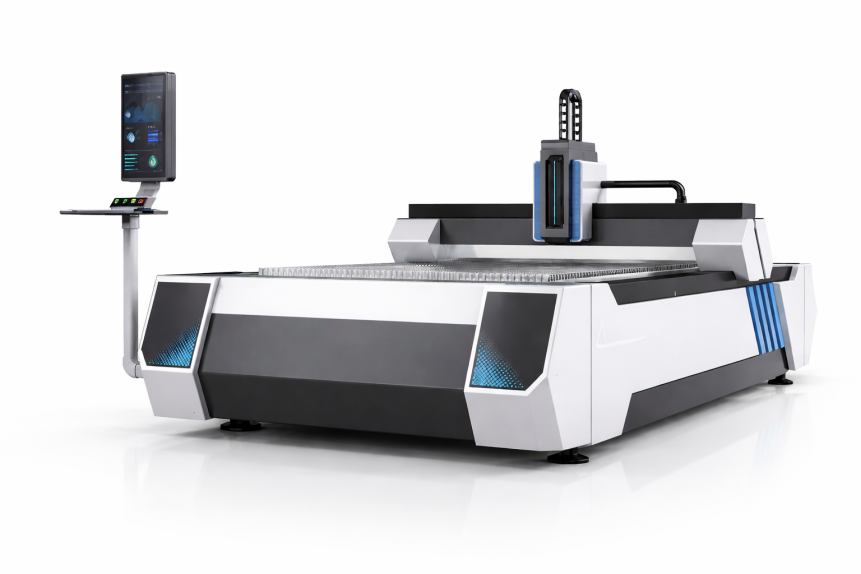
Step into any modern makerspace and you’ll see a laser cutter gliding through plywood as if it were slicing butter. In industrial workshops, that same principle powers advanced systems such as the laser cutting machines and the laser cutting machines, delivering the precision and efficiency that define today’s manufacturing landscape.
One might point to a factory floor in 1965. Another will bring up a diamond pierced by a beam of light in 1963. A physicist may sigh and rewind the story all the way back to a chalkboard in 1917. And the surprising part? They’re all correct.
The Myth of the Single “Eureka” Moment
We’re drawn to tidy origin stories—the apple falling on Newton’s head, a key struck by lightning, a lone inventor tinkering in a garage. But industrial technologies rarely emerge in one dramatic flash of insight.
Why History Books Cite Three Different Years for the Same Invention
In 1963, scientists at Bell Labs used concentrated light to blast a microscopic hole through a diamond—a stunning proof of concept. Yet records show that the first commercial laser cutting machine appeared two years later, in 1965, developed by Western Electric. Open a physics textbook, and the origin shifts again—back to Einstein in 1917. How can one invention have three birthdays?
We tend to picture innovation as a single inventor unveiling a finished product. But when a breakthrough demands advances in quantum theory, optical engineering, and heavy industrial design, no one person—or moment—can claim the whole story. The timeline splinters because historians are tracking different milestones. The real question is: which milestone truly marks the beginning?
The Real Source of Confusion: Are We Talking About the Math, the Beam, or the Machine?
Pinpointing the true birth year of this technology depends entirely on what you consider its origin: the mathematical blueprint, the first concentrated flash of light, or the fully engineered machine. Imagine its evolution as a vast, 50-year industrial conveyor belt. At the very beginning, a theoretical physicist drafts a schematic describing how light might behave under specific conditions. Decades later, another team transforms that abstract theory into a tangible, luminous beam. Further down the line, engineers mount that beam onto a gantry, amplify its power, and harness it to slice through steel.
So when you ask for the birth date of the laser cutter, you must first decide which station on the assembly line counts as the beginning. The mathematics established the rules. The early beams delivered the proof. The factory floor produced the machine. How you separate these stages fundamentally shapes your understanding of how technological progress actually unfolds.
Why "the laser cutter" has no single birth date—and why that matters more than you think
When we compress decades of experimentation, setbacks, and incremental refinement into a single date, we distort the true nature of innovation. A ruby laser in 1960 could scarcely heat a piece of metal—cutting it was out of the question. It took a separate group of researchers, pivoting to CO2 gas in 1963, to generate enough sustained power to melt material effectively.
The laser cutter was not a sudden breakthrough or a solitary flash of brilliance. It was a relay race. Each advance passed the baton to the next. Recognizing this progression dismantles the myth of the lone genius and replaces it with a more accurate picture: transformative leaps in manufacturing are built from countless determined steps taken across generations. To understand how a beam of light ultimately came to slice through solid steel, we must return to the theoretical starting line and meet the first runner.
1917: Einstein Writes the Mathematics That Makes "Cutting with Light" Possible
How a Theoretical Physicist Unintentionally Laid the Foundation for a Manufacturing Revolution
When Albert Einstein published his landmark paper on radiation, he pointedly titled it "On the Quantum Theory of Radiation." That modest preposition—"On"—was a significant concession. He was signaling to his peers that he did not yet possess a complete theory. After all, he wasn’t trying to invent a machine that could slice through sheet metal; he was wrestling with a stubborn equation describing how atoms behave inside a heated cavity.
Einstein realized that if he relied solely on the established laws of physics, the energy flowing into an atom did not match the energy flowing out. The books wouldn’t balance. To resolve this discrepancy, he proposed an entirely new mechanism for how atoms interact with light. In doing so, he inadvertently laid the conceptual groundwork for modern manufacturing. So what was this new atomic behavior he had to invent to make his equations come out right?
Stimulated emission: The theoretical green light for everything that followed
Imagine an atom as a tightly wound spring, brimming with stored energy. Left undisturbed, it will eventually snap open and release that energy as a random burst of light. Physicists call this spontaneous emission—the phenomenon that makes a standard lightbulb radiate in all directions.
But in 1917, Einstein identified a striking alternative. He proposed that if a particle of light—a photon—struck the energized atom before it released its energy on its own, it could trigger the release prematurely. The atom would emit a second photon perfectly matched to the first in color, direction, and phase. One photon enters; two identical photons exit.
It’s like a precision stamping press on an assembly line: a single master template feeds into the machine, and the mechanical force produces an exact replica, perfectly aligned with the original.
This phenomenon became known as "stimulated emission." It provides the "S" and the "E" in the acronym L.A.S.E.R. By demonstrating that light could, in effect, be cloned, Einstein issued the theoretical green light for a beam intense enough to cut through steel.
Yet a serious limitation lurked within his elegant equations. As Einstein himself acknowledged, his mathematics relied entirely on probability to determine the direction the emitted light would travel. If the theory showed that light could be replicated, why couldn’t anyone construct a device capable of controlling it?
The 43-year gap: Why the mathematics didn’t immediately become a machine
In 1927, physicist Paul Dirac finally calculated the precise mathematical rate at which an atom spontaneously emits light. His breakthrough arrived a full decade after Einstein’s original paper. The long gap between theory and application was not due to weak engineering—it reflected incomplete physics. Einstein had constructed his model on daring, almost improvised assumptions, borrowing statistical tools from classical physics and applying them to the strange new realm of quantum mechanics simply to make the equations balance. While his work demonstrated that stimulated emission must exist, it offered no reliable way to determine how quickly it would occur or how to control it. The blueprints were there—but the critical measurements were missing.
Where we begin the story depends on what we consider the true starting point: the mathematical proof or the first physical beam.
You cannot manufacture an industrial-strength tool from a theory riddled with uncertainty. For decades, stimulated emission remained an elegant mathematical curiosity because no one knew how to corral the cloned photons it described. They were multiplying, yes—but dispersing aimlessly into space. To transform abstract equations into a cutting-edge instrument, someone had to learn how to confine those multiplying photons within a cavity and compel them to travel in lockstep, moving together in a single, disciplined direction.
1960: Theodore Maiman Builds a "Solution Looking for a Problem"
On July 7, 1960, Hughes Aircraft called a press conference to announce that a 32-year-old physicist had succeeded in trapping light. Theodore Maiman unveiled a device small enough to sit in the palm of his hand. Yet researchers at the esteemed Bell Labs met the news with deep skepticism. Maiman’s first academic paper had been rejected for lacking key technical details, forcing competitors to scrutinize newspaper photos just to estimate the size and structure of his prototype. The obvious question lingered: how, exactly, had he managed to confine the light?
When theory became hardware (and why this moment feels like the true invention)
Maiman built his device around a one-centimeter cylinder of pink ruby, tightly encased within a spiraled quartz flash tube like those used in high-speed photography. When the tube discharged, it flooded the ruby with an intense burst of white light, exciting the chromium atoms embedded in the crystal. As those atoms released their energy, photons ricocheted between mirrors silvered onto each end of the rod, replicating in perfect copies just as Einstein had predicted 43 years earlier. The light amplified with each pass until it finally escaped through the partially silvered mirror as a focused, coherent beam.
If Einstein had drawn the blueprints, Maiman assembled the first working engine block—a mechanism that transformed raw energy into a tightly controlled output. But what, precisely, was this engine made of?
Whether 1960 truly marks the beginning depends on what you consider the birth of the laser: the first fleeting burst of concentrated light, or the arrival of a continuous, industrial-grade cutting tool. That distinction raises a sharper question—why did Maiman build his machine from a gemstone rather than follow the prevailing technical playbook?
Why the first working laser relied on a solid ruby crystal instead of gas
In 1959, physics heavyweight Arthur Schawlow publicly insisted that pink ruby would never function as a laser medium. The scientific establishment was fixated on gas—specifically potassium vapor. Schawlow and his collaborator Charles Townes had even filed a 1958 patent for a gas-based design. Meanwhile, one of Maiman’s own trainees calculated ruby’s quantum efficiency at a discouraging 1 percent: for every 100 photons pumped into the crystal, just one would emerge as useful laser light. Why defy the consensus to build a device that seemed destined to waste 99 percent of its input?
Maiman consciously declined the direction Schawlow and Townes were steering the field. He saw that gas systems were too temperamental to confine and energize with the crude technology available at the time. A solid crystal, though theoretically inefficient, was dense enough to confine the ricocheting photons and sturdy enough to withstand the violent electrical surge of a photographic flashlamp. He traded theoretical elegance for a rugged, brute-force solution. But what are the consequences of building an engine from a material that converts only 1 percent of its fuel into output?
The “Death Ray” letdown: Why Maiman’s ruby laser couldn’t cut steel
When Maiman finally activated his ruby laser on May 16, 1960, it did not emit a steady, blazing beam. Instead, it released a microscopic burst lasting only 300 millionths of a second. The ruby crystal absorbed so much excess heat from the flashlamp that it would literally crack apart if operated continuously. After each microsecond pulse, it had to pause and cool. The obvious question lingered: could such fleeting flashes ever power real manufacturing?
If it was a beautifully crafted hammer with a glass handle—dazzling in the laboratory yet too fragile to strike steel—what practical purpose did it serve?
The press hailed it as a "death ray," but in reality the device could barely burn a microscopic pit in a razor blade—far from slicing cleanly through industrial sheet metal. As some of Maiman’s own colleagues quipped, it was a "solution in search of a problem." Cutting metal requires more than a pulse; it demands a steady stream of heat capable of melting material along a continuous path. So how do you create a beam that doesn’t switch off?
1963: Kumar Patel Discovers the Invisible Beam That Could Truly Melt Metal
Late one evening at Bell Labs, a 25-year-old electrical engineer watched a thermal power meter climb beyond 10 watts of continuous output. In that moment, Patel (1963) broke through the ruby crystal’s microscopic, microsecond ceiling.
Whether you mark this night as the true birth of the modern laser tool depends on your definition: was it the raw, invisible beam itself, or the automated system that would later steer it? Imagine the laser cutter’s evolution as assembling a massive industrial machine on a factory floor. Earlier physicists drew the schematics and built a sputtering starter motor; Patel installed a continuous, high-horsepower engine. But if solid crystals had already proven they could confine light, why abandon them?
What fatal flaw in the ruby laser drove Patel to experiment with CO2?
Ruby lasers faced a fundamental thermal barrier. Pump enough electrical energy into the solid crystal to sustain a continuous beam, and the crystal would trap the excess heat, overheat, and ultimately fracture. A beam that never turns off requires a medium that does not retain heat like stone. Patel turned to gases. Early gas lasers—such as the helium-neon tubes developed a few years earlier—could operate continuously without destroying themselves.
They simply didn’t deliver enough power to matter.
Those early gas lasers delivered mere fractions of a milliwatt—bright enough to dot a chalkboard, but nowhere near powerful enough for the factory floor. Patel saw a different path forward. Instead of exciting individual atoms drifting in a gas, why not energize entire molecules? Molecules such as carbon dioxide (CO2) vibrate and rotate, providing an entirely different mechanism for converting energy into photons. The real challenge was scale: how do you draw enormous power from a medium as diffuse and weightless as gas?
The efficiency gap: Why this invisible beam made industrial cutting economically viable
In manufacturing, efficiency isn’t a technical detail—it’s the bottom line. Maiman’s ruby laser ran at about 1% efficiency. Feed 10,000 watts of electricity into a 1% efficient ruby system and you get just 100 watts of light, along with 9,900 watts of waste heat—more than enough to destroy the machine itself. Channel that same 10,000 watts into a CO2 laser, however, and you can generate up to 2,000 watts of usable cutting power—sufficient to vaporize steel in an instant—while the circulating gas carries away excess heat with ease.
Patel achieved this remarkable 20% efficiency by transforming the gas mixture into what was essentially a molecular bucket brigade.
He found that nitrogen molecules are excellent energy reservoirs: they readily absorb electrical energy without immediately releasing it as light. When nitrogen was mixed with carbon dioxide, energized nitrogen molecules collided with CO2 molecules, transferring their energy directly and with exceptional efficiency. This steady handoff triggered a cascading surge of high-powered photons. But if this new beam was so extraordinarily powerful, how could anyone safely operate a tool they couldn’t even see?
If the CO2 beam is completely invisible to the human eye, how can you tell it’s working?
The CO2 laser emits light at a wavelength of 10.6 micrometers—deep in the infrared. It produces no visible glow whatsoever. When Patel first activated his high-powered gas mixture, there was no brilliant red streak cutting across the lab to signal success. Instead, he aimed the device at a firebrick. The unseen beam struck the surface, and the ceramic flared white-hot, beginning to melt almost instantly.
At last, the raw power was there.
A beam capable of melting firebrick and steel is no laboratory curiosity—it’s a true industrial blade. Yet an invisible ray that can sear flesh cannot be gripped by hand or guided by a technician peering through safety goggles. You may have a cutting beam, but you don’t yet have a practical cutting tool. So how do you rein in an unseen force that melts everything it touches?
1965–1967: Western Electric, Boeing, and the Leap to the Factory Floor
1965: Why a Telephone Company Became the First Business Desperate Enough to Need a Laser Tool
In the mid-1960s, producing the microscopic gold wire used in early semiconductor packaging meant pulling raw metal through an almost impossibly small hole drilled into a diamond die. Diamond, the hardest material on Earth, does not yield easily. To create that tiny aperture, technicians relied on steel pins coated with diamond dust, grinding for as long as 24 hours to bore through a single stone.
Meanwhile, the telecommunications boom was devouring wire at an unprecedented rate. Mechanical grinding simply could not keep pace with the explosive growth of the silicon age. By 1965, Western Electric needed something close to a miracle—a radically faster way to punch microscopic holes through diamond.
Their solution was counterintuitive. Instead of adopting the newly developed continuous-wave CO2 laser, they turned to the ruby laser—the same pulsed technology many physicists had dismissed as little more than a laboratory curiosity. For Western Electric’s purposes, a continuous beam was unnecessary. What they needed was not a steady slicing tool, but a microscopic, explosive hammer blow.
Imagine the previous 50 years of laser research as the gradual assembly of a massive industrial machine: earlier scientists drafted the blueprints and built the engine. Western Electric was the company that finally bolted that optical engine onto a rigid, motorized frame. They integrated closed-circuit television monitoring, protective enclosures, and precision part-handling systems. The result? An operator could blast a clean hole through diamond in just 15 minutes—without risking blindness in the process.
A raw physics experiment had, at last, been transformed into a practical industrial workstation.
Drilling Diamond Wire Dies: When Does a High-Tech Hole Punch Officially Become a “Cutter”?
Determining the true “invention” date of this diamond-drilling system depends on your definition of cutting. Are we talking about a machine that punches stationary holes, or one that draws a continuous slice through metal?
The Western Electric apparatus was a spectacular hole punch. But try sliding a sheet of metal beneath its pulsing ruby beam and you would not produce a smooth seam. Instead, you would get a ragged trail of overlapping craters.
Genuine cutting demands a continuous, melting beam—like that of a CO2 laser—moving steadily across a surface. Yet when early engineers attempted to drag a CO2 beam across steel, they encountered an unforgiving physical reality. The laser melted the metal flawlessly, but the molten steel pooled in the groove, cooling and resolidifying as soon as the beam passed.
You cannot cut if the material refuses to clear the path. So the critical question became: how do you sweep away a microscopic trench of liquid fire?
1967: Boeing’s Titanium Challenge and the Invention of Gas-Assisted Cutting (the Final Missing Ingredient)
The breakthrough did not come from an American aerospace powerhouse, but from a British welding laboratory. In 1965, Houldcroft at the UK’s Welding Institute took a 300-watt CO2 laser and fitted it with a specially designed nozzle that directed a high-pressure jet of oxygen straight down the beam’s path. This "gas assist" accomplished two critical tasks at once: the force of the gas expelled molten slag from the bottom of the cut, and the oxygen initiated an exothermic reaction with the steel—essentially causing the metal to burn and accelerating the cutting process.
By 1967, Boeing had adopted and refined this same coaxial gas technique to cut through tough, highly reactive titanium for aerospace production. What began as a laboratory innovation became an industrial solution.
The lone-genius narrative likes to crown Boeing as the sole inventor of the laser cutter. Reality is far more complex. The finished machine depended on a pulsed ruby laser to validate the concept, a continuous CO2 beam to supply sustained power, and a British-designed oxygen nozzle to clear away molten slag. Only when these elements came together did the technology truly become viable. What remains are scattered blueprints and milestones—and the question of which one truly marks the finish line.
The Final Verdict: Which Date Deserves a Place in Your History Report?
If you are staring at a blank page, trying to choose a single year for your history report, frustration is almost guaranteed. The lone-genius myth demands a singular lightbulb moment. Real industrial progress, however, is a multigenerational relay race.
Tracing this timeline is like examining a welded joint: you must understand each overlapping layer of molten metal to see how the structure holds. The right answer depends on separating three distinct achievements—the theoretical physics, the development of a powerful continuous beam, and the engineering of workable hardware.
So where, exactly, do you draw the line?
For a physics timeline: 1917 (theory) or 1960 (the first working laser)
If your course centers on the fundamental laws of physics, your timeline concludes long before a laser ever reaches a production line. In 1917, Einstein drafted the conceptual blueprint—decades before any hardware existed—by mathematically demonstrating that atoms could be stimulated to emit synchronized photons. But a blueprint cannot cut steel. It wasn’t until 1960 that Theodore Maiman persuaded a synthetic ruby crystal to emit a pulse of coherent red light, proving Einstein’s theory worked in practice. Still, if the physics were settled by 1960, why couldn’t anyone immediately turn that breakthrough into a practical industrial tool?
For manufacturing history: 1963 (CO2 power) or 1965/1967 (production-ready machines)
A brilliant red pulse is a scientific milestone, but factories run on sustained, relentless power. That leap came in 1963, when C. Kumar N. Patel invented the CO2 laser. By replacing solid crystals with an energized gas medium, he created a continuous, invisible beam powerful enough to melt refractory brick—delivering the raw energy industry required.
But a beam hot enough to melt brick is still just a controlled blaze without direction.
Transforming that blaze into a precision tool required mechanical engineering. In 1965, Western Electric mounted an optical system onto a motorized platform to drill diamond wire dies—demonstrating that lasers could function reliably on the factory floor. Then, in 1967, Peter Houldcroft introduced the crucial refinement: an oxygen-assist nozzle that expelled molten slag from the cut. That innovation enabled Boeing, the same year, to slice clean, continuous paths through aerospace-grade titanium. At that point, had the machine finally come together?
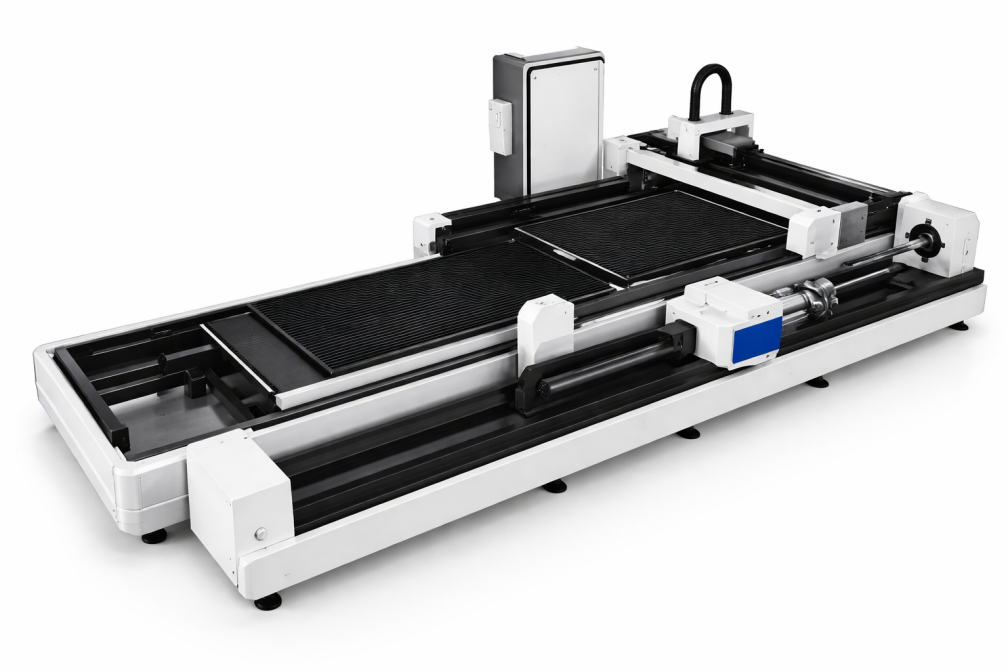
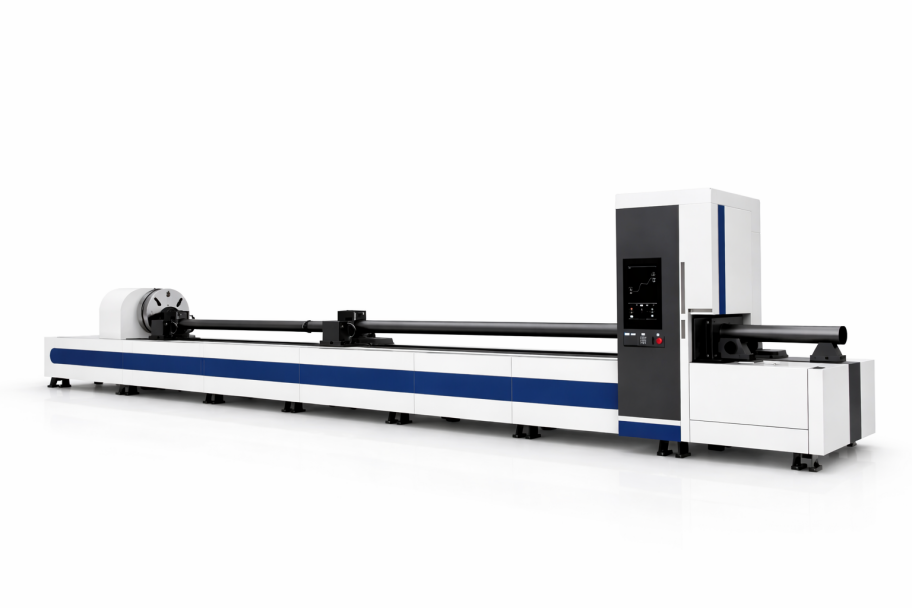
Today, those once room-sized systems have evolved into compact, high-precision industrial platforms such as the laser cutting machines for streamlined sheet processing and the laser cutting machines capable of handling both sheet and tube materials in one integrated setup—direct descendants of the milestones described above.
The purist vs. the pragmatist: A practical framework for choosing the right date in your context
Not entirely. To evaluate your history paper, a teacher needs to know what milestone you consider decisive. A purist will point to 1960, arguing that the moment a coherent beam of light was first generated, the laser cutter existed in principle. A pragmatist will dismiss that view, insisting that a tool doesn’t truly exist until it performs the task it was designed to do.
It’s like asking whether the stamping press was invented when the hydraulic ram was assembled—or when it crushed its first car fender.
For the pragmatist, the true date of invention hinges on what you’re actually referring to: a stationary hole-punching device or a continuous cutting system. If you mean the first moment a laser replaced a mechanical drill on a factory floor, mark down 1965. If you’re thinking of the first clean, gas-assisted cut drawn through sheet metal, then 1967 is your answer. But what happens when we compress that sweeping industrial history into a machine that fits on your desk?
How This Timeline Reshapes Our View of Modern Desktop Lasers
Today, you can purchase a desktop diode laser for a few hundred dollars, connect it to your laptop, and cut plywood in your garage. It appears to be a sleek, self-contained appliance. Yet beneath that plastic housing lies the compression of a vast, multi-ton industrial system into something no larger than a microwave. The software mapping your toolpath depends on the mathematics of stimulated emission first described in 1917. The invisible beam that chars the wood traces its heritage to the high-powered gas lasers of 1963. The small air-assist pump clearing smoke from the lens descends directly from the British welding nozzle introduced in 1967. When you press “start” on a modern machine, you’re not merely switching on a beam of light—you’re setting a century of accumulated human insight into motion.
If you’d like to explore detailed technical specifications, configurations, and application scenarios for modern industrial systems, you can review the official product brochures or directly contact ZWCNC for tailored recommendations based on your production needs.
Download the Infographic With High Resolution
Apply this guidance to your production
Share your material, thickness, part drawing, tolerance, and target output with the ZWCNC engineering team for an application-specific equipment review.
More news, insights, and updates from ZWCNC.
Laser Welding Aluminum: How to Produce Strong, Clean Welds
Laser Welding Machine Types: How to Choose the Right System
Fiber Laser Cutting for Kitchen Equipment: Parts, Quality, and Cost

Types of Fiber Laser Cutting Machines: Selection Guide
Laser Cutting Machine Advantages and Disadvantages: Precision, Costs, and When to Choose Alternatives