
Licensed editorial adaptation
Adapted and localized by the ZWCNC Editorial Team from licensed technical material. The source record is published for traceability.
Technical boundary: confirm machine-specific capacity, configuration and safety requirements against the current quotation, manual and application review.
A press brake can stand ready while its operator searches for the next pallet, checks a drawing revision, or finds the correct tooling. A robotic cell may move parts faster and more consistently, but faster handling will not solve a job-readiness problem. If the ram is waiting for material, programs, tools, inspection, or scheduling decisions, the robot will wait too.
This is why the choice between a robotic press brake and a manual CNC press brake should begin with a production diagnosis—not an automation label. The right system is the one that widens the narrowest point in the flow and remains profitable under an ordinary, difficult month.
Start With the Real Production Bottleneck
Begin at the shipping dock and work backward. Which orders are late, and where do they spend their time? Jobs may queue because the brake is fully occupied, trained operators are unavailable, blanks arrive late, or urgent work constantly changes the schedule. These problems can look similar on a late-order report, but they require different investments.
For application-specific equipment selection, contact ZWCNC.
The work can therefore be divided into three layers:
- Programming: bend sequence, tooling data, and machine settings.
- Bending control: ram movement, backgauge positioning, and repeatable execution.
- Part handling: loading, positioning, flipping, supporting, regripping, and unloading.
A capable CNC brake already automates much of the first two layers. A robotic cell adds automated part handling, but it may still need people to schedule jobs, stage blanks, verify tooling, inspect first pieces, and recover from faults. Labor can fall sharply without disappearing.
Define the result the shop actually needs. More throughput means more accepted parts through the production constraint. Less labor dependence means maintaining output despite difficulty staffing shifts or retaining bending skills. Safer handling means removing repeated lifting, supporting, and rotating. Steadier delivery means reducing variation from setups, operator differences, and interruptions.
These goals overlap, but they are not interchangeable. A large panel that requires two people to rotate may justify handling automation even at modest volume. Small changing parts delayed by missing programs and tooling may not benefit from a robot at all.
Repeatable Part Flow Is the Real Automation Threshold
Annual part volume is only a screening number. Two shops may each produce 50,000 parts per year, yet one runs a few recurring families for long periods while the other divides that volume among hundreds of short jobs. The first can create long robot-completable runs. The second may spend the day changing tooling, programs, grippers, materials, and priorities.
The useful buying criterion is productive run length: the number of accepted parts completed before setup, replenishment, inspection, or recovery requires a person. If an order contains 200 panels but the blank stack must be realigned every 25 pieces, the practical unattended batch is 25—not 200.
A robotic part family is more than a collection of similar-looking components. Its members must share enough of the production recipe to run efficiently: compatible tooling, reliable grip points, predictable orientation, material presentation, bend logic, and finished-part handling. Different part numbers may form one automation family, while visually similar parts may require completely different routines.
For each candidate family, examine run length, recurrence, schedule compatibility, demand stability, and supporting readiness. Programs, tools, blanks, containers, and inspection criteria should be ready before the cell needs them. High-mix production can still automate successfully when many part numbers collapse into a manageable number of proven families. High volume can still be a poor fit when almost every order introduces a new exception.
Count Every Production-Stopping Changeover
Suppose an eight-hour shift contains ten jobs and each transition stops the cell for twelve minutes. Two hours disappear before material shortages, first-piece checks, or fault recovery are included. A faster robotic cycle cannot recover capacity while the cell is idle.
Measure tool, gripper, program, material, and output-container changes separately. Record whether each task is automatic or manual, whether it can happen while production continues, and whether it stops the cell. Preparing the next pallet beside a running cell is very different from stopping production while someone searches for blanks.
Also count interruptions that the schedule does not call changeovers: double-sheet detections, misaligned stacks, dropped parts, tool cleaning, inspection holds, and full output pallets. A practical measure is:
Effective unattended time = scheduled time − stopped setup, replenishment, waiting, inspection, and recovery time
If a person must intervene at nearly every transition, the robot may behave more like an assisted manual cell than unattended automation. In that situation, a fast-changing CNC brake or hybrid system may create more effective capacity.
Prove Complete Handling With Real Parts
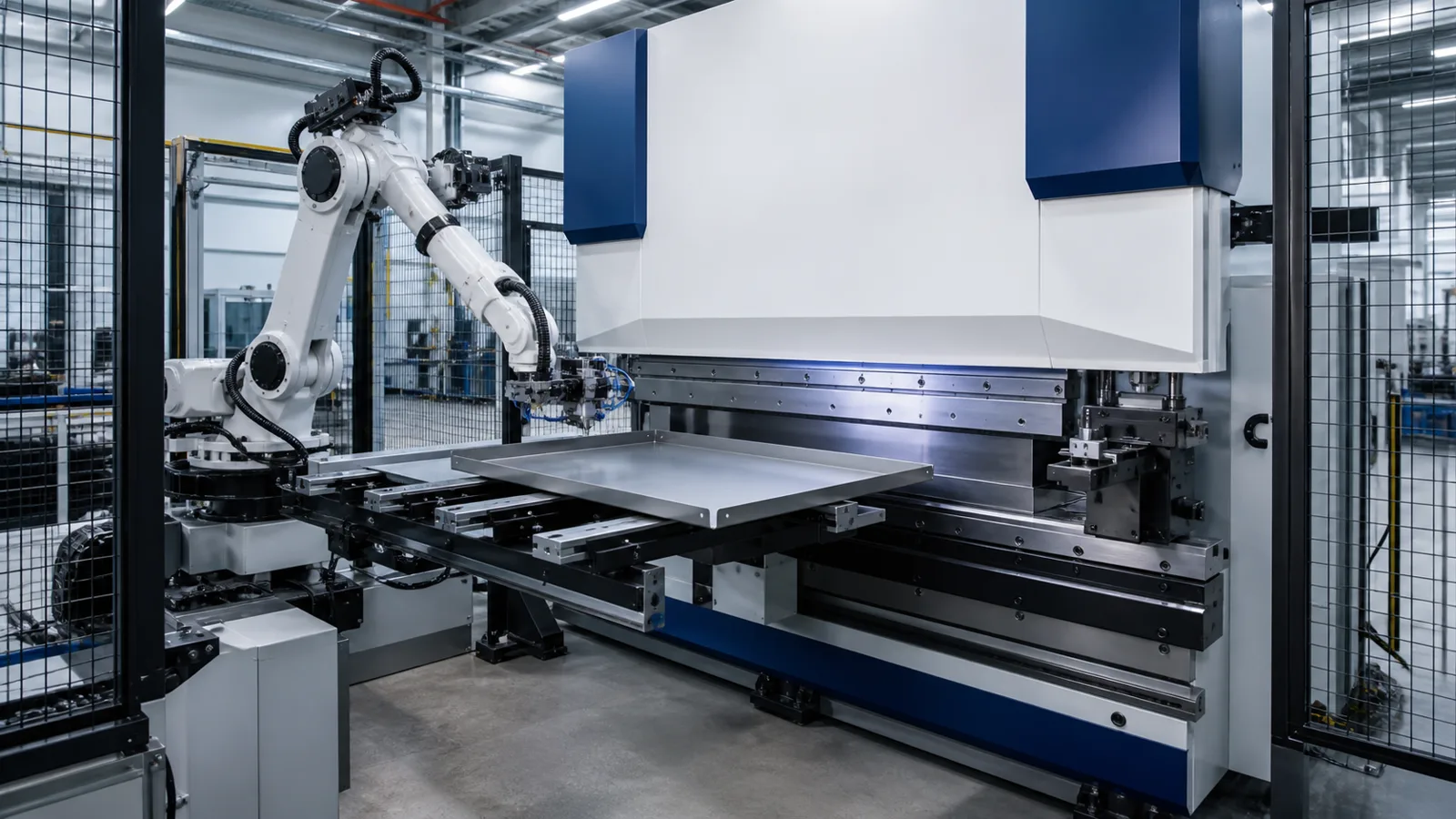
A demonstration with one clean blank on a perfectly aligned table proves little. Production starts with real stacks and ends with formed parts that must be placed without tipping, scratching, nesting, or blocking the next cycle.
Representative trials should prove that the cell can pick and separate blanks, locate the first bend, support changing centers of gravity, rotate or flip the workpiece, regrip when necessary, avoid collisions, complete every bend, and place the finished part in its actual container. Recovery from a missed pick, bad grip, or rejected bend must also be tested.
Include common parts, difficult parts, and awkward parts: large flexible panels, small blanks with limited grip area, asymmetric components, cosmetic surfaces, and pieces requiring several flips. Measure the full cycle from blank pickup to accepted stacking—not only ram strokes.
Geometry and material variation matter. Oil can affect suction, a narrow flange can remove a grip point, a large panel can sag, and thickness or springback variation can change the final angle. Experienced operators often notice and correct these conditions instinctively. A robot needs a detectable condition and a programmed response.
List the routine corrections made by skilled operators. Decide whether each can be prevented, detected and corrected automatically, or still requires human judgment. Frequent items in the third category weaken the robotic case. Repeatable motion is not the same as repeatable conforming parts.
Separate the Benefits Before Calculating Payback
Robotic bending is commonly associated with higher throughput, lower labor, better consistency, and improved safety. Those benefits do not always occur on the same job. A simple part may run at similar speed manually and robotically but still benefit from unattended production. A complex recurring part may gain consistency but require expensive programming. A large panel may justify automation mainly for ergonomics.
Do not credit every possible benefit at full value. Use separate, verifiable columns:
Annual net benefit = contribution from additional saleable output + avoidable labor cost + verified quality savings + measurable risk-cost reduction − added programming, support, maintenance, tooling, and integration costs
Simple payback = incremental installed investment ÷ conservative annual net benefit
Use the complete installed premium over the best practical alternative. Include guarding, end-of-arm tooling, material presentation, software, training, commissioning, facility work, and production ramp-up. A benefit belongs in the model only when it changes cash flow or removes a documented constraint.
Throughput
Measure from the last accepted part of one job to the first accepted part of the next. For each batch, include pickup, transfer, regripping, stacking, inspections, replenishment, faults, and recovery.
Net throughput = accepted parts ÷ total elapsed production time, including production-stopping interruptions
Value only output the business can use. If customers and downstream processes can absorb additional parts, multiply the additional saleable quantity by contribution per part—not revenue. If demand is fixed, value the improvement as avoided overtime, shorter lead time, or released capacity.
Consistency
Robotic handling can reduce operator-to-operator variation, but bend accuracy also depends on material properties, tooling condition, backgauge and ram control, angle measurement, and correction capability. If adaptive controls improve angles, assign that benefit to the brake and control package; a manual or hybrid system may capture much of it without a robot.
Measure first-pass yield, scrap, rework, inspection time, first-piece approval, in-batch corrections, and handling or stacking defects. “Better consistency” has financial value only when it reduces a documented cost or downstream disruption.
Labor
Record programming, tool preparation, material staging, first-piece inspection, consumable maintenance, output removal, fault recovery, and schedule revisions. Separate labor that disappears, labor that moves elsewhere, and new support work created by automation.
Only removed labor creates direct wage savings. Redeployed labor creates value when it avoids a hire, reduces overtime, or increases saleable output at another constrained operation. If payroll remains unchanged and the worker has no productive reassignment, the accounting saving is zero.
Safety
Robotic handling can remove people from repeated lifting, awkward rotations, sharp edges, and fatigue. It also introduces guarding, interlocks, controlled access, energy isolation, and recovery procedures. Compare risks task by task rather than giving automation a general safety credit.
When ergonomics is the main concern, compare a full robot with lifting aids, part followers, manipulators, or other assisted solutions. These may address the exposure with less cost and complexity.
Match the Setup to the Workload
Most shops contain several workload types, so one answer rarely fits the entire department.
| Workload | Production pattern | Main requirement | Best initial fit |
|---|---|---|---|
| Prototypes and fragmented short runs | Very small batches, frequent unpredictable changes | Fast setup, first-piece approval, and flexibility | Manual CNC |
| Compatible recurring families | Medium or high volume with proven tooling and handling | Unattended flow and reliable material supply | Robotic |
| Large awkward parts with changing designs | Small or medium batches, variable centers of gravity | Safe support while retaining operator judgment | Assisted or hybrid |
| Repeated large panels | Stable gripping, reach, support, and unloading | Handling consistency and lower labor dependence | Robotic if trials succeed |
| Revised complex multi-bend parts | Frequent path changes and uncertain clearances | Fast interpretation and recovery | Manual CNC or hybrid |
| Proven complex recurring parts | Repeatable orientations and collision-free paths | Consistency and unattended completion | Robotic |
Manual CNC bending usually wins when rapid changeovers dominate. An experienced operator can retrieve a program, install tooling, approve the first piece, run a short batch, and respond quickly to schedule changes. A robot also needs known pickup locations, grip logic, clear paths, output plans, and recovery procedures. If every job requires human preparation and proving, automation may preserve the attendance burden it was meant to remove.
Robotics gains value when recurring work can keep the cell utilized. Proven programs, predictable blanks, reliable gripping, stable material supply, and sufficient output capacity turn front-loaded preparation into long unattended runs.
Complex multi-bend parts follow the same rule. Deterministic complexity favors robotics because a validated sequence can be repeated without fatigue. Frequently changing geometry favors a skilled operator because each revision may alter grip access, reorientation, and collision clearance.
Use Good Parts per Attended Hour
Brochure cycle time hides the cost of programming, setup, intervention, and restart. Two measures expose the real trade-off:
Good parts per attended hour = accepted parts ÷ total direct labor-hours
Good parts per occupied cell hour = accepted parts ÷ total hours the brake is unavailable for other work
The first measures labor productivity; the second measures capacity. A robot may improve attended productivity while adding little capacity because changeovers and recovery occupy the schedule. A manual brake may require full-time attendance but clear varied work faster.
Define a fair production window. Start when job-specific programming or tooling preparation begins. End when the final part is inspected, accepted, stacked, identified, and released. Add all direct labor, including offline work. Two employees working for thirty minutes equal one labor-hour. Rejected parts never enter the numerator.
For example, if a robotic batch produces 100 accepted parts but needs three labor-hours for programming and proving, two for tooling and gripping setup, one for interventions, and one for inspection and unloading, it delivers 14.3 good parts per attended hour. If the manual process delivers the same batch in eight labor-hours, its rate is 12.5. The robot leads, but the advantage is much smaller than a repeated-cycle comparison suggests.
Build a Complete and Conservative ROI Model
Installed cost should include the brake, robot, integration, guarding, safety devices, material racks or conveyors, tooling, grippers, sensors, software, commissioning, training, facility modifications, spares, and internal launch labor. Annual costs may include maintenance, subscriptions, support, service travel, gripping components, calibration, and specialist programming.
For readers who want detailed materials, brochures is a useful follow-up resource.
Compare the robot with the best realistic manual or hybrid alternative—not with an aging brake or doing nothing.
Incremental investment = full robotic installed cost − full cost of the best manual or hybrid alternative
Build utilization from the schedule downward. Subtract hours without qualified demand, on-cell programming and changeovers, maintenance, upstream shortages, faults, and recovery. Apply robotic rates only to validated families, not every part currently bent manually.
Test at least three scenarios: a conservative case using proven recurring demand, a demand-downside case with fewer qualified hours, and an unattended-miss case with more tending and recovery labor. Do not count the same released hour as both labor savings and additional output unless both benefits can genuinely be realized.
If payback depends on perfect loading, persistent demand, and flawless unattended operation at the same time, the investment is an operational gamble.
Consider a Smarter Manual or Hybrid Brake
A modern manual brake is the control case, not a consolation prize. Advanced backgauges, angle control, offline programming, automatic tool changing, part followers, lifts, cobots, or retrofit handling can remove specific constraints with less capital and less exposure to product-mix changes.
Partial automation must still release measurable labor, improve accepted flow, or solve an ergonomic problem. If the operator must constantly replenish, inspect, reorient, or recover, do not count that person as free.
A manual purchase can also preserve a future automation path. Standardize tooling, select controls with suitable connectivity, protect floor space for guarding and material flow, and obtain written commitments about interfaces, data ownership, retrofit requirements, and reusable components. Meanwhile, develop stable part families, revision control, repeatable material presentation, and reliable inspection rules—the foundation any future robot will require.
Pass Four Production-Fit Gates Before Approval
Treat these gates as vetoes rather than a weighted scorecard:
- Recurring demand: Can proven part families keep the cell productively fed after setup, replenishment, maintenance, and manual exceptions are deducted?
- Technical feasibility: Can difficult representative parts complete gripping, tooling, bending, reorientation, recovery, inspection, and stacking trials without routine intervention?
- Persistent constraint: Is bending labor or throughput repeatedly limiting delivery, rather than drawings, material, inspection, welding, or demand?
- Conservative profitability: Does the investment still meet the company’s return threshold with lower utilization, more setups, fewer unattended hours, and less labor removal?
Require a live vendor trial with written acceptance targets. Use actual blanks, drawings, finishes, tooling requirements, batch sizes, and stacking rules. Measure setup from the last accepted part of one family to the first accepted part of the next. Count accepted output over the complete elapsed window. Inspect agreed dimensions and angles throughout the run. Record hands-on minutes, interventions, replenishment, and recovery.
Include controlled recovery from realistic events such as a mispick, displaced blank, rejected first article, or interrupted cycle. Vendor assistance must be recorded because it cannot disappear from the staffing model. Failed targets should trigger redesign and retesting, a revised financial case, or rejection.
Final Decision
Choose full automation when repeatable jobs, proven handling, stable material supply, and persistent labor or throughput constraints support long unattended runs. Choose a hybrid when lifting, supporting, loading, or one stable family is the narrower problem. Choose a capable manual CNC brake when frequent changes, revisions, and one-off work make adaptability the most valuable form of capacity.
The final comparison is not robot versus operator. It is one production system versus another under a difficult but realistic workload. The best press brake is not the one with the most advanced specification. It is the one that delivers the most accepted parts with the least necessary labor—and stays profitable when the month does not go according to plan.
Apply this guidance to your production
Share your material, thickness, part drawing, tolerance, and target output with the ZWCNC engineering team for an application-specific equipment review.
More news, insights, and updates from ZWCNC.
Panel Bender vs. Robotic Press Brake: How to Choose
Robotic Press Brake Bending: Process, Part Fit, and Cell Planning
Offline Press Brake Programming vs Integrated Robotic Bending: What Truly Delivers Lights-Out Throughput?

Power Plate Press Brake: How to Identify and Buy the Right Machine
Press Brake Die and Punch Selection Guide