
Licensed editorial adaptation
Adapted and localized by the ZWCNC Editorial Team from licensed technical material. The source record is published for traceability.
Technical boundary: confirm machine-specific capacity, configuration and safety requirements against the current quotation, manual and application review.
In a documented shop test, a hydraulic ram completed its cycle in two seconds, then waited eight seconds while the backgauge moved, stabilized, and locked. Four-fifths of the total cycle happened after the blade had finished cutting. Even an infinitely fast blade could improve only the remaining fifth.
This example captures the difference between brochure speed and production speed. Mechanical shears can be exceptionally productive in dedicated thin-sheet lines, but most fabrication shops do not operate under ideal, unchanging conditions. When loading, positioning, unloading, setup, material variation, and quality are included, hydraulic shears often deliver the better combination of accepted-part throughput, flexibility, and long-term value.
Faster Strokes Do Not Guarantee More Finished Parts
A 2023 Rucheng Technology report placed mechanical shears at 60–120 strokes per minute and hydraulic machines at 10–25. In automated thin-sheet lines, that advantage can produce 30–50% more completed blanks per labor-hour. In a manual or mixed-production cell, however, the machine may spend much of the shift waiting for material, the backgauge, the operator, or downstream handling.
Separate blade cycle time from positioning, backgauging, unloading, and stacking time
Measure one complete accepted blank, not one ram movement. The cycle begins with loading and squaring, then includes backgauge travel, cutting, extraction, inspection, stacking, and recovery from errors. In manual cells, these steps occur mostly in sequence. In automated cells, some overlap, but the slowest synchronized operation still determines output. In the documented test, two seconds of cutting plus eight seconds of gauging created a ten-second cycle before loading and stacking were even counted.
Compare rated strokes per minute with completed blanks per labor-hour
With the same eight-second gauge delay, a mechanical shear running at 60 strokes per minute completes a theoretical cycle in nine seconds, or 400 cuts per hour. At 120 strokes per minute, output rises only to about 424 cuts. The two-second hydraulic ram produces 360. A dramatic stroke-rate difference has become an 11–18% theoretical output advantage, and loading, inspection, breaks, scrap, and added operators can reduce it further. The useful metric is dimensionally acceptable blanks per total labor-hour.
Test whether material handling or the shear itself is the actual production bottleneck
For a representative shift, record time spent waiting for material, positioning and gauging, cutting, removing and stacking, and correcting errors. Count accepted blanks separately from strokes. If the ram waits while sheets are handled or the backgauge moves, a faster shear will not remove the constraint. Stroke speed deserves priority only when material is always ready, gauging is complete, finished parts leave immediately, and the blade remains busy for most of the run.
Account for how adjustable hydraulic stroke length can narrow the cycle-speed gap on short cuts
For application-specific equipment selection, contact ZWCNC.
Mechanical Shears Win Only When the Entire Production Cell Can Exploit Their Speed
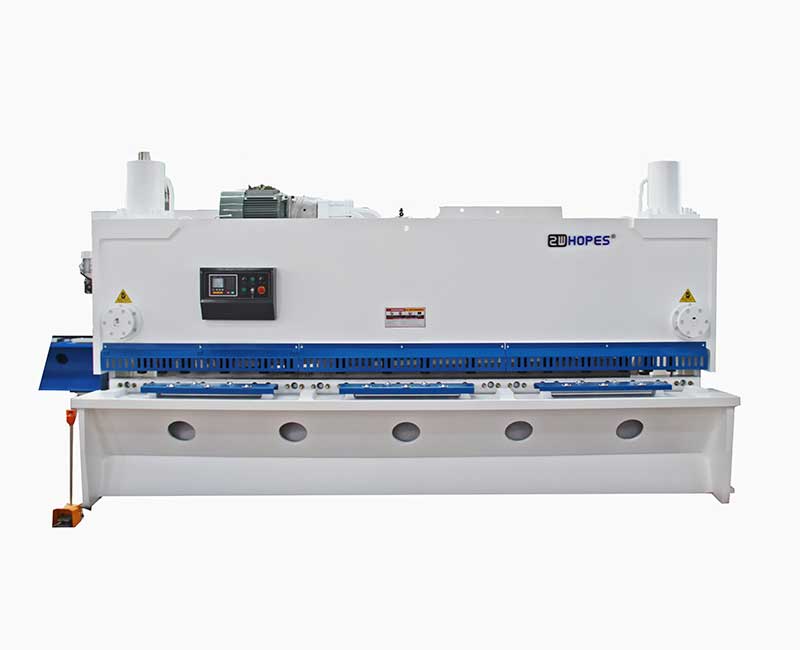
Mechanical shears perform best on a prepared track: uniform thin material, fixed or repeated dimensions, long runs, synchronized feeding and removal, and enough demand to keep the line loaded. A shop processing many grades, thicknesses, and batch sizes may have high annual volume without providing the stability that makes mechanical speed profitable.
Look for stable thin-gauge work, long repeat runs, and minimal changeovers
Confirm that automated feeding, gauging, and part removal can keep pace with the blade
At 60 strokes per minute, the blade is ready every second. Feeding, positioning, discharge, and stacking must match that rhythm or overlap safely. Test the complete cell with production material and record feeder interruptions, gauge faults, removal delays, jams, scrap, and operator interventions. Include guarding and safe jam clearing. Measure output over the full shift, including any batch pauses required for heat, clutch wear, or maintenance—not only the fastest production burst.
Calculate whether higher output justifies both the shear and the supporting automation
Mechanical economics are strongest when synchronized feeders, gauges, conveyors, stackers, and safety systems already exist or can be justified by repeat demand. Evaluate five-year contribution margin from additional accepted parts, avoided overtime, and released capacity. Subtract integration, automation, maintenance, downtime, scrap, financing, and remaining labor. Extra capacity has value only when orders consume it; finishing early merely relocates idle time if no profitable work follows.
Treat mechanical equipment as a dedicated-line choice, not the automatic high-volume default
Ten large orders involving different materials create a different production problem from one order repeated for months, even if annual piece counts are equal. Treat the mechanical shear as a dedicated thin-gauge sprinter. Outside a stable, automated lane, hydraulic flexibility becomes usable production capacity because the same machine can absorb more grades, thicknesses, tolerances, and changeovers over its ownership period.
Capacity and Adjustability Determine Which Work the Shop Can Accept
A machine that fits today’s 2–4 mm mild-steel schedule may still force tomorrow’s thicker stainless or tighter-tolerance jobs outside the plant. Define a five-year work envelope covering grades, strength, thickness, width, tolerance, batch size, and changeover frequency. The machine must be able to accept the job before stroke speed matters.
Verify model-specific ratings instead of treating 6 mm as a universal mechanical limit
Compare the thickest current job with the most plausible future material requirement
Review order history, outsourced work, lost quotations, and credible customer forecasts. Separate recurring demand from occasional, probable, and speculative work. Record more than thickness: tensile strength, cut width, burr allowance, flatness, twist, and batch frequency also affect suitability. Compare the hardest profitable job today with the most demanding job the shop can reasonably win during the ownership period. Capacity planning should follow credible revenue, not imagined possibilities.
Price the consequences of outsourcing, rerouting, or rejecting work beyond the machine’s capacity
A 2025 Rucheng Machinery guide reports that mechanical machines may cost 30–50% less initially, while affected shops may outsource 15–25% of work beyond 6 mm mild steel. It estimates logistics and supplier markup at $800–$2,500 per outsourced batch. Internal rerouting also consumes other equipment and adds queues. Rejected quotations are less visible but equally real; measure their likely contribution margin, especially when they represent repeat job families.
Evaluate blade-gap, rake-angle, pressure, and stroke adjustments across the full material mix
Distinguish useful hydraulic capacity from expensive capacity the shop is unlikely to need
Hydraulic flexibility should not justify buying the largest available machine. A dedicated line making more than 10,000 identical thin-gauge cuts per day may earn a higher return from a lower-cost, lower-energy mechanical shear. Conversely, extra hydraulic force, floor space, and handling capacity become dead capital if probable work never uses them. Buy enough range for profitable, credible demand with a sensible margin—not every theoretical future plate.
Hydraulic Control Reduces the Operational Risks Hidden by Purchase-Price Comparisons
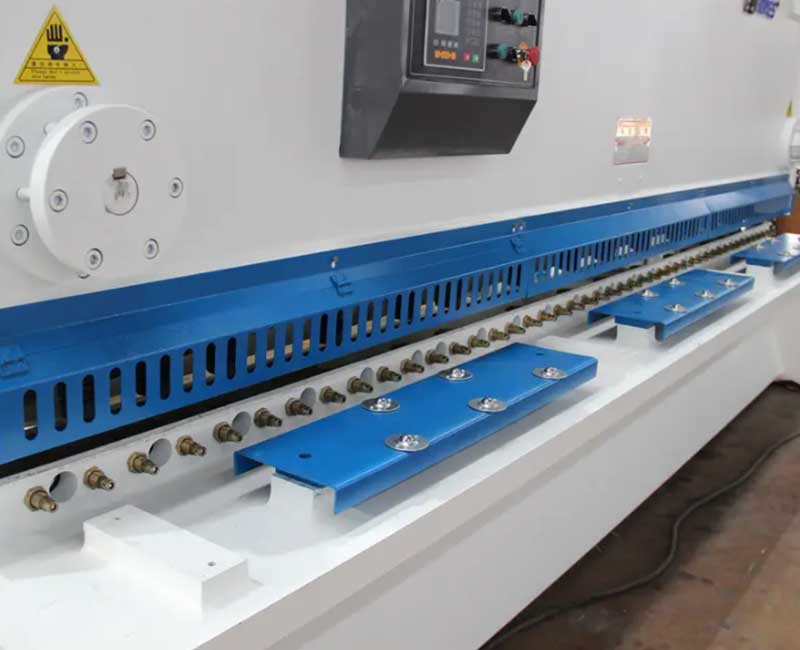
Drive systems respond differently to changing material, overloads, wear, noise, and abnormal stops. A hydraulic relief system can limit pressure and redirect oil when resistance exceeds its setting. A mechanical shear must manage energy already stored in the rotating flywheel through its clutch and brake. These differences affect scrap, maintenance, stopping behavior, operator conditions, and downtime.
Examine cut quality, distortion, and scrap when grades, thicknesses, and cut lengths change
Hydraulic control can match pressure, stroke, blade gap, and sometimes rake to changing work. This does not mean every hydraulic machine automatically cuts better; it means a mixed-work shop has more ways to maintain an acceptable process window. A mechanical shear can deliver excellent accuracy on uniform thin sheet, but a high stroke rate multiplies setup errors quickly when conditions change. Evaluate first-pass yield and productive operator time, not raw cycles.
Compare stored flywheel energy with controlled hydraulic stopping during jams and emergencies
When a mechanical shear jams, disengaging the clutch separates the drive, while the brake must arrest the moving mechanism and energy already committed to the cycle. Hydraulic pressure-flow control can stop descent when resistance reaches the relief setting, although trapped pressure, ram weight, and valve condition still require strict lockout and blocking. For either machine, require demonstrations of normal stop, emergency stop, overload, power loss, and safe restart under representative conditions.
Assess clutch and brake wear against hydraulic risks such as leaks, contaminated oil, heat, seals, and valves
Mechanical machines place repeated duty on clutches, brakes, bearings, gears, and alignment. Hydraulic systems exchange those wear points for risks involving fluid contamination, heat, filters, pumps, hoses, seals, and valves. Neither is maintenance-free. Compare inspection labor, in-house diagnostic skill, spare-parts availability, service response, and recovery time for credible failures. The easier system is the one the shop can support consistently.
Include noise, shock, operator fatigue, guarding, and placement constraints in the equipment review
Mechanical impact can create vibration, noise, fatigue, and foundation demands; hydraulic pumps and cooling equipment can produce continuous noise. Machine age, enclosure, blade condition, foundation, and duty cycle can reverse general assumptions, so measure candidates during comparable cuts. Assess both peak and continuous sound, vibration, guarding, service access, and safe material flow. The catalog footprint is not the complete production-cell footprint.
Match the machine to the maintenance capabilities the shop can reliably support
Choose mechanical equipment only if the shop can inspect and maintain the clutch, brake, flywheel, bearings, alignment, and stopping performance. Choose hydraulic equipment only if it can maintain clean fluid, filtration, temperature, seals, hoses, valves, and pressure settings. Maintenance routines that exist only on paper should not support the business case. Five-year costing must include scrap, service, jam recovery, major failures, guarding, and downtime.
Five-Year Economics Usually Matter More Than the Initial Price Gap
Purchase price is only one line in the decision. Compare both machines from delivery through disposal using the same demand forecast, material mix, labor rates, shift calendar, financing, and discount rate. Model expected, weaker, and stronger or more varied demand so that the decision does not depend on one optimistic production scenario.
Calculate cost per sellable part rather than cost per stroke
Calculate five-year ownership cost as the installed cell, financing, labor, consumables, scrap, maintenance, repairs, downtime recovery, safety systems, and automation, less net resale proceeds. Divide that amount by accepted parts shipped or transferred downstream. Keep enabled contribution margin separate and analyze major part families individually. A low blended cost can hide a machine that excels on repetitive sheet while losing money on short runs or difficult materials.
Include labor, setup time, scrap, preventive maintenance, downtime, safety controls, and supporting automation
Build the ledger at cell level. Include freight, installation, training, direct handling labor, programming, blade-clearance changes, trial cuts, inspection, quality losses, spares, preventive maintenance, repair, recovery overtime or subcontracting, safety provisions, feeders, conveyors, stackers, and scrap handling. Compare equivalent cells. Do not omit automation required to exploit mechanical speed or charge one option for equipment the other would also need.
Estimate the revenue effect of thicker jobs and varied short-run work the machine can or cannot handle
Every forecast job outside verified capacity must be rejected, outsourced, delayed, or routed to another asset. Price each outcome using contribution margin, supplier charges, freight, inspection, administration, and schedule effects. Also measure setup labor and first-piece scrap on varied short runs. Mechanical speed deserves full credit only when earlier completion advances payment, avoids overtime, or releases capacity for profitable backlog.
Test whether mechanical savings survive realistic utilization and maintenance assumptions
Use a practical output formula:
Expected good output = rated output × scheduled time × availability × eligible-work share × line-balance factor × first-pass yield.
Availability removes downtime; eligible-work share excludes jobs outside capacity; line balance reflects feeding and downstream constraints; yield removes scrap. Stress-test both machines with realistic maintenance records and at least one severe but credible failure. If mechanical savings disappear after a modest utilization decline, the investment is a narrow bet on ideal conditions.
Consider resale and reversibility if the shop’s production mix changes
Estimate net exit value after inspection, brokerage, rigging, transport preparation, fluid handling, and floor restoration, then discount it to present value. Also consider whether the machine can move to another cell, accept future automation, or remain useful beside a later purchase. Hydraulic capacity may offer more redeployment options in a mixed shop; a mechanical shear retains strong value when its dedicated product family remains stable.
Choose from Shop-Floor Evidence: Dedicated Thin-Gauge Sprinter or Flexible Production Asset
Put the stopwatch where work begins, not where the blade moves. The final decision should come from accepted-part throughput, setup behavior, operator requirements, work-envelope fit, and proven demand. A mechanical shear must show that the blade is the true constraint. When future work remains uncertain, hydraulic equipment is generally the more defensible default.
Time ten complete parts on representative jobs instead of comparing specification sheets alone
Select actual jobs: the recurring thin-gauge part, common changeovers, difficult blanks, thicker material, and tight-tolerance work. Time setup separately, then measure ten consecutive accepted parts from first loading to the finished stack. Record operator count, handling, gauging, inspection, delays, alarms, scrap, rework, yield, noise, and interventions. Use equivalent material, tooling, automation, and operator preparation for both candidates.
Choose mechanical when repetitive thin-gauge output is demonstrably blade-cycle-limited and handling is automated
Mechanical is the right choice when material is consistently ready before the blade, finished parts clear immediately, downstream operations accept the output, and repeat orders keep the complete cell loaded. Test and price the proposed feeder, gauge, discharge, guarding, and scrap systems together. Confirm that earlier completion protects delivery, improves cash flow, or releases profitable capacity. Large annual volume alone is not enough.
Choose hydraulic when job variation, thickness capacity, controllable setup, quieter operation, and rapid stopping outweigh raw cycle speed
Hydraulic value grows when the constraint changes from job to job. Broader capacity and adjustable pressure, rake, gap, and stroke can keep varied work moving with fewer compromises. Verify those benefits through timed changeovers, yield measurements, operator feedback, and manufacturer-approved stopping tests. The slower ram is not a disadvantage when positioning, setup, handling, material capability, or quality—not blade motion—controls output.
Buy both only when a dedicated mechanical line has proven demand and the hydraulic shear will remain productively loaded
Before buying two machines, assign forecast jobs to each and build a loading schedule without counting any order twice. The mechanical line needs enough proven repeat work to remain productive, while the hydraulic shear needs sufficient varied work to justify its capital, floor space, labor, maintenance, and duplicate safety provisions. If management cannot identify two distinct workloads, buying both postpones the decision rather than solving it.
Make hydraulic the default when future work is uncertain and mechanical the exception that must justify its narrower role
Approve a mechanical shear when representative trials prove higher accepted-part throughput, the complete line matches the blade, demand is stable within its working range, faster completion has measurable value, and five-year results survive realistic downtime and demand changes. Put trial conditions and acceptance targets in the purchase agreement.
Otherwise, choose the hydraulic shear. Its broader work envelope, controllable cutting conditions, and adaptability usually provide the lower cost per sellable part in mixed production. Buy the sprinter only after proving that the shop owns the track, controls every handoff, and has races booked; otherwise, buy the flexible production asset that can keep earning when tomorrow’s work changes.
Apply this guidance to your production
Share your material, thickness, part drawing, tolerance, and target output with the ZWCNC engineering team for an application-specific equipment review.
More news, insights, and updates from ZWCNC.
Hydraulic Shearing Machine Specifications and Product Selection
Guide to Hydraulic Shearing Machine Blades

Top 10 Shearing Machine Manufacturers to Know in 2025
Hydraulic Shearing Machine Components and Cut Quality Guide
Panel Bender Automation: Choosing the Right Level for Your Workflow