
Licensed editorial adaptation
Adapted and localized by the ZWCNC Editorial Team from licensed technical material. The source record is published for traceability.
Technical boundary: confirm machine-specific capacity, configuration and safety requirements against the current quotation, manual and application review.
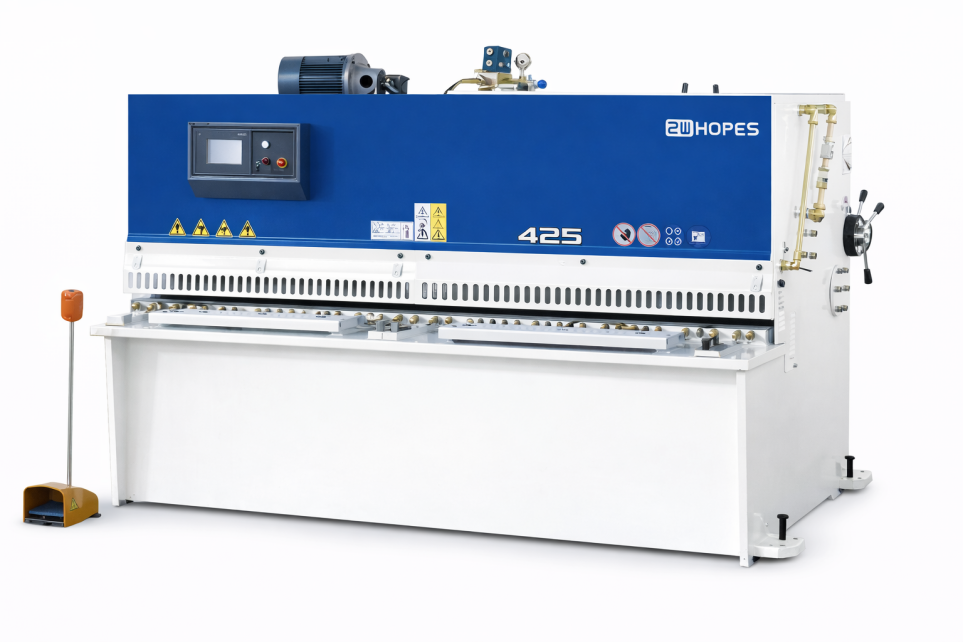
Safe shearing depends on controlling the complete cutting system, not simply keeping hands away from the blade. An operator may stand behind a guard and still be exposed to a descending hold-down, a shifting sheet, a falling offcut, or stored energy in the machine. The danger zone includes the blade opening, the moving mechanisms that prepare the cut, the material's travel path, the space used by helpers, and any energy that could produce movement after an abnormal stop.
The safest operation is therefore a repeatable sequence. The operator confirms that the machine is suitable and guarded, arranges the workpiece so it cannot move unpredictably, keeps every person outside the movement paths, activates the cycle deliberately, and waits for the machine and material to reach a controlled state before handling anything. When the normal sequence breaks down, the response changes from operating to stopping, isolating, and reporting.
This guidance supports workplace training; it does not replace the machine manual, the employer's procedures, required training, or applicable regulations. If those sources impose a stricter requirement, follow the stricter requirement.
Safe Shearing Controls the Whole Cutting System
Blade movement, hold-downs, and stored energy
A shear can injure someone before the blade contacts the sheet. Hold-downs may descend, clamps may close, and linkages or supports may move into position. Depending on the design, motion can come from electrical, hydraulic, pneumatic, spring, gravity, or mechanical energy. A finger under a hold-down is exposed to a crushing point even when the blade appears to be above the work.
An unusual stop does not prove that the machine is harmless. A blade or clamp may be suspended, pressure may remain in a hydraulic or pneumatic circuit, or a control fault may leave the machine capable of moving. If a hand, tool, or body part must enter a danger zone, stop and follow the site's isolation procedure before entering. Lockout/tagout controls energy rather than relying on a switch, emergency stop, or verbal promise. Guards and interlocks protect during normal operation, but they do not replace isolation when protection must be bypassed.
Material movement is part of the hazard
The danger zone extends beyond the blade. A large sheet may shift weight as the cut separates it; a narrow strip may slide, pivot, or drop; and an offcut under residual tension may move suddenly. A newly cut edge can also cut skin, catch clothing, or injure someone carrying it away.
Someone beside the blade may still be in the path of a tipping sheet. A helper pulling from the opposite side can draw material across another person's hands, while trying to catch a falling offcut adds uncertainty when control is already being lost.
Use tables, extensions, stops, carts, lifting equipment, or a second trained person when needed to keep the workpiece stable. Everyone must know who supports the material, who activates the machine, and what signal confirms completion. Communication is part of the control system.
Before Starting, Prove That the Machine and the Cut Are Safe
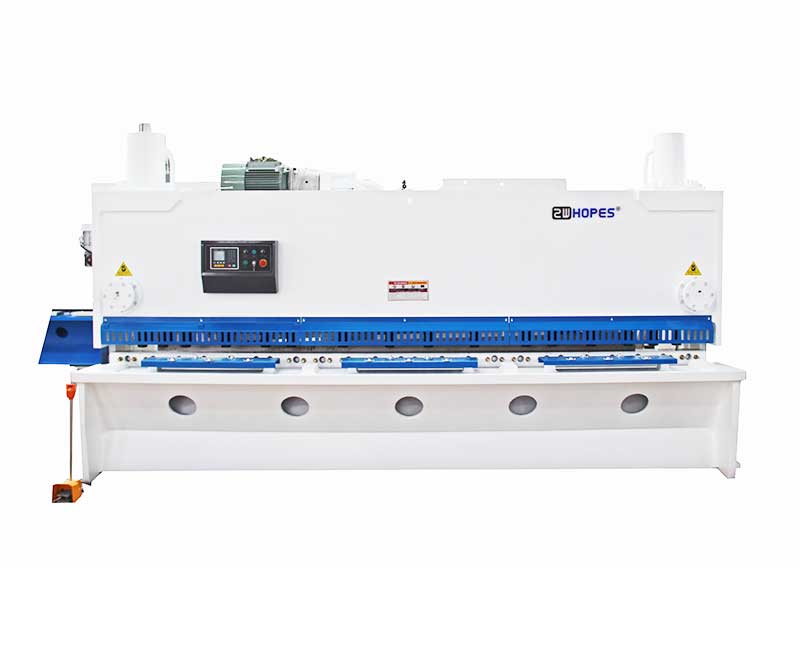
Before pressing a pedal or control, answer two questions: Is the machine capable of operating safely, and is this particular cut arranged so that no one must defeat a safeguard, enter a danger zone, or depend on an uncertain movement? If either answer is no, do not start the cycle.
Follow the manual, training, capacity limits, and site rules
Use the machine only if you have completed the training and authorization required for that equipment and workplace. The machine manual and local procedure establish details that cannot be guessed safely, including permitted material thickness, width, length, hardness, back-gauge use, control settings, inspection points, and shutdown steps.
Compare the actual workpiece with the machine's rated thickness, shape, material, and duty limits before positioning it. A piece outside those limits may require excessive force, shift unexpectedly, damage the blade, or overload hydraulic and mechanical components. If a rating is missing or unsuitable, stop and ask the responsible supervisor or authorized person. Do not discover the limit through a cycle.
Site rules also determine who may adjust the machine, when a helper is required, who may clear a fault, and how isolation is performed. Familiarity with the controls is not authorization to troubleshoot.
Inspect guards, hold-downs, blades, and controls
Inspect the complete danger zone, not just the blade opening. Confirm that fixed and movable guards, finger protection, hold-downs, barriers, and interlocks are present, secure, and positioned as the manual requires. Look for gaps, damage, loose fasteners, bent parts, or any condition that could expose a hand or body part during normal operation.
OSHA incident reports illustrate the risk. In 2002, a worker reached under a roller guard while cutting a small piece and accidentally depressed the foot pedal; the hold-down descended and injured his fingers. In 2005, a fixed-blade guard had been removed because narrow parts were difficult to hold, and a resulting workaround contributed to amputation injuries after a double trip.
A missing guard is not a minor inconvenience. If protection prevents the planned task from being performed comfortably, stop and correct the setup through an approved method. Change the tooling, use an approved aid, select a better process, or obtain assistance. Never remove protection because stock is short or clearance is tight.
Make the work area clear and stable
Remove scrap, tools, packaging, loose stock, and other obstructions from the table, floor, foot-control area, and access paths. Keep the spaces where material will enter, leave, or swing clear of people and objects. Long sheets need room to move without striking a person, post, cart, or adjacent equipment.
Stand on a stable, dry, level surface with enough traction to control your position. Lighting must reveal the blade area, gauge, stock edge, guards, controls, and floor hazards. Correct shadows or glare that hide a pinch point or reference mark before cutting. When helpers or long stock are involved, control access from both sides and make every person's permitted position clear.
Decide whether the task is normal setup or requires lockout/tagout
Normal setup means the operator can position and align the material from intended access points while safeguards remain in place and no one enters a danger zone.
The task changes category when someone must remove or bypass a guard, reach under a roller or hold-down, enter the point of operation, clear material from inside, adjust components near moving parts, or investigate an unusual stop. Follow the site's lockout/tagout procedure for electrical, hydraulic, pneumatic, mechanical, spring, and gravity energy where applicable.
A stopped blade may still be supported by stored force; a hold-down may still descend; pressure may remain in a circuit; and a pedal may still command movement. The authorized person must shut down, isolate, dissipate or restrain stored energy, and verify before entry. If you are not authorized, keep clear and contact the designated person. Do not call hazardous investigation "just a quick adjustment."
Wear PPE that suits the work
Wear suitable eye protection and safety footwear before handling or cutting stock. Footwear should protect against dropped sheet and sharp material while providing secure footing. Clothing should fit close enough to avoid catching on controls or moving parts.
Cut-resistant hand protection may be appropriate when handling sharp sheet or finished edges, but it is not automatically suitable near moving machinery. Gloves can snag or create control problems. Use them only when the machine procedure, risk assessment, and site rules permit them; gloves never authorize placing a hand inside a guarded area.
Before each cut, the operator should be able to prove that:
- The machine is authorized for use and within its capacity.
- Guards, hold-downs, interlocks, controls, and emergency devices are functional.
- The work area and material travel paths are clear.
- The setup does not require unauthorized entry or isolation.
- The selected PPE suits the actual handling risk.
PPE reduces the consequence of some contact; it does not make contact acceptable. Once this proof holds, establish how the stock will remain controlled as the shear applies force and releases both the finished piece and the offcut.
Set Up the Material So It Cannot Shift, Tip, or Strike Someone
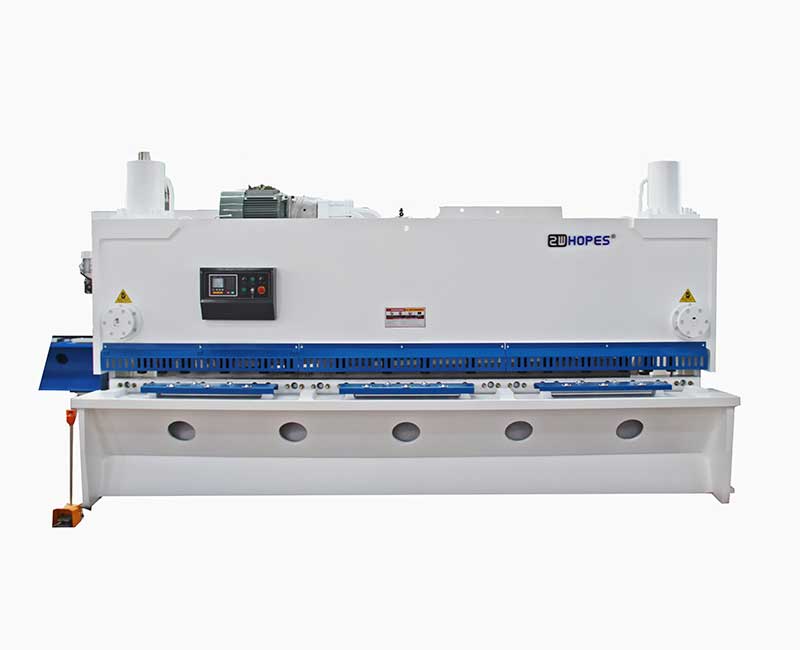
Material control starts before activation. The stock must stay supported, restrained, and predictable as the shear applies force, separates the cut, and releases the pieces. Each setup decision should answer a simple question: where can this material move, and what will stop it?
Confirm thickness, width, length, and material limits
Compare the actual stock with the machine's rated thickness, width, length, material type, hardness, shape, and condition. A piece can fit on the table and still exceed the shear's capacity. Excessive length also creates unsupported weight and rotation, while unsuitable width can place the sheet outside the effective control of the guides, hold-downs, or guards.
Support long or heavy sheets
Support long or heavy stock before it reaches the cutting line. Use the machine table, approved extensions, support stands, carts, or suitable lifting equipment so the sheet does not sag, tip, or swing. Set support surfaces at the intended height and remove gaps or obstructions that could catch the stock.
Do not brace the sheet against your body or pull upward while the machine is activated. Once the cut separates the material, the offcut may become lighter, the retained sheet may rotate, and the load may transfer suddenly. Keep people out of rear and side movement areas, and control the rear where the machine design requires it.
When lifting assistance is needed, agree on positions and roles before lifting. Keep fingers away from contact points between the sheet, table, supports, and guides.
Align the material from the intended access points
Set the squaring arm, back gauge, side guide, and other alignment devices from their intended access points. Keep hands outside guards and away from the point of operation, where stock is held, cut, or released. A guide can align material without becoming a handrest.
The hold-down is a pinch and crush hazard. Keep fingers clear of the space between the stock and hold-down, and do not reach around a guard to improve alignment. If alignment requires bypassing protection, placing a hand behind the shear, or entering the cutting area, stop the normal setup and follow the required isolation procedure.
The correct method leaves the operator with a clear path out of the movement zone. If getting the stock square forces the body into the machine's travel path, the setup has failed.
Control narrow, short, bowed, or unstable pieces
Narrow strips, short pieces, bowed sheets, curled edges, and irregular offcuts may not be controlled by the normal hold-downs and guides. A small piece is not automatically safer; it may sit under only part of the hold-down, twist, or draw a hand toward the cutting area.
Follow the manufacturer's minimum safe dimensions and approved holding methods. Use a fixture only when the machine procedure permits it. Do not improvise a clamp, wedge, block, or hand position near a moving hold-down or the cut line.
If the stock cannot remain flat and controlled without entering a danger zone, do not cut it by hand. Change the process, use suitable equipment, or obtain an authorized fixture. Treat warped, spring-loaded, or partly cut pieces as loaded material.
For application-specific equipment selection, contact ZWCNC.
Remove unsuitable scrap before it reaches the shear
Sort material before it reaches the machine. Remove bolts, brackets, weldments, fasteners, mixed-thickness pieces, and hidden objects. A shear designed for sheet is not a general-purpose scrap processor.
Mixed or hardened scrap can concentrate force, damage the blade, eject fragments, or release unpredictably. Separate unsuitable material and send it to the correct process. If an object is trapped or cutting becomes abnormal, stop, keep clear, and follow the authorized isolation procedure.
Establish one operator and a controlled danger zone
Long stock may require several people to move, but one operator must control activation. Helpers may support, guide, or observe from assigned positions; they must not press controls or adjust stock during the cycle.
Identify the front, sides, rear, discharge path, and any area where the stock, offcut, hold-down, or support can move. Keep bystanders outside it. Agree who gives the ready signal, who confirms that the area is clear, and what signal means stop. The operator must personally verify the zone; if communication is lost, do not activate.
Position helpers so they are not trapped between the material and a fixed object, guide, support, or machine component. A hand on the sheet does not make the setup safe if the helper stands in the release path.
Make Each Cut With a Repeatable No-Entry Sequence
Treat the cut as a sequence rather than a single command: verify the movement, place the body outside every path, clear the hands, activate deliberately, and wait until the machine has finished before touching the work again. OSHA reports from 2021 and 2026 illustrate why clamp movement and cycle completion require the same attention as blade clearance. One report involved a finger entering an unguarded clamping area during foot-control activation; another involved an operator flicking a cut piece forward before a shear double-tripped. Both resulted in amputation injuries.
Perform a dry run
Trace the cut without cycling the machine. Confirm that the stock is aligned, supported along its length, and within the permitted cutting area. Predict where the retained sheet and offcut will go, including any rotation, spring, drop, or possible strike.
Follow the operator's movement without entering the danger zone. Check that controls are reachable from stable footing, guards are positioned correctly, and hands or clothing have no reason to cross blade, hold-down, pinch, drop, or whip zones. If alignment requires leaning through a guard or placing a hand where the hold-down will descend, correct the setup before activation.
Stand outside the material, drop, and whip paths
Stand where the sheet cannot drive its edge toward you if it drops, shifts, or rotates. Keep both feet on a clear, level surface with room to step away without crossing another hazard. Do not straddle the material, stand in the discharge path, or brace stock against your body.
Material can become unstable when the blade separates it: a long end may dip, a bowed piece may straighten, or an offcut may fall and twist. Helpers must remain outside these paths and must not be trapped between the sheet and a fixed object. If activation requires stepping, twisting, or catching your balance, your position is not ready.
Keep hands away from every moving or closing part
Do not place a hand on stock near the cut line to keep it from moving. The hold-down controls the workpiece; fingers are not a backup clamp. Keep hands outside the blade path and the hold-down's closing area, even when the blade appears stationary.
Guards define an exclusion boundary, not a place to reach around, under, or behind. A narrow opening can expose fingers to a closing clamp or linkage. Use guides and approved supports for alignment. If the sheet shifts during the dry run, stop and correct the setup while the machine is safe.
Ask not only whether your hands are away from the blade, but whether every part of your body is outside every part that can move, clamp, drop, or eject material.
Use approved tools for small pieces
Because small pieces are light, an operator may try to guide them with fingertips. That can draw the hand toward the point of operation, where blade and hold-down movement occur together.
Use only tongs, pushers, clamps, fixtures, tables, or other methods approved for the machine and workpiece. The tool must preserve distance without creating an ejection or pinch hazard. A homemade stick, wedge, clamp, or magnetic tool may slip or interfere with guarding.
For a short, curled, bowed, or unstable piece, first ask whether the machine can hold it as designed. If not, change the process, use suitable equipment, or obtain an authorized fixture. A tool is a control only if it preserves distance through the entire cycle.
Operate the foot pedal deliberately
Treat the foot control as a source of machine motion. Before stepping on it, confirm that the dry run is complete, the danger zone is clear, and hands and body are already safe. Activate once from a stable stance; do not balance, adjust stock, or communicate with a foot poised over the pedal.
The pedal should be enclosed, shrouded, or otherwise protected against unintended operation when required. Keep tools and loose material away from it. After activation, follow the machine-specific instruction for foot placement. Some procedures require removing the foot completely after each cut unless safeguards such as light curtains are present.
Keep a clear view without leaning through a guard
From the operating position, see the alignment, material paths, and people within the controlled area. Do not lean over the blade line, crouch beneath a guard, or look through an opening that places your face or shoulders near moving parts.
If the view is blocked, stop. Use an approved sightline, light, mirror, camera, indicator, or communication method if provided. Seeing the blade does not necessarily mean seeing the hold-down, rear movement, offcut, or helper. If no safe viewing position exists, correct the setup before cutting.
Wait for the complete cycle
Keep the work and offcuts still until the blade and hold-down have completed movement and the machine has returned to the condition specified by its procedure. Do not flick, pull, catch, or push a piece during the cycle or assume that a pause is safe.
After completion, handle the work and offcut from outside the danger zones using the approved method. If a piece remains trapped, partly cut, or unusually loaded, leave it in place and follow the abnormal-condition procedure. A cut ends only when the machine has finished, the material has settled, and approach does not enter an active hazard zone.
Stop When the Machine or Material Behaves Differently
A jam, strange sound, incomplete cut, shifted sheet, or failed guard changes the task. Stop activation, keep hands and body outside the danger zone, warn anyone nearby, and follow the machine's abnormal-condition procedure. Do not treat the problem as a minor interruption to a normal cut.
Recognize stop conditions
Stop when you notice:
- Unusual sound, vibration, resistance, or movement.
- A blade that binds or fails to complete its stroke.
- Material that shifts, buckles, lifts, twists, or remains trapped.
- A guard, hold-down, indicator, control, or emergency device that does not function normally.
- A repeated jam or a cut that differs from the expected result.
An incomplete cut deserves the same response as a loud mechanical failure. Material may still be held under force, the blade may be loaded, or the machine may be between movements. "Almost finished" is not a safe state.
Do not force, adjust, or reach into the shear
Forcing a cut turns resistance into stored and redirected energy. Pushing harder, stepping on the pedal again, pulling the sheet, or levering out a stuck piece can release that energy through the material, tool, or operator.
Do not adjust stock, reposition a stop, remove an offcut, clear a jam, or retrieve a tool while energy remains connected. Do not reach through a guard because the blade appears stationary. The moment a hand, tool, or body part enters a hazardous area, the task changes from ordinary operation to hazardous-energy isolation.
Use the emergency stop for immediate danger, then isolate
Use the emergency stop when someone is exposed to unexpected motion or when waiting for the normal cycle would increase danger, such as a person entering the zone, material moving toward someone, a guard failing, or continued movement after the expected control action.
Activate it from a safe position, warn affected workers, and prevent anyone from approaching. The emergency stop is a rapid command to stop, not proof that the machine is safe to touch. Pressure, electrical energy, gravity, or mechanical loading may remain. Keep the machine out of service until an authorized person isolates and investigates it. Do not reset it merely to see whether the problem has gone away.
Apply lockout/tagout before hazardous entry
Lockout/tagout applies when servicing, adjustment, jam clearing, or inspection requires entry into a hazardous area or removal of a guard. The procedure identifies sources, disconnects them, applies locks and tags, releases or restrains stored energy, and verifies that the machine cannot operate.
Only trained and authorized workers should perform isolation. Do not improvise, rely on verbal assurance, or assume that switching off the main control is enough. The authorized worker must verify that the machine cannot start and that movement or pressure has been controlled. Missing, damaged, or bypassed guarding is a stop condition before the next cut.
Report abnormal behavior and near misses
Stopping prevents the immediate event; reporting prevents the same condition from waiting for the next operator. Tell the responsible supervisor, maintenance team, or designated authority about damaged guards, dull or damaged blades, repeated jams, unexpected movement, failed controls, incomplete cuts, near misses, and emergency stops.
Include the machine, material, operation, symptom, and what happened immediately before it. Preserve the machine's status unless the authorized procedure directs otherwise. A near miss shows that one part of the control chain nearly failed. Repeated problems deserve correction, not a private workaround such as pushing harder, bypassing a guard, or resetting the machine repeatedly.
Clear Scrap and Shut Down Without Creating a New Hazard
The final cut changes the task from cutting to controlled recovery. Motion must stop, material must remain controlled, scrap must be removed safely, and the machine must be left in a condition another person can understand. A clean-looking machine is not necessarily a safe machine.
Let all moving parts stop
Wait for the complete cycle and for every moving part to stop before reaching for an offcut or partially cut piece. Do not rely on the blade appearing still: clamps, slides, guards, feed mechanisms, or supported material may continue moving.
Releasing a pedal, switching off the operating control, or hearing the motor fall silent does not give permission to reach in. Partially cut material may drop, spring, rotate, or slide as its balance changes. If an offcut will not come free without force, stop pulling; the task may have become jam clearing.
Handle sharp pieces and control the drop zone
Sharp scrap remains a cutting hazard after the machine stops. Remove it with the approved method, such as designated tongs, a scrap hook, a brush, or another site-approved device. Do not improvise with a hand, sleeve, loose material, or a tool that can slip into the blade area.
Wear required protection, but do not treat PPE as permission to grip an uncontrolled edge. Place offcuts in the designated container when the approved method allows it. Do not let pieces pile beneath the shear, against the frame, or across footing; accumulated scrap hides sharp edges and encourages hurried reaching.
If the collection area is full or a piece lands where it cannot be safely reached, stop and obtain the approved response. Do not kick scrap aside or reach under the machine.
Use normal shutdown for routine work and lockout/tagout for intrusive work
For a routine job, let the cycle finish, remove scrap by the approved method, stop through the normal control, and leave the controls in the state required by site procedure.
Cleaning inside the machine, adjusting components, maintenance, jam clearing, guard removal, or placing a hand or tool in a hazardous area requires lockout/tagout. Stored energy may be electrical, hydraulic, pneumatic, mechanical, gravitational, or material energy. The authorized worker must identify and isolate sources, release or restrain stored energy, and verify that the machine cannot operate or move.
Off is a visible condition, not proof of isolation. Never reset, test, or remove a jam by trial and error after isolation begins. If you are not authorized, keep the machine out of service and contact the designated person.
Leave a safe handoff for the next operator
Confirm that shutdown is complete, controls are in the required position, protective devices are restored after authorized work, and no tool, scrap, or partly cut material remains where it can move or be contacted. If the machine is not safe, keep it identified and out of service; do not make it appear ready.
Clear sharp scrap from the floor, preserve stable footing, return handling tools, and keep controls and emergency equipment unobstructed. The handoff must include the machine's condition: report a repeated jam, damaged guard, unusual movement, incomplete cut, remaining isolation, or other abnormal condition to the responsible person and next operator.
A Practical Safe-Shearing Standard
Before every cut, the operator should be able to demonstrate that the machine, material, people, and response plan are ready:
- Machine: The operator is trained and authorized, the workpiece is within capacity, and the manual and site procedure are available.
- Safeguards: Guards, finger protection, hold-downs, interlocks, controls, emergency devices, and foot-control protection are present and functional.
- Work area: Floors, lighting, access paths, the front and rear of the machine, and the material travel path are clear.
- Material: The stock is suitable, supported, aligned, and stable; narrow or irregular pieces have an approved handling method.
- People: One operator controls activation, helpers have assigned positions, signals are understood, and the danger zone is clear.
- Cut: A dry run confirms body position and material movement; hands remain outside all movement paths; activation is deliberate.
- Completion: Everyone waits for the full cycle to end before handling the work or offcuts.
- Abnormal conditions: Any unexpected behavior triggers a stop, emergency response when necessary, authorized isolation before entry, and a report.
- Handoff: Scrap is controlled, the machine is shut down correctly, and the next operator is told about any condition that remains.
Safe shearing is not a single precaution and not a test of how close a person can work to a blade. It is a controlled arrangement in which machine safeguards, body position, material support, communication, energy isolation, and housekeeping reinforce one another. When the arrangement cannot be maintained, the correct decision is to stop and correct it before the next cycle.
Apply this guidance to your production
Share your material, thickness, part drawing, tolerance, and target output with the ZWCNC engineering team for an application-specific equipment review.
More news, insights, and updates from ZWCNC.
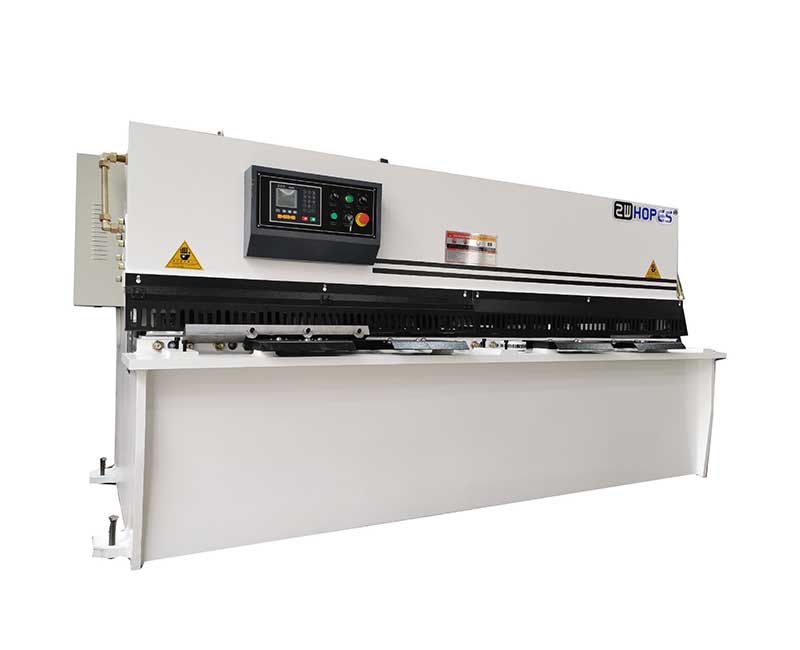
Hydraulic Shearing Machine Components and Cut Quality Guide
Shearing Machine Troubleshooting & Safety
Ironworker vs. Press Brake vs. Shear: The Ultimate Guide to Selection and Operation

How to Cut Galvanized Steel Safely with a Fiber Laser
Hydraulic vs. Mechanical Shearing Machines: A Practical Comparison