Licensed editorial adaptation
Adapted and localized by the ZWCNC Editorial Team from licensed technical material. The source record is published for traceability.
Technical boundary: confirm machine-specific capacity, configuration and safety requirements against the current quotation, manual and application review.
If all you needed was force, you could buy a 20-ton bottle jack from a hardware store for fifty bucks. But a press brake is not a jack; it is a surgical instrument that happens to weigh ten tons. The price difference is not in the “push”—it is in the machine’s ability to keep that push perfectly level while the entire frame is trying to pull itself apart.
The Tonnage Trap: Why Raw Force Is the Cheapest Part of Your Machine
Moving from “Shape Former” to “Tolerance Holder”: The Precision Gradient
Walk onto any floor with a “bargain” press brake and you will see operators shimming dies with strips of paper or masking tape. They are trying to compensate for the “banana effect,” where the center of the bend is shallower than the ends because the machine’s bed and ram have deflected under pressure. When a machine is sold only on tonnage, the manufacturer often cuts cost by using lighter side frames and less rigid bed designs. These machines are “shape formers”—they will get the metal into a V-shape, but they will not hold a +/- 0.5-degree tolerance across a long part.
The premium in a high-end quote pays for the evolution into a “Tolerance Holder.” This means massive, normalized steel plates and, more importantly, a sophisticated crowning system. Modern CNC machines use sensors to detect exactly how much the bed is bowing in real time, then use a series of hydraulic cylinders or motorized wedges to “pre-bend” the bed upward. This offsets the deflection before the punch even touches the metal. You are not paying for the steel in the frame; you are paying for the sensors and the logic that let the machine lie to itself so the part comes out straight.
Why does this matter to your bottom line? A “shape former” requires a highly skilled operator to spend twenty minutes “dialing in” a part with test bends and shims. A “Tolerance Holder” hits the angle on the first hit, every time. If you are paying a premium, you are buying back the hours your operator currently spends wrestling with a flexible machine.
But what happens when that flexibility is not just in the center, but spread across the full length of the bed?
Why Force per Meter Matters More Than Total Tonnage Capacity
Most buyers look at the nameplate, see “200 Tons,” and assume they can use all 200 tons anywhere they want. This is how machines end up with “permanent smiles”—permanent deformation of the ram because the operator tried to apply full tonnage on a very narrow part in the center of the bed. Standard tonnage calculators assume you are “air bending” (touching the metal at three points) across a wide V-die, but real-world jobs often require bottoming or bending thick, short pieces that concentrate all that force into a tiny area.
The true cost of a machine shows up in its “force per meter” rating. A high-quality machine is engineered with deep side frames and a throat depth that does not compromise the structural integrity of the “C” frame. Cheap machines often have shallow throats or thinner side plates that “gape” open like a shark’s mouth when pushed to their limit. If you plan to bend a 12mm plate over a short distance, you may need only 80 tons of force, but that force is so concentrated that a light-duty 100-ton machine will literally twist its own frame trying to deliver it.
When a quote looks high, compare the machine’s weight with its competitors. If two machines are both rated at 150 tons, but one weighs 2,000 kg more, that extra mass is the “insurance” you are paying for. It is the structural rigidity that helps the machine stay square for ten years instead of two.
Does that mean a heavy, rigid machine is all you need to work quickly?
Speed vs. Force: The high cost of reducing cycle times with high-frequency hydraulics
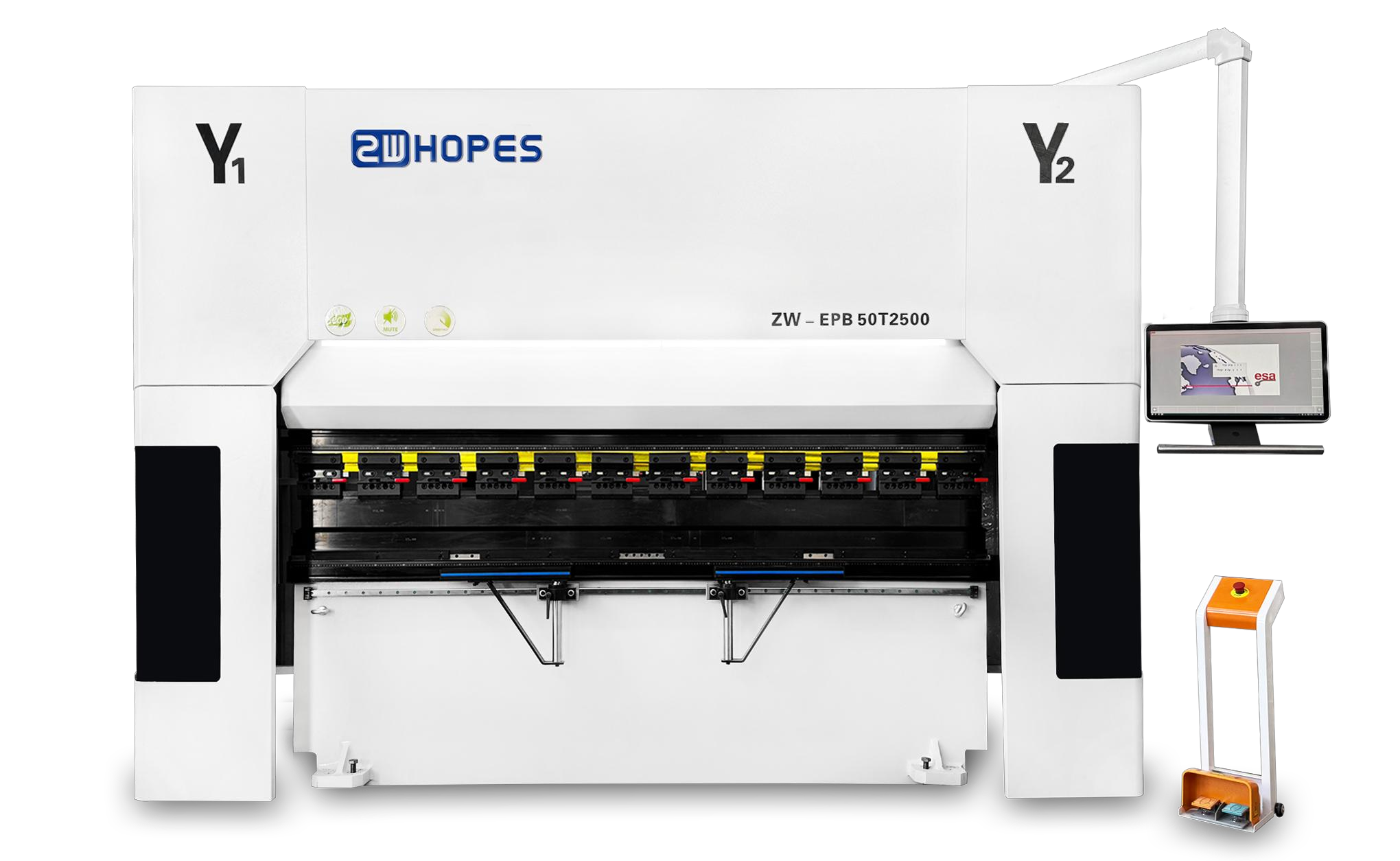
If you watch a budget press brake in operation, it moves with a “clunk-thud” rhythm: the ram drops quickly, stops, creeps slowly into the bend, and then lumbers back up. This happens because basic hydraulic systems are binary; they are either on or off. To achieve precision with inexpensive hydraulics, the machine has to slow to a crawl so the controller can “catch” the ram at the correct depth. You are paying for the force, but losing heavily on cycle time.
The “digital intelligence” mentioned in the high-end quote refers to high-frequency, closed-loop hydraulics. In these systems, the CNC controller communicates with the hydraulic valves hundreds of times per second. This lets the ram move at high speed and “flare” into a soft landing with micron-level accuracy, without stopping or stuttering. It is the difference between someone slamming on the brakes at a red light and an autonomous car smoothly slowing to a stop exactly one inch from the line.
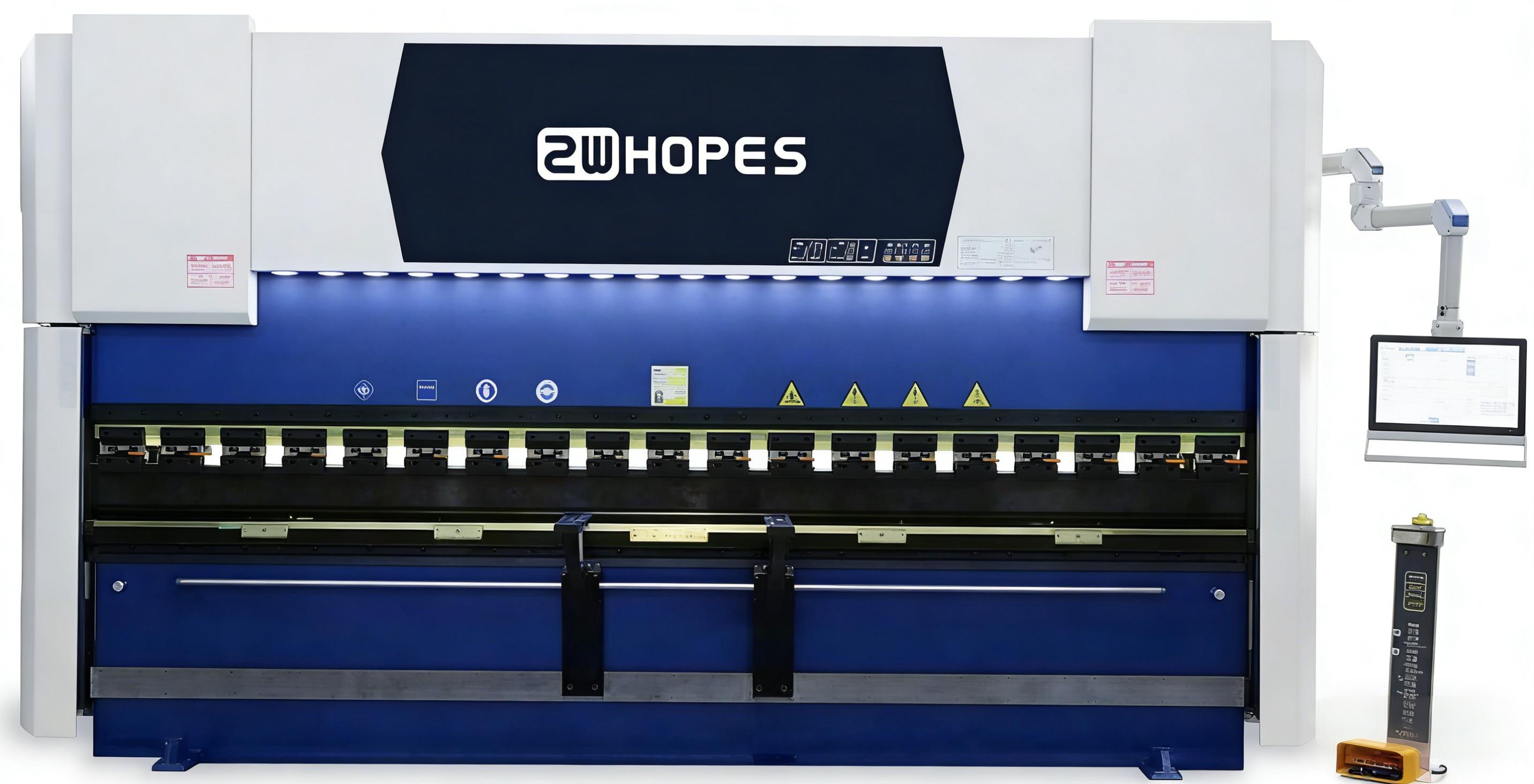
This speed costs a fortune because it requires high-resolution glass scales on both ends of the ram—the Y1 and Y2 axes—that tell the computer exactly where the ram is at all times. If one side is 0.01 mm lower than the other, the high-frequency valves immediately adjust the oil flow to level it. You are paying for the ability to run at 200 mm/second approach speeds without crashing your tools into the bed.
If the hydraulics provide the speed and the frame provides the strength, what happens when the part you are bending is more complex than a simple 90-degree bracket?
The Brain Tax: How the Controller Multiplies Hardware Value
For application-specific equipment selection, contact ZWCNC.
2D vs. 3D Graphical Simulation: Paying for reduced scrap and faster operator training
Imagine handing a flat blank to a new operator and asking them to carry out a seven-bend sequence. On a machine with a basic numerical control (NC) or a rudimentary 2D screen, the operator has to visualize the folding process mentally. They complete the first three flanges successfully, but on the fourth bend, the previously folded metal swings up and collides violently with the upper punch. The part is ruined, the tooling may be damaged, and the operator has to start again, guessing a different sequence.
Premium controllers eliminate this costly trial and error with offline programming and 3D graphical simulation. The engineering department imports a CAD file directly into the machine’s brain. The controller calculates the exact bend sequence, selects the optimal tooling, and simulates the entire process on screen before the hydraulic pump even starts. If a collision is likely, the software flags it and automatically generates a safe alternative sequence.
You are not paying thousands of dollars for a colorful touchscreen. You are paying for the ability to hire an operator with no sheet metal experience, place them in front of the machine, and have them execute complex, multi-axis bends flawlessly on their first day. The simulation software turns a highly skilled, high-wage setup process into a simple follow-the-bouncing-ball routine.
But what happens when the digital simulation is perfect, yet the physical sheet metal refuses to cooperate?
Closed-Loop Feedback: The electronic difference between “close enough” and repeatable accuracy

A pallet of cold-rolled steel arrives at your dock. The mill certificate says it is all the same grade, but the reality of metallurgy is messy. The first sheet bends to exactly 90 degrees. The tenth sheet is slightly harder, resisting the punch and springing back to 92 degrees when the ram lifts. A basic controller has no idea this has happened; it simply pushes the ram to the programmed depth and assumes the job is done.
High-end controllers operate on a closed-loop feedback system, acting as the machine’s nervous system. They do not merely execute commands; they measure results in real time. Advanced setups use laser angle measurement sensors mounted next to the dies. As the punch drives into the metal, the sensor reads the actual physical angle of the bend. If it detects that harder piece of steel springing back, it immediately communicates with the controller. The brain recalculates the required depth in milliseconds and drives the ram down a fraction of a millimeter farther, over-bending the material just enough so that it relaxes perfectly into a 90-degree angle.
This electronic feedback loop is the difference between a machine that is “close enough” and one that delivers repeatable accuracy across thousands of parts. It compensates for grain direction, thickness variations, and thermal changes in the hydraulic oil without the operator ever touching a dial.
If this digital intelligence is so critical to holding tolerances, why do quotes vary so widely even among machines that all claim to feature “CNC controls”?
The Ecosystem Premium: Why industry-standard controllers (Delem, ESA) command a quote markup
A proprietary controller built in-house by a budget machine manufacturer might bend metal perfectly on day one. Five years later, when a power surge fries the motherboard, you discover the true cost of that cheap quote. The manufacturer no longer supports that specific software version, replacement parts are stranded on another continent, and no local technician knows how to troubleshoot the proprietary code. Your machine is now a ten-ton paperweight.
When you see a quote specifying an industry-standard controller such as a Delem or an ESA, you are paying an ecosystem premium. These brands command a markup because they provide a universal language for metal fabrication. Their offline software integrates seamlessly with major CAD/CAM programs. Their tooling libraries are standardized. Most importantly, if a screen cracks or a servo drive fails, you can overnight a replacement part and hire a local, independent technician who has spent a decade working on that exact interface.
The markup on a premium controller is effectively a subscription to long-term uptime. You are paying to reduce the risk of ecosystem lock-in and to ensure that your machine remains serviceable long after the warranty expires.
Still, the most advanced digital brain and the fastest hydraulic nervous system are useless if the machine cannot physically position the metal in the right place. How does this expensive intelligence actually control the flat blank before the ram ever drops?
The Cost of Motion: Why Every Axis Beyond Y1 and Y2 Raises the Quote
The Backgauge Breakdown: When does manual adjustment become a financial liability?
A standard 100-ton CNC press brake from a budget-oriented manufacturer might land on your floor for $22,000, while a high-spec European model with the same tonnage can easily reach $75,000. On the spec sheet, the frame weight and motor size are often nearly identical. The gap in the quote often starts at the backgauge—the mechanical "fingers" that stop the metal at the correct depth. On a cheaper machine, you might have two axes of motion (Y1 and Y2) controlling the downward stroke, while the backgauge is a "dumb" bar that moves only forward and backward (the X-axis).
Manual adjustment is a profit killer in a high-mix shop. If your operator has to stop the machine, walk to the back, and manually crank a handwheel to adjust the height of the backgauge fingers because the next bend uses a different die, the machine is sitting idle. You are paying a skilled worker to do the job of a $500 stepper motor, and you are doing it every time the part design changes. In a typical shift with ten different setups, a manual backgauge can waste two hours of production time.
The liability is not only the lost time; it is the cumulative error of human touch. A manual backgauge is only as accurate as the operator’s eyesight and the play in the old lead screws. If that gauge is off by half a millimeter, every subsequent bend becomes scrap, and in precision fabrication, scrap is simply expensive trash that you paid to ship to your dock.
But if the backgauge can move on its own, how many directions does it actually need to move to justify its price tag?
4-Axis vs. 6-Axis vs. 8-Axis: Matching part complexity to your axis investment
A 4-axis machine is the industry’s "meat and potatoes," covering Y1/Y2 (the ram), X (depth), and R (height). The R-axis is the secret weapon in the mid-range quote. Without a powered R-axis, the operator must manually shim the backgauge fingers up or down every time they switch between a tall offset die and a flat bottoming die. Adding that one motor to the quote might cost $3,000, but it removes the "shim-and-pray" method from your workflow.
When you move to a 6-axis configuration, you are typically adding independent control of the backgauge fingers (Z1 and Z2), allowing them to move left and right across the width of the machine. This is where the price jump starts to feel steep, often adding $10,000 to $15,000 to the base price. You are not just buying motors; you are buying the ability to perform "stage bending." This allows an operator to set up three different tool sets across the bed and move the part from left to right, while the backgauge fingers automatically reposition themselves for each specific bend.
Investing in an 8-axis machine—which adds independent X1/X2 and R1/R2 movement—only makes sense for shops handling extremely complex geometries. These machines let the fingers sit at different depths and heights at the same time. If you are bending a tapered part or one with flanges of different lengths on the same side, an 8-axis gauge can handle it in a single hit. Without those additional axes, the same part requires multiple setups, custom jigs, and a much higher chance that the operator's fingers will get too close to the pinch point.
But what happens when the part is not a perfect rectangle, but a complex, asymmetrical shape that wants to twist out of the operator's hands?
Independent Z1/Z2 Motion: The hidden price of handling asymmetrical bends
This independence requires a more sophisticated control architecture and higher-quality linear guides capable of handling the torque from unbalanced loads. A cheap backgauge will flex when an asymmetrical part hits it; a premium independent system stays rigid. You are paying for the backgauge's “spine” to remain perfectly straight even when the part is trying to twist it.
The “hidden” cost is also in the software. To make Z1 and Z2 motion useful, the controller must automatically calculate the part's center of gravity and pivot points. If the software is clunky, the operator will simply disable the feature and go back to using a tape measure. The premium in the quote ensures that the mechanical ability to move is matched by the digital intelligence to know where to go.
The precision of the backgauge ensures the part is in the right position, but all that accuracy is wasted if the machine's own frame bows under the pressure of the hit.
The Length Paradox: Engineering for Deflection, Not Just Steel
The precision of an 8-axis backgauge guarantees that your part is positioned perfectly, but that sophisticated positioning means nothing if the machine's frame buckles under the hit. Look at the sourcing data for standard industrial press brakes. A 100-ton, 3.2-meter machine might arrive at your loading dock for $25,000. Stretch that bed to 4 meters and increase the tonnage to 200, and the quote does not rise proportionally—it jumps sharply into the $50,000 range. Premium European equivalents can double or triple that number.
Buyers often see this gap and assume they are being overcharged for a little extra steel. They calculate the price per foot and feel cheated. This is the length paradox. You are never just buying a longer piece of metal. You are financing a war against physics.
Automatic Crowning Systems: The non-negotiable cost of a straight bend on a long bed
When you bend a 10-foot sheet of steel, the hydraulic cylinders pushing the ram down are located at the far left and right ends of the machine. The center of the span is completely unsupported. As tonnage builds, the middle of the upper ram bows upward, and the middle of the lower bed bows downward. The result is a part that measures exactly 90 degrees at the ends and 93 degrees in the center. In the trade, this is called the canoe effect.
To eliminate this, premium quotes include automatic CNC crowning. This is not a fixed piece of iron; it is a dynamic, motorized system of precision wedges or hydraulic cylinders built directly into the lower bed. When the controller reads your part program, it calculates exactly how much the machine frame will bow under the required tonnage. It then commands the lower bed to bulge upward in the center, precisely matching the deflection of the upper ram. You are paying for a machine that deliberately deforms its own bed to ensure your part remains perfectly straight.
Throat Depth and Stroke: The dimensional "breathing room" that can quietly double a quote
Requesting a deeper throat or a taller open height (stroke) can quietly detonate a quote. Think about the mechanics of a C-clamp. If you make the "C" deeper, the clamp becomes inherently weaker and tends to yawn open under pressure. To give you that extra ten inches of breathing room for large panels, the manufacturer cannot simply cut a deeper hole. They must dramatically increase the thickness and mass of the entire side frame to prevent the machine from flexing open during a heavy hit. You are paying a premium for empty air, funded by the massive steel plates required to surround it.
Why a 4-meter machine costs significantly more than two 2-meter machines combined
The math of structural engineering is ruthless. Deflection in a loaded beam does not scale linearly; it increases with the cube of the length. A 4-meter bed is not twice as difficult to keep straight as a 2-meter bed—it is exponentially harder.
Two 2-meter machines only need enough internal rigidity to manage their own modest spans. Combining them into a single 4-meter footprint forces the manufacturer to upgrade every structural component to withstand exponential stress. The crowning system must be far more complex, the hydraulic cylinders must be larger, and the frame must be cut from dramatically thicker plate. You are not buying more machine. You are buying the specialized engineering required to overcome the physical reality that long steel wants to bend. This structural integrity ensures the machine will not flinch, but even the stiffest frame is useless if the tooling clamped into it cannot survive the tonnage.
The Invisible Build: Components That Don't Appear on the Main Spec Sheet
Imagine two machines sitting side by side on a showroom floor. They both claim 100 tons of force. They both have the same paint job and the same brand of controller. One is quoted at $40,000, and the other at $90,000. To the untrained eye, the $50,000 gap is a mystery, perhaps even a scam. But the difference is not in what you can see; it is in the "nerves" and the "bone density" of the machine. A high-performance athlete looks like an ordinary person until the starting gun fires. In manufacturing, that "gun" is the second shift of a high-volume production run, where heat, vibration, and repetitive stress begin to separate the tools from the toys.
Frame Rigidity and Stress Relieving: Why some machines lose accuracy after 24 months
Steel has a memory. When a massive steel plate is rolled at the mill or welded into a press brake frame, it is filled with internal “frozen” stresses. If you take that raw frame and immediately machine the surfaces where the ram and bed meet, it will look perfect on day one. But as the machine operates—as it heats up, cools down, and vibrates under 100 tons of pressure—those internal stresses begin to relax. The steel “moves.” A frame that was straight to within a thousandth of an inch can gradually warp over two years until your bends are no longer repeatable.
The premium you pay for a high-end quote covers a process called stress relieving. The best manufacturers place their welded frames in a massive oven and bake them at controlled temperatures (annealing), or use high-frequency vibratory equipment to “shake” the stress out of the metal before final machining. This ensures that the frame you buy is metallurgically dead. It won’t move, it won’t open up, and it won’t surprise you three years into a contract. You aren’t just buying weight; you are buying the expensive, time-consuming heat treatment that ensures that weight stays where it was put.
Does that stability matter if you’re only bending a few brackets a week? Perhaps not. But for a shop running three shifts, a shifting frame is a ghost in the machine that no operator can fix.
Tooling Clamping Systems: The high price of shaving 15 minutes off every setup
If you look at a quote and see $8,000 for “Hydraulic Clamping,” your instinct may be to stay with the standard manual bolts. After all, a wrench is cheap. This is a classic trap. Manual clamping requires an operator to slide tools in from the side, tighten a dozen individual plates, and then “seat” the tools by bringing the ram down under pressure. On a 10-foot bed, that is a 20-minute ordeal. If your shop performs four setups a day, you are losing more than an hour of production every single shift.
Hydraulic or pneumatic “click-in” systems change the math for the entire shop. These systems allow the operator to snap tools in vertically from the front. With a single button press, the machine clamps and aligns the tools with micron-level precision—no shimming, no manual seating, no guesswork. The “intelligence” here is mechanical. The clamping system is designed to communicate with the controller, ensuring that the ram will not move unless the tools are locked.
You are paying to convert “dead time” into “green-light time.” In a world where labor is the most expensive variable in your shop, a $10,000 clamping system pays for itself in less than a year simply by keeping the ram moving.
Safety as a Variable: Comparing integrated laser guards versus “bolt-on” solutions
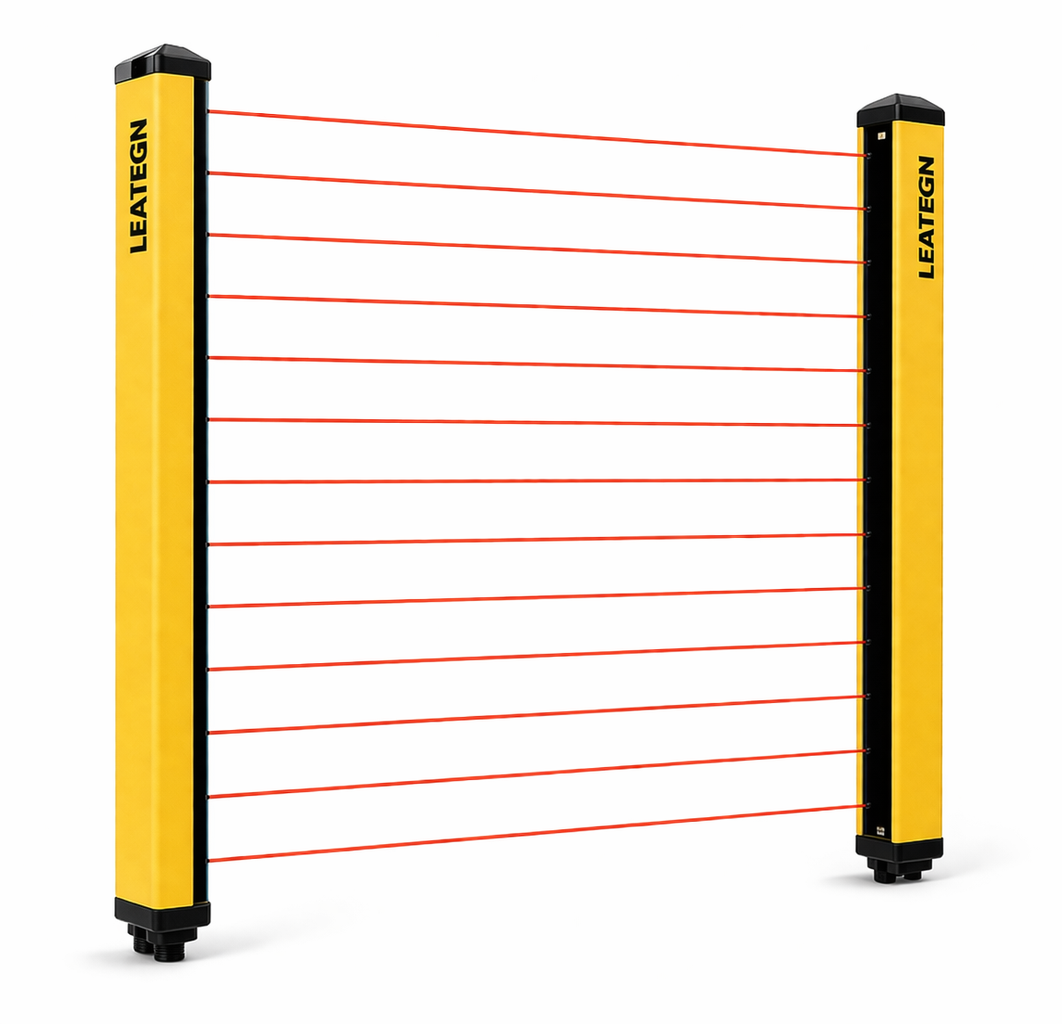
Safety is often the last item on a quote, but it is the one that most frequently ruins a machine’s cycle time. A cheap, “bolt-on” light curtain is a dumb sensor. If anything breaks the beam, the machine stops. This forces the operator to work at a snail’s pace, constantly worried that a stray finger or a piece of wavy sheet metal will trip the sensor and stop the cycle. It is safety through obstruction.
Integrated laser systems, such as those from Iris or Lazer Safe, are fundamentally different. These systems are “aware” of the machine’s position. They communicate directly with the CNC controller. As the ram descends at high speed, the laser knows exactly where the top of the material is. It allows the ram to move at “rapid” speeds until it is only millimeters above the part before slowing to the “bend” speed. If a finger is in the way, it stops; if it is only the metal being bent, it continues.
This integration enables a “high-speed approach” that can cut three seconds from every single bend. Over a 500-piece run, that is 25 minutes saved. A quote that includes integrated safety is not just protecting your employees; it is buying you the right to run your machine at its maximum rated speed without compromising a single finger.
The question for the buyer then becomes: are you looking for a machine that merely reaches a tonnage figure, or a system that can maintain that performance over a decade of shifts?
Reading a Quote as a Capability Map, Not a Price List
The Three Specs Worth the Premium: Identifying Your ROI Drivers
Walk through your shop and look at the scrap bin. Every piece of bent steel in that bin is a failed investment, usually caused by a machine that could not compensate for its own physical limitations. When you review a premium quote, you are looking for three specific drivers that prevent that waste: automatic crowning, a multi-axis backgauge, and offline programming. Crowning is the most critical; as the ram pushes down, the machine bed naturally bows like a bridge under a heavy truck. Automatic crowning uses sensors and wedges to push back up from below, ensuring that your 90-degree bend is the same in the middle of the machine as it is at the ends. Without it, your operator will spend hours “shimming” the bed with strips of paper, a manual process that destroys productivity.
A 6-axis backgauge is the next “brain” upgrade worth paying for. Most cheap machines offer two axes—in and out, up and down—which works well enough for a simple box. But once you have a part with asymmetrical flanges or tapered sides, a 2-axis gauge becomes a liability, forcing the operator to build custom jigs or “eyeball” the placement. A 6-axis gauge moves each finger independently, allowing the machine to “grip” complex geometry with ease. Finally, look for offline programming software. This allows your engineering office to simulate the bend sequence and check for collisions before the machine ever touches metal.
You are paying to remove the “art” from the bending process. In an era when master fabricators are retiring, a machine that requires a 20-year veteran to operate is a bottleneck. A premium machine allows a person with two weeks of training to produce perfect parts because the “intelligence” is built into the quote, not dependent on the person’s hands. Why do these high-end features always get stripped out of the “entry-level” packages?
Reverse-Engineering the Low Quote: What Was Omitted to Hit That Price Point?
When a quote comes in 40% lower than the others, the manufacturer has not discovered a magic way to buy cheaper steel; they have simply shifted the costs onto you. The first omission is often the “support ecosystem.” This includes rigging, installation, and on-site training. A machine that arrives on a truck and is left for your team to figure out is a machine that may sit idle for weeks. Also, look at the component list. Premium quotes specify brands like Hoerbiger for hydraulics and Heidenhain for scales—parts that are standardized and stocked globally.
Cheap machines use “no-name” or proprietary valves and cylinders. When a $200 hydraulic seal fails three years from now, you will not be able to buy a replacement at a local supply house. You will be stuck waiting for a shipping container from overseas while your production line stands still. The low quote also hides the cost of the “rework tax.” If a machine lacks the rigidity to hold a 0.1-degree tolerance, you will spend twice as much on secondary operations—grinding, forcing parts into alignment during welding, or simply throwing away parts that do not fit.
The “brute” machine offers raw force but no “nerves.” It cannot sense when the material thickness varies by 0.5 mm, and it will not adjust its stroke to compensate. You end up with a pile of parts that are “close enough,” which is a death sentence for high-precision assembly. If the hardware is a commodity, why does the software determine the machine’s ultimate lifespan?
The Resale Reality: Which Configuration Choices Protect Your Long-Term Asset Value?
A CNC press brake is an asset, not a consumable, and its value in year ten is shaped by the decisions you make today. The most important factor in resale value is the “openness” of the control system. Proprietary, “closed” controllers from obscure manufacturers can become dead weight as soon as that company stops supporting the software. By contrast, Windows-based platforms or industry-standard systems such as Delem or ESA retain value because they can be readily updated, networked, and repaired by third-party technicians.
Tooling compatibility is the second pillar of resale value. Quotes that specify “Wila-style” or “New Standard” clamping systems ensure that the machine can use the world’s most common high-precision tools. If you buy a machine with an unusual, non-standard tang—the part of the tool that clicks into the machine—you are locking yourself into a closed ecosystem. When you try to sell that machine, the buyer will recognize that they would need to replace their entire tooling library just to use your “bargain” machine, pushing your resale price sharply downward.
Think of the premium as insurance against obsolescence. You are buying a machine that will still be compatible with the CAD software of 2035 and with automated robotic cells you have not even purchased yet. Once you factor in 10-year labor savings and higher trade-in value, the “expensive” machine is almost always the one with the lowest cost per part produced. The choice is not between a $50,000 machine and a $100,000 machine; it is between $0.50-per-part overhead and $1.20-per-part overhead for the next decade.
Apply this guidance to your production
Share your material, thickness, part drawing, tolerance, and target output with the ZWCNC engineering team for an application-specific equipment review.
More news, insights, and updates from ZWCNC.
Press Brake Die and Punch Selection Guide
Auto-Tool Panel Bender vs. Press Brake: Which Machine Fits Your Parts?
Press Brake Mold Lines: Bend Geometry, Flat Patterns, and Setup
What Is a Press Brake? How Sheet Metal Bending Works
Press Brake Drawing Files: Preparing DXF, STEP, and Controller Files