Licensed editorial adaptation
Adapted and localized by the ZWCNC Editorial Team from licensed technical material. The source record is published for traceability.
Technical boundary: confirm machine-specific capacity, configuration and safety requirements against the current quotation, manual and application review.
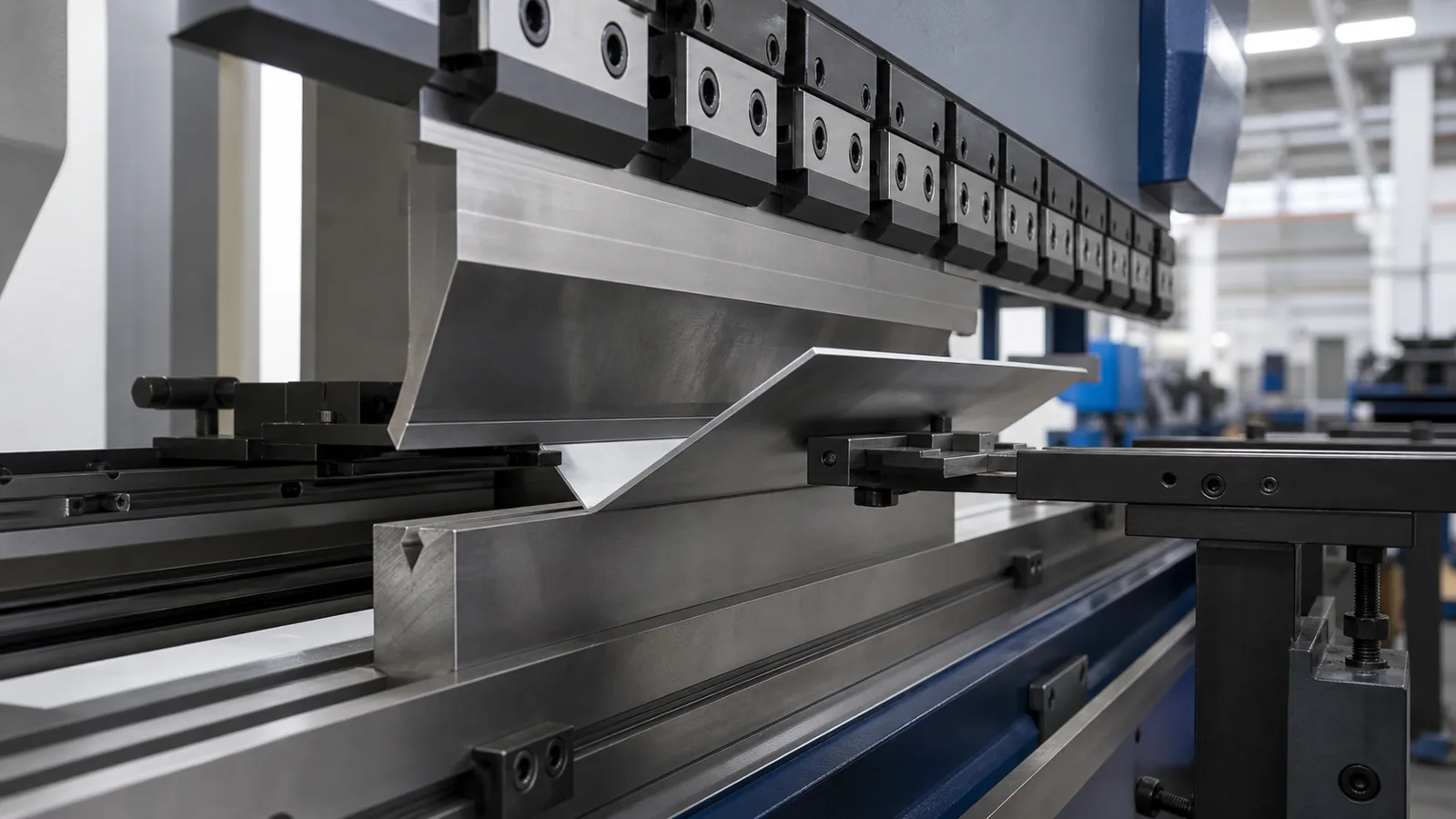
During the bending process of the torsion bar press brake solutions, the angle on the left and the angle on the right are adjusted by the lead screw inside the hydraulic cylinder.
The lead screw inside the cylinder controls the downward depth. When there is an angular error between the left and right during bending.
We need to adjust the stroke of the lead screw inside the cylinder to ensure the synchronization of the lead screws, so as to guarantee the synchronization of the angles.
For example, if the angle on the right side is 90 degrees, and the angle on the left side is 91 degrees, then we need to disconnect the Y-axis connecting rod to make adjustments, and adjust the Y1 side to 90 degrees as well. If you need detailed specifications and operational references, you can also check our Brochures for more information.
How do we adjust it? First, raise the machine tool, move the Y-axis up to the top dead center, then turn off the power. Next, we disassemble the connecting rod.
Since the angle on the left is 91, and the angle on the right is 90, it means the left cylinder needs to move down a bit to compensate for this 1° error.
If you are bending thin sheets, a 1° error is roughly equivalent to one full rotation. Normally, when the machine leaves the factory, the connecting rod is assembled with screws and keys.
If you rotate it normally, both cylinders are adjusted together. Now, we are adjusting the left cylinder individually, so we need to disconnect this synchronization connecting rod.
First, remove these two hex screws, move this connecting sleeve to the left, and disconnect the connection. At this point, the connecting rod is independent, and its connection to the motor side has been disconnected.
Since there is a 1° difference on that side, you need to rotate it one turn counterclockwise downward, then reconnect it, and reinstall the screws.
Install the screws. Installation is complete, this side has been rotated one turn counterclockwise individually, adjusting the stroke downward by one turn. Now you can bend again, and check if the angles are the same.
If there is still an error, you can adjust again. This is a hexagonal type, which allows for a lot of adjustment. If the angle is too large, disconnect and rotate counterclockwise. If the angle is too small, disconnect and rotate clockwise.
If you still encounter difficulties or have technical questions, please contact ZWCNC for professional assistance.
Apply this guidance to your production
Share your material, thickness, part drawing, tolerance, and target output with the ZWCNC engineering team for an application-specific equipment review.
More news, insights, and updates from ZWCNC.

How to Calibrate the Left and Right Bending Angles of a Press Brake

How to Calibrate X-Axis Position Deviation of the Press Brake

Power Plate Press Brake: How to Identify and Buy the Right Machine
Press Brake Springback by Material: Charts, Trial Bends and Angle Control

Free Press Brake Operation Manuals: Find the Right PDF and Bend Safely